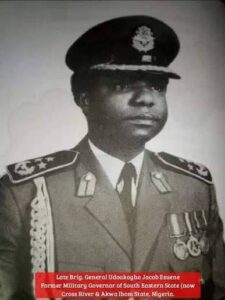
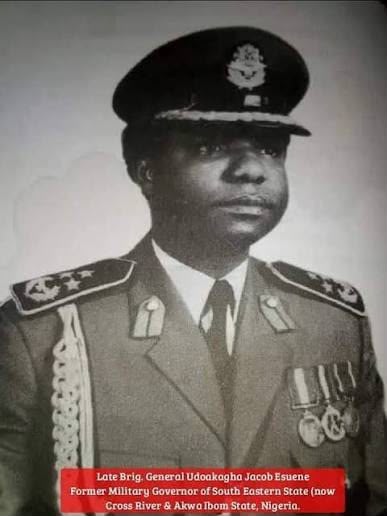
Long before the creation of Akwa Ibom State, and at a time when Nigeria itself was still finding its feet as an independent nation, Brigadier-General Udoakaha Jacob Esuene had already risen to one of the highest levels of military and political authority available to a Nigerian of his generation.
Soldier, fighter pilot, administrator, statesman, institution-builder and traditional leader, Esuene belonged to that pioneering generation of Nigerians who entered public life at the dawn of independence and were called upon to build institutions in a country emerging from colonial rule, regional politics and, eventually, civil war.
He became the first Military Governor of the newly created South-Eastern State (now Akwa Ibom and Cross Rivers States combined) in 1967, administering a vast territory during one of the most difficult periods in Nigeria’s history. His eight-year tenure left behind roads, educational institutions, industries, public utilities and administrative structures that continued to shape the development of the area long after he left office.
Born in 1936 at Ekpene Afaha Eket in the former Eket Division of Calabar Province, Esuene came from the historic Afaha lineage of Eket and was raised in an environment where discipline, leadership and community responsibility were deeply valued.
His early education began at Afaha Eket Group School before he proceeded to Ibeno Central School, where he completed his primary education and obtained the Standard XI qualification in 1948.
In 1950, he entered the Etinan Institute, a Qua Iboe Mission institution which had become one of the important centres of secondary education in the old Calabar Province. He completed his studies in 1954 and obtained the Cambridge Senior School Certificate.
Thereafter, Esuene entered the teaching profession. He attended the Government Teacher Training College, Uyo, where he obtained his Teachers’ Grade II Certificate in 1957.
He briefly taught at Central School, Ikot Ubo, in present-day Nsit Ubium Local Government Area. But teaching would prove to be only the beginning of a remarkable public career.
In 1958, Esuene joined the Nigerian Army as a cadet.His military training took him first to the Regular Officer Training School at Teshie, Ghana, and subsequently to Britain, where he received further officer training at the Mons Officer Cadet School, Aldershot, before proceeding through the Royal Military Academy, Sandhurst.
Among the officers of that pioneering generation with whom his military career became closely associated with was his friend, Olusegun Obasanjo, who was also undergoing officer training during the period. The two belonged to the emerging generation of Nigerian military officers who would later occupy important positions in the country’s political and military history.
Esuene also trained at the Small Arms School Corps at Hythe and the School of Infantry at Warminster.
The training gave the young officer a combination of military discipline, professional competence and international exposure that would later become important in his career as a military administrator.
His first major operational experience came with Nigeria’s participation in the United Nations peacekeeping mission in the Congo. He served with the 1st Battalion from November 1961 until May 1962 and returned to Nigeria as a Lieutenant.
One of the lesser-known but highly significant chapters of Esuene’s military career was his role in the birth of the Nigerian Air Force.
When the Federal Government began establishing an indigenous air force in 1963, Nigeria did not yet have a sufficiently large corps of trained Nigerian air officers to independently operate and command the new service.
Experienced Army officers were therefore selected and transferred to help provide the professional foundation for the fledgling organisation.Esuene was among the pioneers.
A Nigerian Government Official Gazette published in January 1965 records the transfer, with effect from December 18, 1963, of four Army captains to the Nigerian Air Force:
Captain Shittu Akanji Alao; Captain Emmanuel Ebije Ikwue; Captain Udoakaha Jacob Esuene; and Captain David Omokhagbo Odiwo.
These four officers belonged to the small group of Nigerian military professionals who helped establish the indigenous leadership structure of the new Air Force. Two of them, Alao and Ikwue became Chiefs of the Air Staff later in their career journey.
He, with the others, proceeded to West Germany for specialised training with the German Air Force. His knowledge of German, acquired during his earlier military training, reportedly proved useful in coordinating Nigerian personnel undergoing training there.
In 1964, while serving with the Air Force, he was promoted to the rank of Major. His promotion was within the Army establishment, an indication of the unusual institutional arrangement under which the pioneer Army officers served in the infant Air Force.
In 1965, Esuene became Commanding Officer of the Nigerian Air Force base at Kaduna. The base was formally commissioned on January 3, 1966.
Following the January 1966 military coup, he was transferred to Air Force Headquarters in Lagos, where he served as Senior Air Staff Officer, Operations.
By this stage, Esuene had acquired a rare combination of experience: Army officer, Congo peacekeeper, Air Force pioneer, trained pilot and senior military administrator.
That experience would soon take him into the centre of Nigeria’s most turbulent political period.
The decisive chapter of Esuene’s career began in May 1967.
Following the creation of twelve states by the Federal Military Government, the former Eastern Region was divided into East Central State, Rivers State and South-Eastern State.Esuene was appointed the first Military Governor of South-Eastern State on May 28, 1967.He was only about 30 years old.
The appointment placed an enormous responsibility on a young officer at one of the most turbulent moments in Nigerian history. Within weeks, the country was plunged into civil war, and the new South-Eastern State became part of the theatre of conflict.
When Calabar, the new state’s capital, came under Federal control in October 1967, Esuene was able to establish his administration there and begin the difficult task of rebuilding a state whose administrative structures were still in their infancy.
One of his first challenges was to build an effective administration almost from scratch.
Esuene assembled experienced administrators from the former Eastern Region, the Federal Civil Service and other professional backgrounds to construct the machinery of government.
South-Eastern State had inherited the disruptions of war, inadequate transportation links, limited industrial capacity and weak public infrastructure.Esuene’s administration therefore pursued a broad programme of reconstruction and development.
The government’s development plans covered roads, public buildings, water and electricity supply, agriculture, afforestation, industrial development, financial institutions and social services.Infrastructure became one of the most visible expressions of his administration.
The Calabar-Itu road was among the important transportation links developed during the period, helping to connect Calabar with the interior and with communities across the Cross River and present-day Akwa Ibom axis.His administration also developed roads, housing, water schemes and public buildings in different parts of the state.
The administration’s infrastructure programme included the Government House in Calabar and government lodges, while water-treatment facilities and cottage hospitals were established in various locations.
Education was another major component of the Esuene years.His administration developed the University of Nigeria’s Calabar campus, which subsequently evolved into the University of Calabar.The College of Technology, Calabar, which later became part of the state’s tertiary education system, was formally opened by Governor Esuene in November 1974.
The administration also established or supported other institutions that became part of the economic and social infrastructure of the region.Industrial development was pursued alongside physical infrastructure.
The period witnessed efforts to revive agricultural estates and industrial enterprises, including oil-palm, rubber and cocoa plantations, while the administration promoted industrial and commercial institutions as part of its broader development strategy.
The development philosophy was not limited to Calabar, the state capital only.Esuene’s government spread public infrastructure across the territory, including roads, health facilities, water schemes and administrative structures.
His administration also established the Cross River State Newspaper Corporation, publisher of the Nigerian Chronicle, providing the new state with its own institutional platform for public information and communication.
The development of sports and public recreation also featured prominently.The stadium in Calabar that would later bear his name became one of the enduring symbols of the era. The U.J. Esuene Stadium remains a major sporting landmark and a physical reminder of the first generation of state building after 1967.
Beyond infrastructure, Esuene’s administration was also involved in efforts to attract investment and develop the state’s economic base.
Accounts of the period credit his government with helping create conditions for the establishment of important industrial and commercial ventures, including efforts surrounding Mobil Producing Nigeria’s operations in the region.His tenure therefore represented an important transition from the emergency administration of a newly created state to a more deliberate programme of institutional and economic development.
Esuene’s tenure came to an end in July 1975 following the overthrow of General Yakubu Gowon’s government by General Murtala Mohammed.
The new military administration dismissed a number of military governors, including Esuene.
The circumstances surrounding the dismissal and allegations made against some of the governors have remained subjects of historical debate.
After leaving active military administration, Esuene increasingly devoted himself to community affairs, politics and public engagement.
He became involved in the political movements of the Second Republic and was a stalwart of the National Party of Nigeria (NPN) before subsequently moving into other political platforms. He remained a recognised political figure whose experience and personal standing attracted attention whenever major political questions concerning the old Cross River area arose. It was in his house that the decision to zone the 1979 Governorship to the Mainland part of the state was taken.
He was also deeply involved in efforts to promote unity among the Ibibio people.Esuene was a foundation member of Akwa Esop Imaisong Ibibio, through which he participated in efforts to advance Ibibio unity during the politically charged years of the Second Republic.
In 1983, he contested the governorship of Cross River State under the Unity Party of Nigeria (UPN) against Senator Donald Etiebet. The election was subsequently declared in favour of Etiebet.
His standing in his community was formally recognised in May 1982 when the traditional rulers of the former Eket Local Government Area conferred on him the title Atta of Eket.The ceremony attracted prominent Nigerians, including Chief Obafemi Awolowo.
The title reflected the unusual range of Esuene’s public career: soldier, military commander, governor, institution builder and community leader.
His contribution to education was also recognised through honorary distinctions. The University of Nigeria, Nsukka conferred on him an honorary Doctor of Laws degree, while the University of Calabar awarded him an honorary Doctor of Science degree. The Polytechnic, Calabar, also recognised him as a Fellow of the institution.
Esuene remained politically active into the early 1990s.
In 1992, he joined the Social Democratic Party (SDP) and participated in the political process leading to the 1993 presidential election.
The Option A4 electoral system produced Chief M.K.O. Abiola as the SDP presidential candidate, and Esuene subsequently supported Abiola and participated in the campaign.
It was during this period that illness overtook him.
Esuene died on April 6, 1993, at the age of 56.
His death brought to an end the life of a man whose career had traversed some of the most consequential decades in Nigerian history: the final years of colonial rule, independence, the military transition, United Nations peacekeeping, the birth of the Nigerian Air Force, the Nigerian Civil War, the creation of states, post-war reconstruction and the return of partisan politics.
For Akwa Ibom, he was among the earliest sons of the present day State to rise to the highest levels of military and governmental leadership in the old Eastern Nigerian political order.His career demonstrated, decades before the creation of Akwa Ibom State in 1987, that men and women from the territory occupied positions of national responsibility and shape institutions far beyond their immediate communities.
As Akwa Ibom celebrates 39 years of statehood, the story of Brigadier-General Udoakaha Jacob Esuene belongs among the stories of the pioneers whose lives predated the creation of the State but whose achievements became part of the historical foundation upon which succeeding generations would build.
Brigadier-General Udoakaha Jacob Esuene was, in every sense, one of the pioneering giants of his generation and a worthy Hero of the Akwa Ibom Project.
#AkwaIbomAt39
#IbomLeadingLights
#CelebratingOurHeroes
#39Heroes39Prides
#HeroUdoakahaEsuene
#The39thAnniversaryCollectives
#AkwaIbomStateMinistryOfInformation
#AriseAgenda