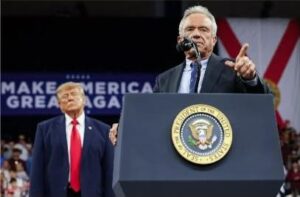
United States Health Secretary Robert F. Kennedy Jr. has sparked controversy after claiming that the Arab world, despite having a population of about 500 million people, does not produce scientific research, win major international prizes or contribute to literature.
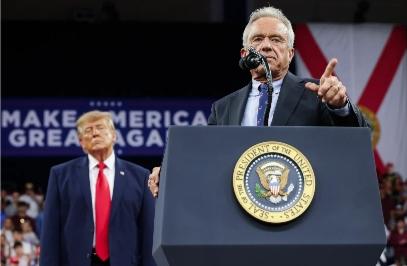
Kennedy made the remarks on Monday at a Republican campaign rally in Grand Rapids, Michigan, where he appeared alongside Republican Senate candidate Mike Rogers and gubernatorial candidate John James ahead of the US midterm elections.
His comments came during a discussion about the Muslim Brotherhood, an Islamist movement that has become a contentious issue in the Michigan Senate race between Rogers and Democratic candidate Abdul El-Sayed.
Kennedy defended criticism of the organisation against accusations of Islamophobia, arguing that discussing the Muslim Brotherhood should not automatically be interpreted as hostility towards Muslims.
He subsequently described communities living under the organisation’s influence as being trapped in what he called a “death cult”, accusing its ideology of promoting victimisation, murder and genocide.
However, his sweeping assessment of Arab achievements in science and literature drew attention to historical records that contradict his assertions.
Among those records is the 1999 Nobel Prize in Chemistry awarded to Egyptian scientist Ahmed Zewail for his work on the study of chemical reactions at extremely short timescales. Egyptian novelist Naguib Mahfouz also won the Nobel Prize in Literature in 1988.
Additionally, Yemeni journalist and human rights activist Tawakkol Karman shared the Nobel Peace Prize in 2011 for her role in the struggle for women’s rights and democracy.
Kennedy’s remarks were delivered in Michigan, a state with the highest proportion of residents reporting Arab ancestry in the United States. Data from the 2024 American Community Survey put the figure at approximately 2.2 per cent of the state’s population.
The controversy comes amid growing political tensions surrounding El-Sayed, a physician and Democratic Senate candidate whose opponents have repeatedly sought to associate him with the Muslim Brotherhood. He has denied having ties to the organisation and has publicly disavowed it.
During a debate on October 21, Rogers raised questions about El-Sayed’s alleged connections to the group. El-Sayed rejected the insinuations, describing suggestions that he was not committed to the US Constitution as shameful.
The Democrat also reaffirmed his rejection of the Muslim Brotherhood when questioned at a campaign event earlier in October, while criticising the suggestion that his Muslim faith implied divided loyalties.
Rogers continued to challenge El-Sayed over the issue during an appearance on NBC’s Meet the Press on Sunday, arguing that the Democrat had not sufficiently addressed concerns about the organisation.
Kennedy had travelled to Grand Rapids earlier on Monday for an official health-related engagement at Corewell Health, where he promoted an initiative encouraging hospitals to improve food quality and nutrition education.
He said nearly 300 hospitals, including 21 Corewell facilities, had signed a pledge to prioritise whole foods, reduce highly processed foods and sugary drinks, and increase the availability of fibre-rich whole grains.
His appearance at the facility preceded his participation in the Republican campaign rally, where his comments about Arabs introduced another contentious dimension to an already heated political contest.