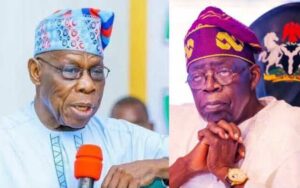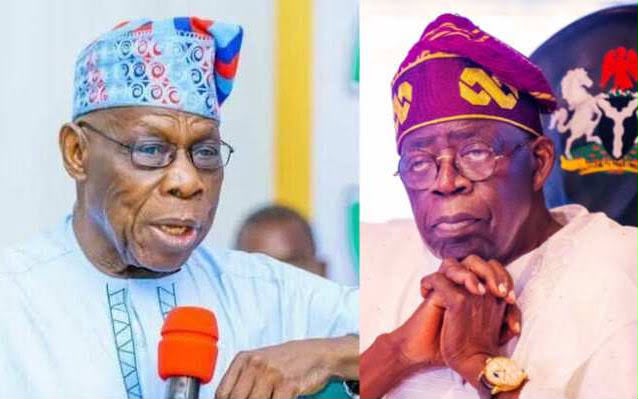
Former President Olusegun Obasanjo has warned that Nigeria’s growing dependence on borrowing could impose economic hardship on generations yet unborn, challenging the Federal Government’s justification for taking loans to finance national development.
Obasanjo, who described debt as more destructive than leprosy, said the consequences of excessive borrowing extended beyond the present generation, unlike the disease which affects an individual.
He made the remarks on Friday in Abeokuta, Ogun State, while speaking at the Ajibosin Platform, a public forum themed, “Leveraging Artificial Intelligence to Solve Grassroots Problems and Accelerate National Development.”
The former president was reacting to President Bola Tinubu’s earlier assertion that borrowing was not leprosy and that his administration would continue to obtain loans whenever necessary, provided the country worked hard to repay them.
Disagreeing sharply with the president, Obasanjo described the comparison as “absolute nonsense”, insisting that the long-term implications of debt made it a greater threat to national prosperity.
“And for anybody to say debt is no leprosy, is absolute nonsense. Debt is worse than leprosy. Because leprosy destroys only one person. Debt destroys generations,” he said.
Obasanjo also questioned Nigeria’s economic performance over the past four decades, particularly the dramatic depreciation of the naira against the United States dollar, despite the country’s vast human and natural resources.
Recalling his experience when he established his farm 47 years ago, the former president said the naira exchanged at N1 to $1.85 at the time, contrasting that position with the current exchange rate of about N1,500 to the dollar.
“When I started my farm, 47 years ago, naira to the dollar was one naira to $1.85. Forty-seven years ago. What has Nigeria done in 47 years that we now have 1,500 naira to the dollar? What have we done?” he asked.
He expressed concern over the quality of decisions taken by the country’s political leadership, questioning whether those in positions of authority possessed the knowledge and capacity required to reverse the country’s economic decline.
“What do our leaders know? And what do they not know? And from what they know, what can they do for us?” he queried.
The former president also faulted Nigeria’s dependence on international financial institutions, particularly the World Bank and International Monetary Fund (IMF), arguing that their economic prescriptions were not necessarily suited to the country’s peculiar circumstances.
According to him, the institutions were established before Nigeria’s independence and could not be expected to fully understand or address the country’s development challenges.
“World Bank and IMF were not designed for us. They were not built by us. They were built before we became independent. And that’s the people who would determine what we do,” he said.
Obasanjo further recalled how Nigeria was discouraged from providing agricultural subsidies to farmers, despite the extensive support governments in developed countries offered their own agricultural sectors.
He cautioned against the unquestioning adoption of economic policies recommended by foreign institutions and experts, particularly those trained abroad, without examining their relevance to Nigeria’s economic realities.
His remarks come amid sustained public concern over the country’s rising public debt and the growing proportion of government revenue required to service existing obligations.