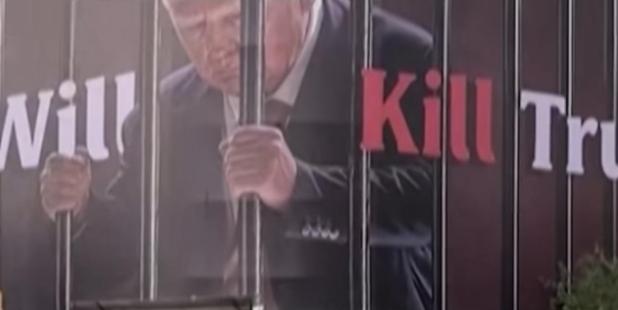
Iran has stepped up its public campaign against United States President Donald Trump, unveiling a giant billboard in Tehran bearing a direct threat against the American leader amid escalating tensions between the two countries.
The billboard, mounted at Enghelab Square in the Iranian capital, carries the words, “We will kill Trump,” alongside an image portraying the US president behind prison bars with his head lowered.
The display, which appeared on Tuesday, November 3, is part of a wider anti-American campaign featuring political banners, paintings and installations across different parts of Tehran, according to an Agence France-Presse (AFP) report.
At Tajrish Square in northern Tehran, another exhibition features several artworks depicting Trump in disturbing and humiliating scenes. One painting shows him lying on the ground with a bloodied face, while another portrays a bomb covering his head.
Organisers have also set up a life-sized replica of a prison cell at the location, where an actor dressed to resemble Trump was displayed inside. A nearby screen reportedly showed images of destruction following American military operations in Iran.
The developments come against the background of the conflict that began on February 28, 2026, following US and Israeli military strikes that killed Iran’s Supreme Leader, Ayatollah Ali Khamenei. Since then, relations between Tehran and Washington have remained severely strained.
Iran has repeatedly accused Trump of authorising attacks on civilian facilities, including a school and a wedding ceremony, which it claims resulted in the deaths of dozens of people, including women and children. However, the allegations were not independently verified in the report.
Despite the growing hostility, diplomatic efforts are reportedly underway to prevent another round of military confrontation. Trump has also indicated that an agreement with Iran remains possible, saying a deal could still happen.
The billboard campaign is unfolding as Americans head to the polls for crucial midterm elections, with the ongoing conflict reportedly becoming one of the issues generating concern among voters.
Iran has frequently used public murals, billboards and political exhibitions to communicate its opposition to the United States and Israel, a practice that has remained prominent since the 1979 Islamic Revolution.
The latest displays highlight the depth of the confrontation between both countries, even as diplomatic efforts continue to explore ways of preventing further escalation.