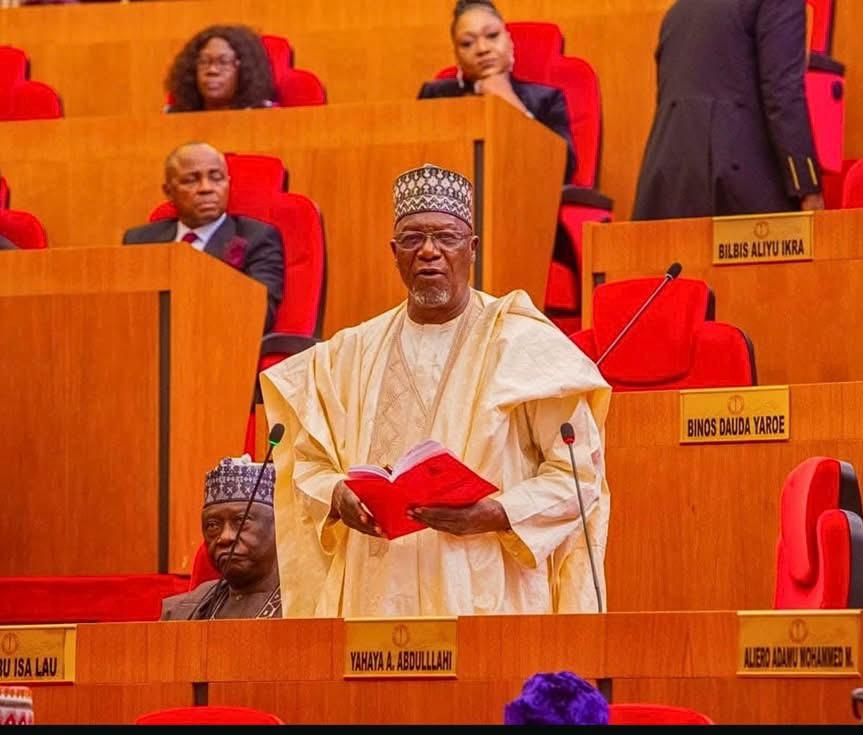
Nigeria’s tertiary education system may enter a seven-year consolidation phase as the Federal Government urges the National Assembly to stop approving new federal universities, polytechnics and colleges of education.
The proposal, contained in a memo from the Minister of Education, Dr. Tunji Alausa, is aimed at redirecting scarce public funds toward institutions already struggling with overcrowded classrooms, inadequate laboratories, staff shortages and deteriorating infrastructure.
In the November 2, 2026 memo to Senate President Godswill Akpabio, Alausa asked lawmakers to suspend consideration of bills seeking to establish additional federal tertiary institutions in line with a moratorium approved by the Federal Executive Council in August 2025.
The government’s argument is that Nigeria’s education crisis is no longer primarily about the number of institutions available to prospective students. Instead, it is about whether existing universities, polytechnics and colleges of education have the resources to provide credible teaching, research and skills training.
According to the minister, continued expansion risks creating more institutions that have legal recognition but lack the facilities, personnel and funding required to operate effectively.
He said the proposed pause would allow the government to complete existing projects, improve academic standards, strengthen staffing and increase the capacity of institutions already established.
The appeal comes amid continued legislative interest in creating new federal tertiary institutions. While acknowledging the constitutional authority of the National Assembly to initiate and pass such laws, Alausa urged lawmakers to assess each proposal against national education policy, clearly established needs and the long-term financial burden on the government.
He warned that every new institution would require more than an enabling law. It would also need land, lecture halls, laboratories, libraries, hostels, equipment, academic and non-academic staff, utilities, take-off grants and annual recurrent funding.
The minister said the government’s existing obligations already raised questions about its ability to sustain further expansion. He disclosed that only N250 billion had been released between 2013 and 2021 from the N1.3 trillion commitment under the 2013-2018 Federal Government-ASUU revitalisation agreement.
He added that just N50 billion had initially been released from an additional N150 billion approved in 2025 for Needs Assessment Intervention.
These funding gaps, he argued, showed the difficulty of maintaining current commitments, let alone assuming the costs of new institutions across the country.
Alausa pointed to institutional consolidation efforts in Ekiti and Imo states as evidence of the consequences of creating tertiary institutions without dependable funding. Ekiti merged three state-owned universities into Ekiti State University, Ado-Ekiti, in 2011, while Imo also reviewed and integrated some of its institutions.
He said some state governments had gone further by asking the Federal Government to take over universities they could no longer finance, illustrating how expansion without sustainability could eventually shift the burden to the federal treasury.
The minister also referred to consolidation measures adopted in countries including Australia, Finland, Japan, the United States and South Africa, where governments have sought to reduce duplication, improve efficiency and protect the quality of higher education.
Rather than increasing the number of institutions, he said Nigeria should focus on making existing ones viable and relevant. He identified TETFund infrastructure projects, NELFUND, vocational education, skills acquisition initiatives and the implementation of CATA and CONTTA as competing priorities for limited resources.
The proposed moratorium would not permanently block the creation of new institutions, the minister clarified. Future expansion could still be considered where there was a compelling national need, but only after proper feasibility studies, credible funding plans and evidence that existing capacity could not meet demand.
Alausa therefore appealed to the Senate leadership and other lawmakers to support the seven-year pause and resist establishment bills that lacked clear educational justification or sustainable financing.
He said the performance of Nigeria’s tertiary education sector should be judged by the quality of instruction, the competence of graduates, the strength of research and the contribution of institutions to national development—not by the number of universities, polytechnics and colleges created.