
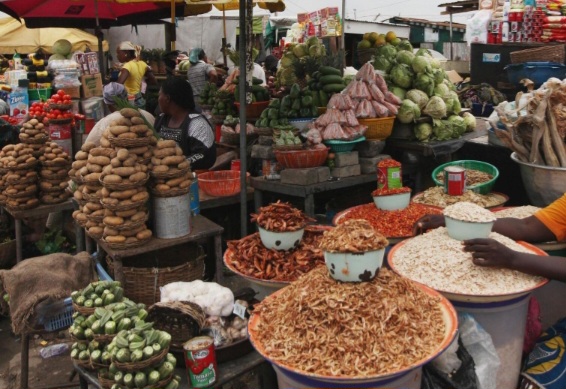
Nigeria’s harvest season has failed to bring significant relief to consumers as food prices remain elevated, with rising production expenses, insecurity and distribution challenges limiting the availability of affordable food across the country.
Despite a decline in headline inflation for the fourth consecutive month, food inflation stood at 19.13 per cent in October 2026, considerably above the general inflation rate of 14.06 per cent, according to the latest Consumer Price Index (CPI) figures released by the National Bureau of Statistics (NBS), as reported by The Guardian.
The October figure represents a decline from the 19.59 per cent recorded in September and the July peak of 20.31 per cent. However, the month-on-month food inflation rate slowed to 0.75 per cent in October from 1.55 per cent in September, indicating that the harvest season has not translated into substantial price relief. Core inflation, which excludes agricultural produce and energy, also declined to 10.78 per cent year-on-year from 21.25 per cent in October 2025.
Economists attributed the persistent pressure on food prices to insecurity in farming communities, high fuel and transportation costs, expensive agricultural inputs and inadequate storage facilities. Head of Research at Iron Capital, Abiodun Ogunniyi, explained that rising energy costs affect virtually every stage of agricultural production, including mechanised farming, processing and transportation. He also warned that increased food demand during the December festive period could offset any gains from the ongoing harvest and sustain price pressures into 2027.
Managing Director of Macrostat Nigeria Limited, Justin Amase, identified declining agricultural production as another major concern, noting that insecurity and rising cultivation costs had forced some farmers to abandon or reduce farming activities. He disclosed that prices of some essential food items at Wuse Market in Abuja had increased by more than 30 per cent within a month. Amase, who is also a farmer, said he was discouraged from expanding his rice production this year because fertiliser, herbicides and insecticides remained expensive, while the prices farmers received for their produce had declined.
The food supply challenges have also raised concerns about the country’s worsening food security situation. The Food and Agriculture Organisation (FAO) projected that 34.7 million Nigerians would face acute food insecurity in 2026, identifying armed conflict, displacement and climate-related disruptions as major drivers. Similarly, the Famine Early Warning Systems Network (FEWS NET), in its October 2026 food security outlook, projected that between 16 million and 17 million people would require humanitarian food assistance as Nigeria approaches the 2027 lean season, with parts of northern Nigeria expected to experience severe food access difficulties.
Regional figures released by the NBS further showed significant differences in food inflation across the country. Ondo recorded the highest year-on-year rate at 31.74 per cent in October, followed by Lagos at 31.43 per cent and Imo at 29.75 per cent. Nasarawa recorded the lowest at 3.70 per cent, while Bayelsa and Kano posted 7.11 and 7.13 per cent respectively. On a month-on-month basis, Yobe recorded the highest food inflation at 18.41 per cent, followed by Kebbi at 16.45 per cent and Borno at 13.96 per cent.