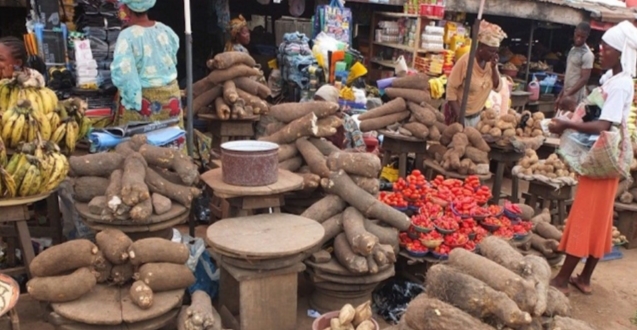
Nigeria’s improving inflation figures have yet to bring significant relief to consumers, as the prices of food items remain high despite the ongoing harvest season.
Although the harvest period is traditionally expected to increase food supply and bring down market prices, many Nigerian households are still struggling with the rising cost of basic food items. Economists say insecurity, expensive farm inputs, poor transportation networks and inadequate storage facilities are preventing farmers from producing and distributing enough food at affordable prices.
The latest figures released by the National Bureau of Statistics (NBS) show that headline inflation dropped for the fourth consecutive month, falling to 14.06 per cent in October 2026. However, food inflation remained considerably higher at 19.13 per cent, showing that the decline in general inflation has not translated into cheaper food.
Food inflation had risen from 8.89 per cent at the beginning of the year to 20.31 per cent in July before gradually declining to 19.13 per cent in October. Despite the improvement, the figures indicate that the cost of feeding remains a major concern for households across the country.
The situation has also raised questions about why the harvest season has failed to produce the expected reduction in food prices. Economists believe that the volume of agricultural produce reaching markets is still insufficient to meet demand, particularly as insecurity continues to disrupt farming activities in several parts of the country.
Head of Research at Iron Capital, Abiodun Ogunniyi, identified high energy costs, transportation expenses, insecurity, poor storage facilities and expensive agricultural inputs as major reasons food prices remain elevated.
He explained that the cost of fuel and diesel affects nearly every stage of agricultural production, including operating farm machinery, processing harvested crops and transporting food from rural communities to urban markets.
Ogunniyi also warned that insecurity in farming communities has reduced access to farmland, displaced farmers and disrupted the movement of agricultural products. According to him, the absence of adequate storage facilities further increases post-harvest losses, making it difficult to preserve and distribute food efficiently.
He expressed concern that food prices could remain high into 2027, particularly as increased demand during the December festive season could put additional pressure on available supplies.
Managing Director of Macrostat Nigeria Limited, Dr Justin Amase, also attributed the situation to declining agricultural production, arguing that insecurity and the rising cost of farming have discouraged many farmers from expanding their operations.
Amase explained that several farmers, particularly in the North-West and Middle Belt, have been unable to access their farmlands because of persistent attacks and displacement. He said the development has reduced food production in regions that traditionally supply large quantities of agricultural produce to markets across Nigeria.
The economist further disclosed that his observations at Wuse Market in Abuja showed that the prices of some essential food items had increased by more than 30 per cent within a month.
He also spoke about the difficulties farmers face in recovering their production expenses, noting that the prices of fertilisers, herbicides and insecticides have continued to rise while the prices farmers receive for their produce at the farm gate have declined.
Amase, who is also a farmer, said the situation discouraged him from expanding his rice production this year because the potential returns could not justify the cost of cultivation.
He maintained that farmers would have little motivation to increase production if the money invested in farming could not be recovered through sales. This, he warned, could further reduce food availability and sustain high market prices.
Meanwhile, concerns over food affordability have been reinforced by projections from international organisations. The Food and Agriculture Organisation (FAO) estimates that approximately 34.7 million Nigerians will experience acute food insecurity in 2026.
The organisation identified armed conflict, climate-related challenges, displacement and the destruction of livelihoods as major factors worsening the country’s food crisis.
Similarly, the Famine Early Warning Systems Network (FEWS NET), in its October 2026 outlook covering October 2026 to May 2027, warned that insecurity and below-average harvests could leave millions of Nigerians dependent on humanitarian assistance.
The organisation projected that between 16 million and 17 million people would require food assistance as Nigeria approaches the 2027 lean season. It also warned that high fuel and transportation costs would continue to weaken household purchasing power.
FEWS NET further noted that flooding, prolonged dry spells and insecurity had affected agricultural production in several northern communities. It estimated that harvest losses in some affected areas could range between 30 and 50 per cent.
The report also highlighted severe food insecurity in parts of Borno State, particularly Abadam, Guzamala and Marte, where conflict has restricted access to farmland and markets.
Adding to the concerns, data from the NBS revealed significant differences in food inflation across Nigerian states. Ondo recorded the highest year-on-year food inflation in October at 31.74 per cent, followed by Lagos with 31.43 per cent and Imo with 29.75 per cent.
On the other hand, Nasarawa recorded the lowest rate at 3.70 per cent, while Bayelsa and Kano recorded 7.11 per cent and 7.13 per cent respectively.
The figures highlight the uneven impact of rising food costs across the country. While the overall inflation rate continues to decline, millions of Nigerians are yet to experience meaningful improvements in their ability to afford basic necessities.