Nigeria is sitting on billions of naira in domestic investment funds, yet thousands of small businesses continue to struggle to secure the money they need to grow, expand operations and create jobs.
The situation has exposed a major gap in the country’s financial system, where pension funds and other institutional investors control substantial resources but relatively little of the money finds its way into businesses that drive economic activities.
Figures from the National Pension Commission (PenCom) show that Nigeria’s pension assets climbed to N31.8 trillion as of August 2026. However, N17.8 trillion of the total was invested in Federal Government securities, while only N344.62 billion went into infrastructure funds and N132.81 billion into real estate.
The concentration of investment in government securities has raised concerns about how effectively Nigeria is using its domestic capital to support productive sectors, particularly small and medium-sized enterprises.
Micro, small and medium-sized enterprises (MSMEs) account for 96.9 per cent of businesses in Nigeria, provide 87.9 per cent of employment and contribute 46.32 per cent to the country’s Gross Domestic Product (GDP). Despite their importance, the sector faces an estimated financing gap of $160 billion.
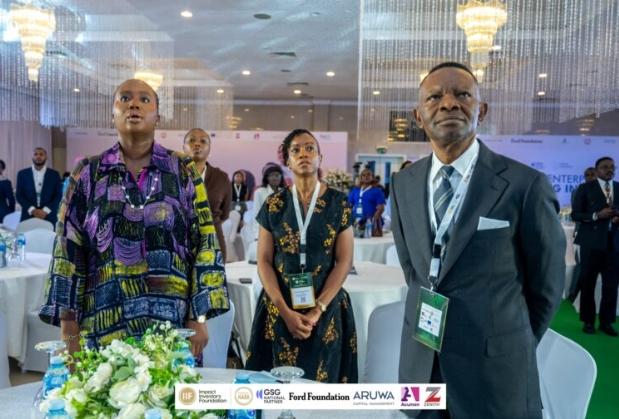
The funding challenge took centre stage at the ninth Annual Convening on Impact Investing organised by the Impact Investors Foundation (IIF) in Lagos on November 25 and 26. The event, themed “Unlocking Institutional Capital for Nigeria’s Impact Economy”, brought together government officials, financial institutions, investors and development partners.
Speaking at the gathering, IIF Chief Executive Officer, Oare Ehiemua-Ochui, argued that Nigeria’s problem was not necessarily a lack of available money but the absence of effective structures to connect investors with businesses that need funding.
She noted that while pension funds manage more than N31 trillion, small businesses responsible for a significant share of employment remain unable to access affordable growth capital.
According to her, institutional investors need reliable investment opportunities, proper business structures and clear regulatory guidelines before committing funds to smaller enterprises.
IIF Chairman, Frank Aigbogun, also called for stronger cooperation between government and the private sector, stressing that financing small businesses should be treated as an investment rather than charity.
He explained that supporting entrepreneurs could generate wider economic benefits through job creation, increased production and tax revenue.
Aigbogun illustrated the difficulties faced by small business owners with the example of women who are sometimes forced to choose between investing in their businesses and meeting pressing family responsibilities, including healthcare and children’s education.
He also pointed to First City Monument Bank’s provision of 2,000 interest-free loans, largely to women, as an example of how financial institutions could help entrepreneurs who are often excluded from conventional lending.
Another major concern raised at the meeting was the difficulty businesses face when seeking funding between the microfinance and commercial banking levels.
Adesuwa Okunbo-Rhodes, founder and managing partner of Aruwa Capital Management, said many growing businesses are too large for microfinance institutions but lack the financial strength and requirements needed to attract commercial banks and traditional private equity investors.
She noted that interest rates on commercial bank loans, which can approach 30 per cent, make borrowing particularly difficult for businesses seeking long-term expansion.
Okunbo-Rhodes also drew attention to the funding disadvantage facing women entrepreneurs across Africa. According to figures she presented, women-founded businesses received less than one per cent of capital raised on the continent in 2025, while male-founded businesses accounted for 91 per cent.
Through Aruwa Capital, she said her firm had built a portfolio of 17 businesses and manages approximately $80 million, with women-led or women-founded enterprises accounting for 70 per cent of its investments.
The portfolio has recorded average growth of about 23 times since investment and supports more than 200,000 direct and indirect jobs.
Meanwhile, the Impact Investors Foundation unveiled the Nigeria Impact Investing Policy and Diagnostic Report, which examines the barriers preventing domestic institutional investors from financing businesses with strong economic and social impact.
The report is expected to help identify policy gaps and improve cooperation among regulators, pension fund operators, development finance institutions and private investors.
Development partners are also working to strengthen the investment environment. Yakubu Musa-Paiko, an adviser under the GIZ-supported Value Chain for Agribusiness, Climate and Employment programme, said efforts were underway to improve business readiness in sectors such as dairy, cocoa, ginger and tomato production.
He disclosed that the partnership with IIF had supported plans for a Nigerian Wholesale Impact Investment Fund, alongside efforts to develop a policy framework for impact investing.
The proposed $1 billion Nigerian Wholesale Impact Investment Fund, which has received government backing, is expected to mobilise capital for MSMEs through investment intermediaries.
The foundation also introduced the Nigeria Impact Economy Community, a platform designed to bring government agencies, private investors and development organisations together to improve access to funding.
However, stakeholders stressed that the success of these initiatives should be measured by the amount of money eventually reaching businesses, the jobs created and the improvements recorded across the economy.
For many Nigerian entrepreneurs, the challenge remains finding affordable financing that allows them to expand without being overwhelmed by high interest rates and difficult lending conditions.
The wider concern is that Nigeria cannot fully benefit from its growing financial resources if businesses responsible for most of its employment and economic activities continue to struggle for capital.