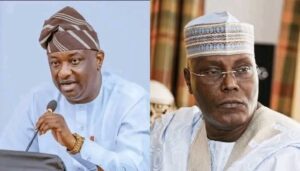
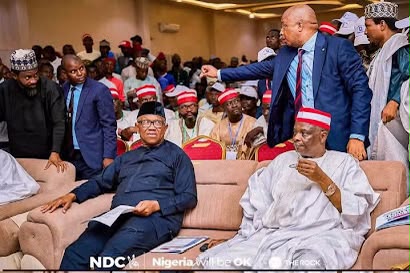
The 2027 presidential contest may be shaped less by Peter Obi’s decision to step aside for Atiku Abubakar than by the changing electoral arithmetic created by opposition realignments since the 2023 election, according to political analyst Suraj Umar.
Umar, in an analysis circulating on Facebook, argues that Obi’s political position has changed considerably since the last presidential election and that his 2023 performance should not be assessed merely by comparing his 6.1 million votes with Atiku’s 6.98 million.
Official results released by the Independent National Electoral Commission (INEC) showed that Bola Tinubu of the All Progressives Congress (APC) won the 2023 election with 8,794,726 votes, followed by Atiku of the Peoples Democratic Party (PDP) with 6,984,520 votes and Obi of the Labour Party with 6,101,533 votes. Kwankwaso of the New Nigeria Peoples Party (NNPP) polled 1,496,687 votes.
Umar’s analysis places particular emphasis on the combined figures recorded by Obi and Kwankwaso. Their separate totals amounted to about 7.6 million votes, a figure higher than Atiku’s individual tally, although the votes were secured under different parties and cannot automatically be treated as a transferable bloc.
The geographical spread of those votes also forms part of the argument. Obi won 11 states and the Federal Capital Territory, while Kwankwaso secured Kano State, demonstrating the existence of distinct political constituencies in different parts of the country.
According to Umar, the significance of the figures lies in what has happened since 2023. Obi and Kwankwaso are now operating within the Nigeria Democratic Congress (NDC), with Obi as presidential candidate and Kwankwaso as his running mate, bringing two previously separate political structures into the same electoral arrangement.
That development, the analyst argues, alters the opposition calculation ahead of 2027 because the political forces represented by the two men are no longer competing against each other for presidential votes as they did in 2023.
Umar also questions the assumption that Atiku’s second-place finish in the previous presidential election, by itself, establishes that Obi should step down in his favour. He argues that the 2023 figures must be considered alongside the different party structures, regional support bases and political circumstances under which the votes were obtained.
The analysis points to Kano, Bayelsa, Akwa Ibom, Benue and Rivers among states whose political dynamics could become significant in a more consolidated opposition contest. Such projections, however, remain political analysis and do not constitute established outcomes for 2027.
Umar’s position is that the opposition landscape has therefore moved beyond the configuration that existed during the 2023 election. The emergence of new alliances and the movement of political actors across party platforms have created a different framework within which the presidential contest will be fought.
The emerging contest will ultimately be shaped by factors including party organisation, campaign structures, voter turnout, regional voting patterns, alliances and the capacity of the competing political movements to convert political support into actual votes.
For Umar, those changes provide the basis for arguing that Obi’s political calculation in 2027 cannot simply be reduced to whether his 2023 vote was lower than Atiku’s.
Whether the new political arithmetic translates into electoral gains, however, will only become clear when Nigerians vote in the 2027 presidential election.