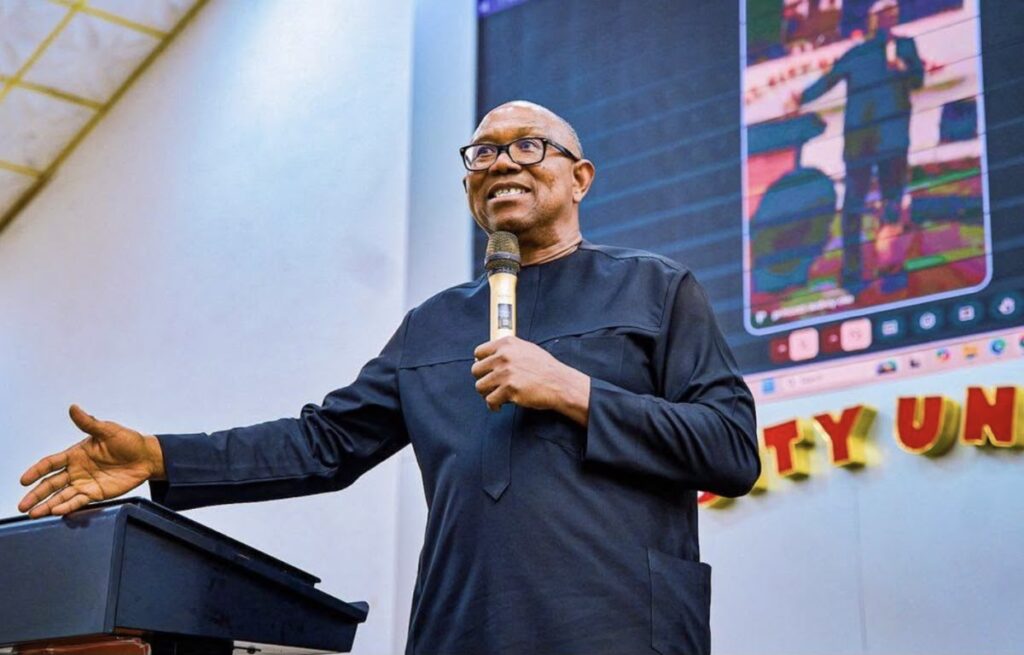
Presidential candidate of the Nigeria Democratic Congress (NDC), Peter Obi, has effectively put a one-year timeline on his proposed presidency, saying Nigerians would begin to see measurable changes in governance within 12 months if he wins the 2027 election.
Obi made the commitment in his Independence Day address on Thursday, in which he presented insecurity, displacement, unemployment, weak productivity, education and healthcare as issues requiring immediate attention. He said his proposed administration would judge its performance by tangible improvements in the lives of citizens. (Channels TV)
Rather than treating governance as a succession of promises, the former Anambra State governor said he would make government performance measurable and accountable, with public policy centred on the welfare and productivity of Nigerians.
“As President of Nigeria, I will make governance measurable, accountable and centred on the welfare and productivity of our people. Within the first year, Nigerians will begin to see the tangible impact of purposeful and effective leadership,” he said. (Channels TV)
A major part of Obi’s proposed first-year agenda is security, with particular emphasis on Nigerians displaced from their communities by violence. He said his administration would seek to create conditions for farmers to return to their farms, children to resume schooling and businesses to operate without fear.
“No Nigerian should be forced to live in an IDP camp because his or her government has failed to provide security,” Obi said, promising that displaced Nigerians would be supported to return safely and with dignity to their communities.
The security pledge followed a recent visit by Obi and Senator Rabiu Kwankwaso to Sokoto State, where they visited the Internally Displaced Persons camp at Ramin Kura. Obi said the conditions he encountered among displaced women and children illustrated the wider consequences of insecurity, including disruption of education, healthcare, farming and economic activity. (Global Upfront Newspapers)
On the economy, Obi proposed a shift from what he described as a consumption-driven system to one built around production, job creation, agriculture, manufacturing and investment in human capital. He also listed education and healthcare alongside security and productive enterprise as priorities for his proposed administration. (Prime Times)
He argued that Nigeria’s difficulties were not primarily the result of a shortage of resources, but of the failure to convert the country’s human and natural resources into improved living conditions, productivity, security and shared prosperity.
Obi identified poverty, out-of-school children, hunger, maternal and infant mortality, youth unemployment and underemployment, drug abuse and low life expectancy among the problems he said required urgent government attention.
Beyond his policy proposals, the NDC candidate called on citizens to demand accountability from those entrusted with public office, arguing that national development could not depend on promises or prayers alone.
He also pledged that, if elected, he would spend his presidential holidays within Nigeria, naming Zamfara, Borno, Kwara, Ebonyi and Ekiti among states he intended to visit in order to interact directly with citizens and better understand their challenges.