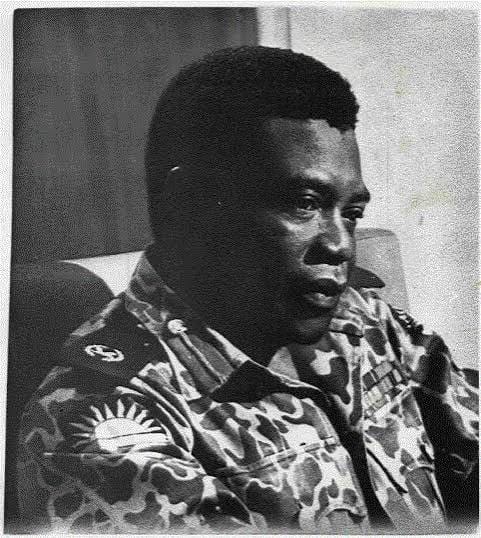
General Philip Effiong was a soldier of extraordinary historical significance who rose through the ranks of the Nigerian Army before becoming one of the most senior officers in the secessionist Republic of Biafra.
Born on 18 November 1925 in present day Ibiono Ibom, he joined the Nigerian Armed Forces on 28 July 1945, beginning a military career that would span the colonial period, Nigeria’s independence, the political crises of the 1960s and the Civil War.
Effiong rose steadily through the ranks and developed a particular professional reputation in military logistics and ordnance. He underwent officer training in Britain and received his commission in January 1956 after training at Eaton Hall in Chester, England.
He later served in the British Army’s Rhine area in West Germany and was subsequently transferred to the Nigerian Army Ordnance Corps.
His professional development continued with further military training in Britain following Nigeria’s participation in the United Nations peacekeeping operation in the Congo in 1961.
He eventually became Nigeria’s first Director of Ordnance, an important appointment in a period when the Nigerian Army was progressively developing an indigenous command and administrative structure.
But the historical currents surrounding Effiong’s generation were becoming increasingly turbulent.Following the military coup of January 1966, Effiong was posted to the Supreme Headquarters as Principal Staff Officer (akin to being today’s Chief of Staff to the President) to Major General Johnson Thomas Umunnakwe Aguiyi-Ironsi, who had emerged as Nigeria’s Military Head of State.
The position placed him close to the centre of the political and military upheaval that followed the first coup.
In the months leading to the July 1966 counter-coup, Effiong became deeply concerned about the growing crisis within the armed forces. He was subsequently posted to Kaduna as Deputy Brigade Commander. The July counter-coup and the violence that followed dramatically altered the political and military landscape of Nigeria.
For Effiong, as for many officers of his generation, the events of 1966 would become a defining turning point.
When the Eastern Region declared the independent Republic of Biafra in May 1967, Effiong became part of the new military establishment. Under Ojukwu, he emerged as Chief of General Staff, making him the senior military officer after the Head of State, while also serving as ‘Vice-President’ of Biafra.
The Civil War that followed from 1967 to 1970 became one of the most devastating episodes in Nigeria’s history.
Effiong’s role throughout the conflict was principally that of a senior military commander and administrator. He was involved in the organisation and administration of Biafra’s military effort.
Then came January 1970.With the Biafran position collapsing and Ojukwu leaving the territory, Effiong assumed responsibility as Officer Administering the Government of Biafra.
On 12 January, he announced the decision to end the war in a broadcast to the people of Biafra.
Three days later, on 15 January 1970, at Dodan Barracks in Lagos, General Philip Effiong formally signed the instrument that brought the Nigerian Civil War to an end.
In the declaration, he affirmed loyalty to Nigeria, accepted the authority of the Federal Military Government and declared that the Republic of Biafra had ceased to exist.
The moment was historic.Effiong became the history maker who formally closed the chapter of a three-year war that had cost Nigeria enormously in lives, displacement and destruction.
His role in the final days therefore occupies a distinctive place in Nigeria’s history as the last Head of State of Biafra, albeit briefly, and the senior officer who formally negotiated and executed the surrender on behalf of the Biafran government.
For General Effiong, the end of the Nigerian Civil War did not mean the end of his struggles.In fact, one of the least discussed chapters of his life began after the guns fell silent.
The return to a united Nigeria did not immediately translate into a return to his former military career.
In the months that followed the surrender, Effiong’s movements attracted the attention of the authorities. A contemporary report published by Le Monde in May 1970 said he had reportedly been arrested and transferred under military escort to Lagos, although the Federal Government did not publicly confirm the report at the time. The report also noted that General Yakubu Gowon had earlier indicated that Effiong would not be punished for his role in the surrender.
What followed was a difficult period of adjustment.Unlike some former Biafran officers who were eventually reintegrated into the Nigerian military, Effiong did not return to active service in the Nigerian Army.
His son, Prof. Philip Effiong Jr., later recalled that his father was dismissed from the Army without benefits, leaving a professional soldier who had spent virtually his entire adult life in military service without the institutional career and retirement security he might otherwise have expected.
For a man whose working life had been almost entirely devoted to the military, the consequences were profound.Effiong now had a family to support, but his principal profession had been taken away from him. According to his son, he spent the post-war years looking for contracts and other means of earning a living. Opportunities were difficult to secure because of the continuing suspicion surrounding his role in Biafra. In his son’s account, potential clients were reluctant to engage a former Biafran senior commander for fear of falling out of favour with the authorities.
It was a striking reversal of fortune.
His family also experienced the consequences. His son has recalled how the family struggled with accommodation, food and the education of the children. His wife, according to the account, took on various forms of work, including sewing and selling drinks, as the family tried to rebuild its livelihood.
The difficulties did not completely withdraw Effiong from public life.He remained interested in the affairs of the country and, by 1979, sought to participate in the democratic process.
His son stated that Effiong was a governorship aspirant in the old Cross River State in 1979, but was prevented from contesting because of his role in Biafra. According to the same account, Effiong personally approached the then military governor concerning the matter, but was told the situation could not be changed.
The experience illustrated the limits of post-war reconciliation. The Federal Government’s famous “No Victor, No Vanquished” policy sought to reintegrate the country after the conflict, but the experiences of individuals differed considerably.
He continued to live quietly and maintained his dignity as a private and family-oriented man who carried the burdens of his past while trying to provide for his family.
For the remaining three decades of his life, therefore, Effiong lived largely outside the military establishment that had defined his earlier career.
On 6 November 2003, General Effiong died at the age of 77.
For Akwa Ibom, General Philip Effiong remains one of the state’s most historically consequential military figures.
For Nigeria, his story belongs to the difficult history of nation-building, a story of soldiers, political upheaval, war, loss, reconciliation and the search for a path back from conflict.
As Akwa Ibom marks its 39th anniversary, General Philip Effiong is remembered among the state’s historic leading lights as a soldier who rose from colonial military service to the highest levels of command, became the second-in-command of Biafra, and ultimately became the man who formally brought the Nigerian Civil War to an end.
#AkwaIbomAt39
#IbomLeadingLights
#CelebratingOurHeroes
#39Heroes39Prides
#HeroPhilipEffiong
#The39thAnniversaryCollectives
#AkwaIbomStateMinistryOfInformation
#AriseAgenda