N.T.A Efo
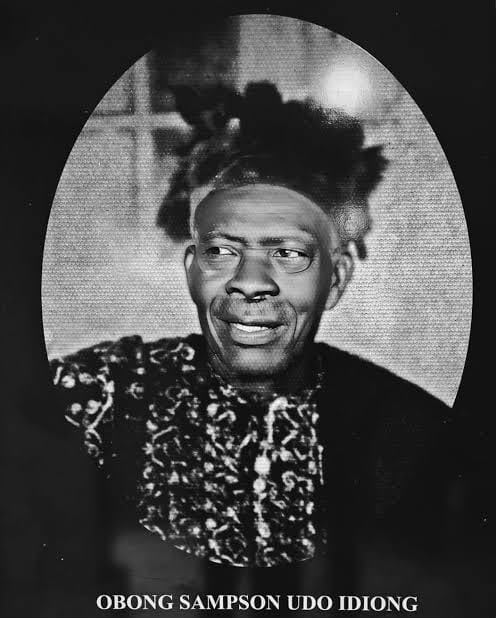
Obong Sampson Udo Idiong belonged to that remarkable generation of Akwa Ibom pioneers whose lives were defined by a profound commitment to the advancement of their people, the pursuit of education, the promotion of unity and the building of institutions that would outlive them.
Traditional ruler, nationalist, community leader, educationist and political organiser, Obong Sampson Udo Idiong occupies a distinguished place in the history of Akwa Ibom because he was one of the early architects of the collective consciousness that eventually produced not only a stronger community identity, but also the intellectual and political foundations upon which the creation of Akwa Ibom State was built.
He was one of the pioneering figures associated with the formation of the Ibibio Union in 1928, an organisation established to promote unity, self-reliance, civic responsibility, moral advancement and the acquisition of higher education among the people.
Idiong’s contribution to the Ibibio Union was particularly significant because he understood early that the emancipation of a people required required education, organisation and the creation of institutions capable of preparing succeeding generations for leadership.
He was the first Vice-President of the Ibibio Union, serving alongside the founding generation of leaders who gave the organisation its direction and purpose. His place in the Union’s history therefore predates many of the institutional achievements for which the organisation later became famous.
The emergence of the Ibibio Union marked one of the most important chapters in the history of the people of what is today Akwa Ibom State. At a time when colonial educational opportunities were extremely limited and higher education was largely beyond the reach of ordinary Africans, these pioneers recognised that the people had to take responsibility for preparing their own future.
Idiong belonged to that generation of men who embraced the philosophy of self-help and collective advancement. Rather than waiting for government or the colonial administration to provide the institutions they needed, they mobilised their own people to build them.
This philosophy found one of its most enduring expressions in the Ibibio Union’s pioneering overseas scholarship programme.
In 1938, the Union sponsored six young men from the various districts of Ibibioland for university education abroad. Among the beneficiaries was his brother, Asuquo Udo Idiong who got the slot for Abak District, and was sent to study Medicine in North America. It is important, however, to distinguish this young scholar from Obong Sampson Udo Idiong himself. The former was a beneficiary of the famous scholarship scheme; the latter was one of the senior leaders who helped build the organisation that created the scheme.
Their education abroad subsequently contributed to the development of law, medicine, agriculture, education and public administration in Nigeria.
The tragedy of Asuquo Udo Idiong’s death before completing his studies only deepened the emotional significance of the scholarship programme. Historical accounts indicate that the Union subsequently awarded another scholarship to Effiong Udo Ekpo to fill the Abak District quota. The Union also contemplated the establishment of a hospital at Ikot Okoro as part of its educational and social development programme, with the institution intended to serve as a fitting memorial to the young scholar who had died abroad.
But Idiong’s own legacy extended far beyond the Union. He was a major figure in the political and administrative development of the old Annang area. Historical accounts record his involvement in the development of local government structures and his emergence as an important representative of the people in the political institutions of the colonial era.
He was the first Chairman Southern Annang County Council then known as “Main Council” in 1934.
He was elected to represent Southern Annang at the Calabar Provincial Council which gave birth to Eastern House of Assembly, in 1944. He was the pioneer founding member of NCNC and later Action Group in 1945/1957 working with both Dr. Nnamdi Azikiwe and Chief Obafemi Awolowo respectively for the independence of Nigeria.
It was Obong Idiong who in 1945 spearheaded the establishment of the first government farm in Eastern Nigeria at Obio Akpa, his community, which later transformed into a School of Agriculture before it bacame a campus of Akwa Ibom State University, and presently, the Federal University of Agriculture and Technology. He was also the arrowhead in the establishment of Ikot Okoro General Hospital in 1954, Southern Annang Secondary School in 1964 and pioneered several scholarships for the indigenes. He also established Abak Motor Park with seven vehicles in 1948 as a pioneer chairman of the Council. He was elected Political Leader Annang People in 1958.
His generation understood that education, healthcare, transportation and political organisation were interconnected elements of community development.
His activities during the nationalist period placed him among the generation of leaders who participated in the political struggles and constitutional developments that eventually culminated in Nigerian independence.
His traditional leadership was perhaps the most enduring expression of his influence.
He was appointed Nsobom of Obio Akpa Clan in 1940, and his stature among the people continued to grow over the following decades.
In 1962, he was installed as Obong Ikpaisong of Ibibio and Annang, a position that reflected the enormous respect he commanded across the wider community.
He later became the first Paramount Ruler of Ukanafun in 1976, and subsequently the first Paramount Ruler of Oruk Anam in 1989. His traditional leadership therefore connected several generations and administrative eras, from colonial rule through independence and into the period immediately preceding the creation of Akwa Ibom State.
That contribution became particularly important in the long historical journey towards the creation of Akwa Ibom State.When General Ibrahim Babangida visited Akwa Ibom State in 1986, his official speech acknowledged the pioneering contribution of men such as Obong Sampson Udo Idiong to the unity and development of the people. He specifically recalled Idiong as one of the leaders who had the foresight to promote unity among the various Ibibio groups and to support the historic 1938 overseas scholarship initiative.
One of his grand children is former First Lady of Akwa Ibom State, Dr. Mrs. Martha Udom Emmanuel, and current House of Assembly member, Prince Sampson Idiong.
In recognition of this enduring contribution, his name has also been immortalised in modern Akwa Ibom’s physical landscape. In 2023, Governor Udom Emmanuel inaugurated the dualised 3.32-kilometre Ring Road 2 in Uyo and named it Chief Sampson Udo Idiong Drive, describing the naming as a tribute to forebears who had the foresight to work for the emergence and development of Akwa Ibom State.
Obong Sampson Udo Idiong died in 2000, having lived to the age of about 115.
For Akwa Ibom, Obong Sampson Udo Idiong remains a symbol of the pioneering generation that transformed communal consciousness into organised action.
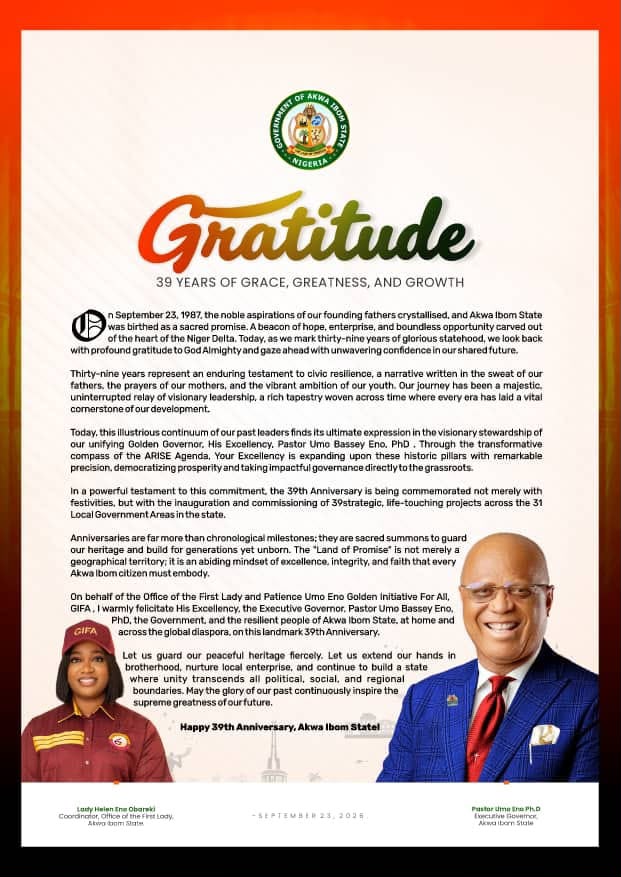
As Akwa Ibom celebrates its 39th anniversary, the story of Obong Sampson Udo Idiong deserves celebration.
Obong Sampson Udo Idiong is celebrated today as a HERO because he belonged to the generation that understood that a people’s future must be built before it can be inherited.
#AkwaIbom@39
#IbomLeadingLights
#CelebratingOurHeroes
#39Heroes39Prides
#HeroSampsonUdoIdiong
#The39thAnniversaryCollectives
#AkwaIbomStateMinistryOfInformation
#AriseAgenda