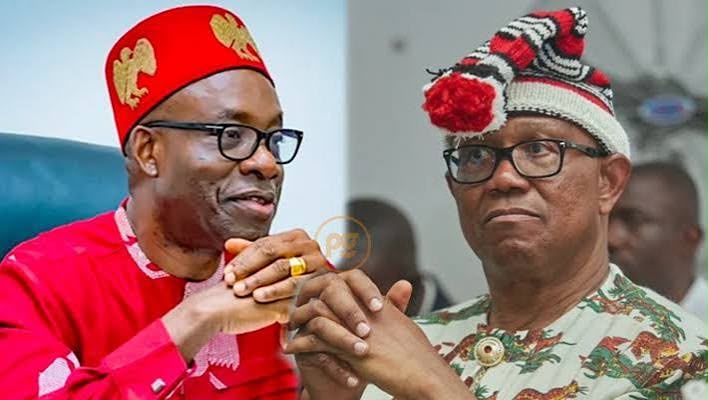
A fresh dispute over the financial state of Anambra at the end of Peter Obi’s administration has shifted attention from political claims to a more fundamental question: what exactly did the former governor leave behind when he handed over power in March 2014?
The Anambra State Government says records now available show that Obi’s administration contracted eight IDA-World Bank facilities totalling $123.77 million, with $92.35 million, equivalent to about N127.37 billion, still outstanding as of June 30, 2026.
Obi, however, has rejected the interpretation, insisting that he neither borrowed from a financial institution nor issued bonds during his eight years as governor and that the state’s foreign debt stood at about $30 million when he left office.
Speaking in an interview with Arise News on Thursday, September 24, 2026, Obi also maintained that he left more than $150 million in funds and investments, arguing that the resources were sufficient to offset the foreign obligations being attributed to his administration.
The competing accounts have turned what initially appeared to be a political disagreement into a question of public financial records, particularly the distinction between loans contracted directly by a state government and concessionary facilities obtained by the Federal Government and subsequently on-lent to states.
During the same interview, Obi said the World Bank and International Fund for Agricultural Development facilities cited against him belonged to the latter category, arguing that describing them simply as money he borrowed gives a misleading picture of how the financing arrangements worked.
The Anambra government takes a different position. In a statement issued in Awka on Saturday, September 26, 2026, the state government said eight World Bank loans were signed during Obi’s tenure and argued that the existence of the facilities and the state’s continuing obligation to service them cannot be erased by describing the funds as concessionary support.
According to the state, the outstanding obligations are still being serviced through deductions from monthly Federation Account allocations, meaning that the financial consequences of the facilities have extended well beyond the administration under which they were contracted.
The dispute also extends beyond external debt. In its September 26 statement, the state government said more than 700 workers of the former Anambra State Water Corporation were left with salary, pension and gratuity claims that eventually became the subject of arbitration and litigation.
It said an arbitration panel in 2009 and a 2019 National Industrial Court judgment established the workers’ claims, after which the state entered an out-of-court settlement in 2024 for N1.563 billion. The government said N1.199 billion has so far been paid, leaving a balance outstanding.
The government further alleged that 11 months of pension arrears owed to primary-school teachers before Obi’s tenure remained unresolved during his administration.
Obi’s position remains that he did not leave salaries, pensions, gratuities or verified and certified contractor obligations unpaid when he handed over in 2014. During the September 24 interview, he challenged those making contrary claims to verify the allegations against official records.
The former governor has specifically pointed to his handover documents, saying they contain details of the cash, investments and foreign-currency holdings he left behind, including bank statements that, according to him, support the $150 million figure.
He has also called for the relevant institutions, including the World Bank and Nigerian banks, to make the underlying records available for independent verification.
The competing positions were reported by Arise News, which carried Obi’s interview and his response to the allegations.
The dispute ultimately turns on records rather than rhetoric: what was borrowed, who contracted the facilities, how much was drawn down, what remained outstanding in March 2014, and what assets and liabilities were formally transferred to the incoming administration.
The $123.77 million figure should therefore not automatically be equated with money personally borrowed by Obi, just as his claim of leaving more than $150 million does not by itself establish that the funds were available to extinguish every liability.
With Obi now seeking the presidency in 2027, his record in Anambra is likely to remain under scrutiny. But the broader public interest lies in whether the relevant loan agreements, debt-service records, audited accounts, bank statements, handover documents and workers’ claims can be reconciled.
That documentary trail, rather than competing political narratives, would provide the clearest account of what Anambra owed, what it owned and what was transferred in 2014.