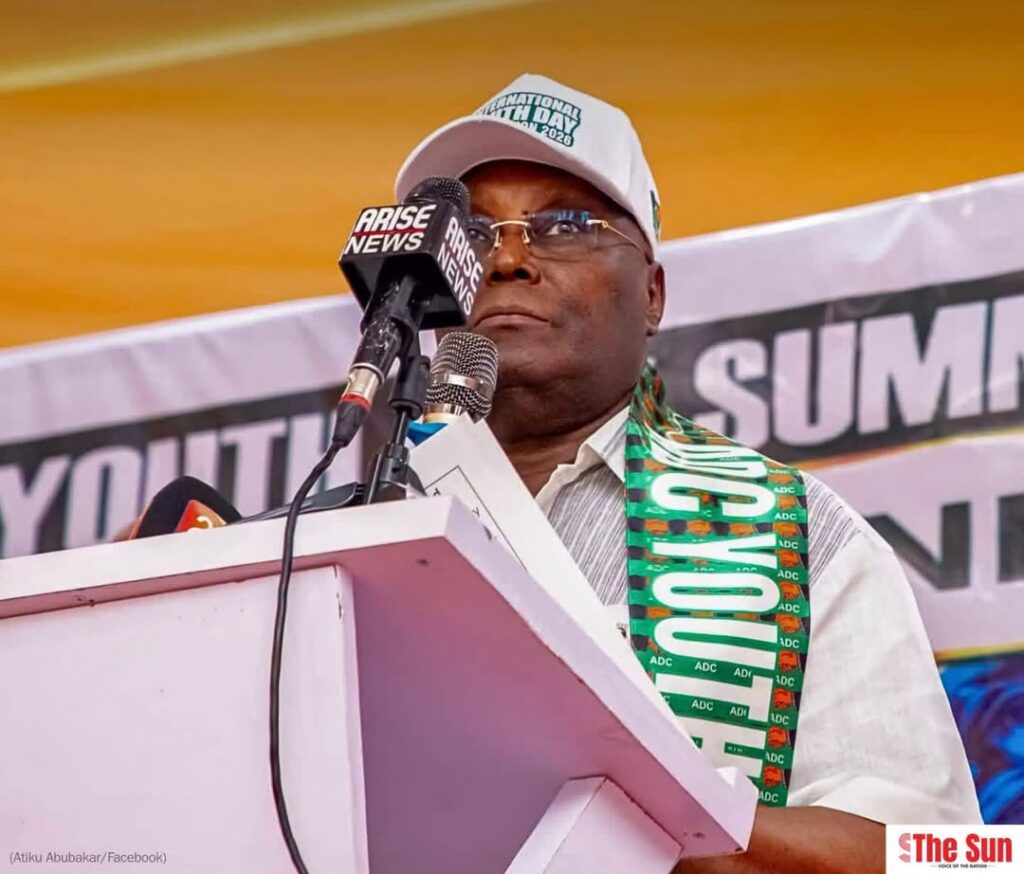
Former Vice President Atiku Abubakar has challenged President Bola Tinubu to account for Nigeria’s economic performance, citing the depreciation of the naira, rising living costs and projected poverty levels in a fresh exchange between the ruling All Progressives Congress (APC) and opposition leaders ahead of the 2027 election.
Atiku, the African Democratic Congress (ADC) presidential candidate, was reacting to Tinubu’s accusation that opposition parties were responsible for creating hunger and poverty in the country during the APC presidential campaign flag-off in Kaduna on Saturday.
In a statement issued by his Director of Strategic Communication, Phrank Shaibu, the former vice president said the administration should take responsibility for the economic conditions confronting Nigerians rather than blame its political opponents.
“The APC governed Nigeria for eight years before you took office. You have added another three and a half years,” Atiku said.
“Nigerians know who has been in power, and hardship did not begin when the opposition started talking about it. Stop insulting their intelligence and answer for your record.”
Atiku pointed to the removal of petrol subsidy and the depreciation of the naira as issues requiring an explanation from the Federal Government, arguing that their effects on household purchasing power and business costs should form part of the assessment of the administration’s performance.
He cited a movement in the exchange rate from about ₦471 to ₦1,329 to the dollar, while also referring to a World Bank estimate that 63 per cent of Nigerians could be living below the national poverty line in 2026.
The ADC chieftain also questioned the government’s handling of public expenditure, raising concerns about the extension of the 2024 budget into 2025 alongside a separate 2025 budget.
He further sought explanations for figures he cited as ₦7.13 trillion recorded under energy security in 2024 and ₦11.2 trillion in NNPC pipeline-related spending.
Atiku also criticised the planned inauguration of a section of the Abuja–Kaduna Expressway, arguing that government ceremonies should not be treated as substitutes for completed infrastructure.
“A road cannot be completed with a speech or a ribbon-cutting ceremony,” he said.
The former vice president’s remarks deepen the political dispute over who should bear responsibility for Nigeria’s economic difficulties as parties prepare for the 2027 presidential election.
The exchange places the spotlight on issues likely to feature prominently in the campaign, including the cost of living, exchange-rate stability, poverty, budget implementation and the delivery of public infrastructure.
Tinubu’s remarks at the Kaduna campaign launch and Atiku’s response reflect the widening contest between the APC and opposition parties over the government’s economic record. The figures cited by Atiku, however, require assessment against official economic data and expenditure records to establish their precise context.