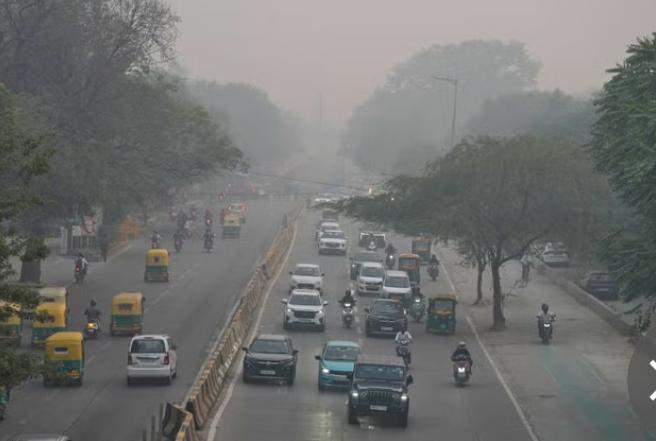
India’s capital, Delhi, has emerged as the world’s most polluted city, overtaking Pakistan’s Lahore as dangerously high pollution levels blanket the city in thick smog.
The situation has raised fresh concerns about public health, as millions of residents struggle with deteriorating air quality and reduced visibility across major roads and residential areas.
According to Swiss air quality monitoring organisation IQAir, Delhi recorded an Air Quality Index (AQI) of 334 on Friday, November 13, placing it in the hazardous category. An AQI reading of 50 or below is generally considered safe, with minimal health risks.
India’s Central Pollution Control Board (CPCB), however, reported an even higher reading of 403 at about 9am local time, classifying the pollution level as severe. The difference between the two figures is attributed to variations in the measurement and classification systems used by both organisations.
The worsening situation comes days after the celebration of Diwali, the Hindu festival of lights, which took place on November 8. Despite restrictions permitting only approved green firecrackers during specific hours, pollution levels have continued to rise.
Data from India’s pollution control agency showed that Delhi’s AQI increased from 299 on Tuesday to 313 on Wednesday before reaching 350 on Thursday afternoon. By Friday, 33 out of the city’s 58 monitoring stations had recorded severe pollution levels, with some locations exceeding 450.
A report by the Centre for Science and Environment also revealed that average PM2.5 concentrations in the week leading up to Diwali reached 236 micrograms per cubic metre, almost twice the 120 recorded during the corresponding period in 2025.
The annual pollution crisis in northern India and neighbouring Pakistan is largely associated with vehicle emissions, construction dust and the burning of agricultural waste. Cold weather conditions during winter make matters worse by trapping pollutants close to the ground.
India’s Ministry of Environment, Forest and Climate Change estimates that vehicles account for 23 per cent of winter pollution, while biomass burning, including agricultural residue, contributes another 20 per cent.
The health implications remain particularly worrying. A study published in The Lancet Planetary Health in July 2024 linked exposure to excessive PM2.5 pollution with approximately 33,000 deaths annually across 10 Indian cities, including Delhi.
With pollution levels reaching dangerous heights, the latest development has once again highlighted the growing environmental and public health challenges facing India’s capital.