
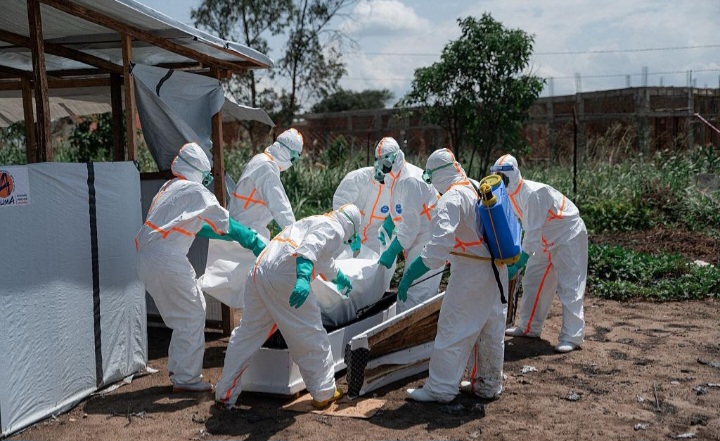
Efforts to contain an Ebola outbreak in eastern Democratic Republic of Congo are encountering resistance from communities whose traditional burial practices conflict with medical safety measures introduced to prevent further infections.
The disagreement has heightened tensions between residents and health workers, with some families unwilling to surrender the bodies of deceased relatives to medical teams for specialised burials.
Channels Television reported that residents of Bulambo-Isale in North Kivu Province recently attempted to prevent an ambulance carrying the body of an Ebola victim from entering the community, insisting on traditional burial arrangements.
The Nande people, who regard the area as a major cultural and religious centre, believe that deceased relatives must be buried by their families and returned to ancestral land to preserve their spiritual connection with the living.
Traditional leader Pimbo Kakule said the community’s burial customs were deeply connected to its beliefs about life after death, warning that disregarding them could create further distrust.
“Our people believe there is life after death and our customs must be respected when a person is buried. Otherwise we think they’ve been sacrificed,” Kakule said.
He suggested that health authorities could reduce opposition by involving families in safe burial procedures rather than imposing arrangements without adequate consultation.
“If we were to say: ‘Your brother’s died. We’re going to teach you how to bury him,’ we might reach an agreement and there wouldn’t be all this tension,” he added.
Beyond burial disagreements, misinformation and suspicion surrounding medical interventions have complicated the outbreak response. Some residents reportedly believe patients taken to treatment centres are deliberately harmed, while others question the intentions of health workers recruited to combat the disease.
Roland Vivaya, head of the local youth council, acknowledged that he had initially doubted the existence of Ebola until he contracted the virus and nearly died.
He said poor communication, unfamiliarity with local customs and inadequate community engagement had contributed to the hostility confronting response teams.
Medical personnel have also faced physical attacks, with Vuhovi health district chief doctor Wilson Kasyani disclosing that a nurse’s son was recently wounded during an incident at the nurse’s residence.
“We are fighting the disease, not the response teams,” Kakule said, reflecting the community’s position that disease control should not come at the expense of its cultural practices.