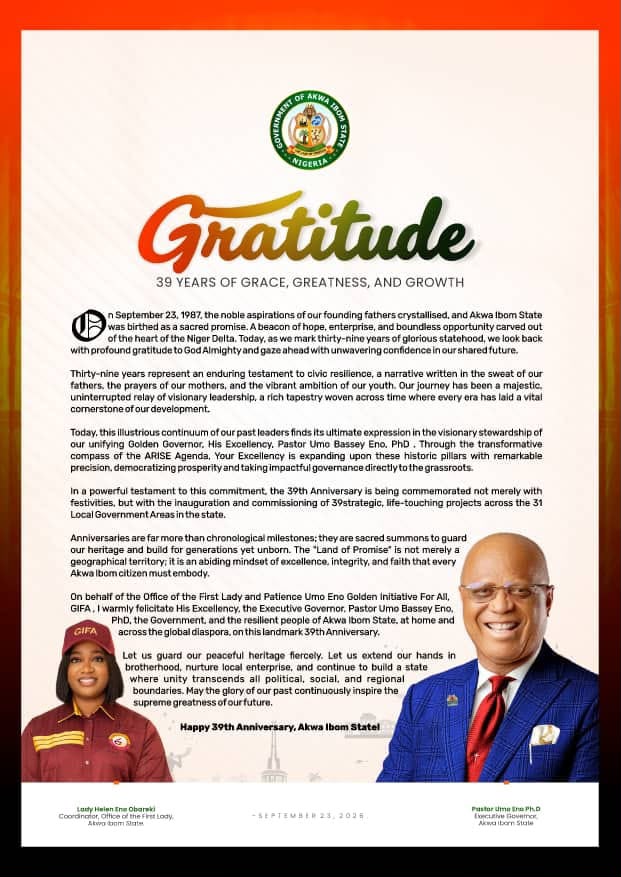

With 1.3 million registered voters in Akwa Ibom State ahead of the 2027 elections, Governor Umo Eno is banking on an unprecedented grassroots mobilisation strategy as he seeks a second term in office.
Rather than relying primarily on the conventional top-heavy campaign arrangement, the governor’s re-election machinery is being designed around the state’s 329 wards, with ward coordinators expected to serve as the critical link between the campaign leadership and voters across the state.
The structure reportedly places significant responsibility on Ward Coordinators, who will organise campaign activities in their respective territories through Polling Unit Coordinators. Unlike arrangements in which government appointees automatically assume campaign responsibilities in their communities, the ward positions are to be determined by the State Campaign Council.
The implication is that political influence, rather than government position alone, will be central to the selection process. An aide who enjoys access to Government House but lacks a strong following in his or her community would not automatically qualify, just as a politically influential grassroots figure without a government appointment could emerge as a key player.
The strategy draws on a large pool of government appointees. With more than 380 Personal Assistants, Special Assistants and Senior Special Assistants, and a broader appointee network involving commissioners, special advisers, delivery advisers and board members, the administration has a substantial base from which potential grassroots organisers can be identified.
But the proposed arrangement stops short of turning government appointments into automatic campaign positions. Instead, the State Campaign Council is expected to assess who can actually mobilise people, command local confidence and take responsibility for electoral performance within a defined ward.
At the heart of the arrangement is therefore a shift from proximity to power to proximity to voters. Ward Coordinators are expected to have clearly defined territories and measurable responsibilities, making their performance directly connected to the outcome recorded in their wards.
The approach also seeks to create a stronger sense of personal ownership of the campaign. Rather than leaving responsibility for electoral mobilisation to a broad and sometimes indistinct political structure, individual coordinators are expected to know precisely what is required of them and where they are expected to deliver.
With the governor reportedly targeting as many as 1.2 million votes, the proposed ward-by-ward architecture represents an attempt to translate a statewide political ambition into thousands of localised mobilisation efforts. Whether that ambitious target can be achieved will ultimately depend not on the size of the structure, but on how effectively those selected can convert organisation at ward and polling-unit levels into actual votes.