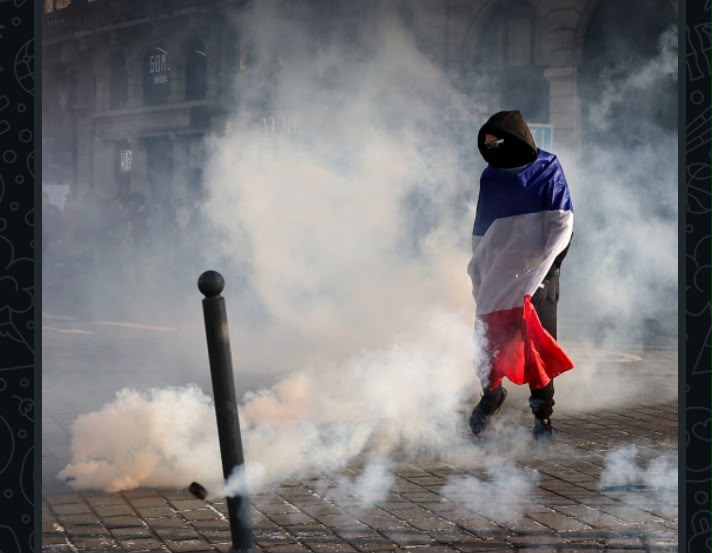
France is facing a growing challenge in controlling street demonstrations as confrontational protest tactics once associated with organised radical groups increasingly spread among young people, turning public protests into clashes with security forces.
What began as student demands for better school conditions has expanded into a wider expression of public anger, drawing in trade unions, Yellow Vest activists and other groups protesting economic hardship and demanding political change.
The growing tension was evident during nationwide demonstrations on October 17, when largely peaceful marches degenerated into looting, vandalism and violent confrontations. The historic town hall in Limoges was set ablaze, shops were ransacked and several protesters sustained life-changing injuries.
An internal French Justice Ministry document showed that 68 per cent of the 186 people jailed between October 18 and 21 were aged 25 or younger, while 52 per cent had no previous criminal record. Nearly half were classified as looters.
The development has raised concerns about a generation of young demonstrators increasingly accustomed to violence as part of political expression.
One of them, 19-year-old Lucas Petit, said his perception of street protests was shaped by the violent confrontations that accompanied the 2018 Yellow Vest movement.
Petit, who has been involved in blocking his school in eastern Paris for more than a month, said tear gas, rubber bullets, water cannons and stun grenades had become familiar features of demonstrations.
“We feel somewhat compelled to respond with violence because we’re facing social, institutional, symbolic and now physical oppression,” he told CNN.
A major factor behind the changing protest culture is the spread of tactics associated with the Black Bloc movement, whose masked participants traditionally organise themselves around direct confrontation with authority and attacks on symbols of capitalism.
The tactics, which originated among radical-left and anti-capitalist movements in Germany during the 1980s, gained visibility in France during the 2016 labour protests and became more prominent during the Yellow Vest demonstrations.
Unlike a formal organisation, Black Bloc describes a method of protest in which participants conceal their identities, move in groups and sometimes break away from larger demonstrations to confront police or damage property.
Experts say the approach is no longer restricted to established militant groups, as some young people without formal political affiliations have begun adopting similar methods.
Thierry Vincent, an expert on radical-left movements, told CNN that Black Bloc tactics were becoming increasingly familiar among young demonstrators who were not necessarily members of the ultra-left.
The changing behaviour of protesters has also complicated police operations, with small mobile groups sometimes splitting from larger marches and forcing officers to divide their attention.
Former riot police officer Olivier Cappe said security personnel were increasingly confronted with fireworks, Molotov cocktails and other dangerous projectiles, making direct intervention more frequent.
He also identified a shortage of about 800 specialist riot police officers as another challenge facing French security agencies.
According to Cappe, the traditional French crowd-control approach relies heavily on the numerical strength of police formations to discourage confrontation. However, when officers are outnumbered, they may resort more quickly to force.
The consequences have included serious injuries among young demonstrators. A 14-year-old boy reportedly suffered a fractured jaw and damaged teeth after being struck by a tear gas canister, while a 16-year-old lost an eye after being hit by a rubber bullet. Another teenager, aged 15, lost a hand to a stun grenade, prompting the interior minister to temporarily suspend its use.
Cappe acknowledged that aggressive police responses could further deepen hostility, particularly when students caught up in demonstrations begin identifying with more militant protesters.
For Petit, however, attacks on property associated with capitalism are sometimes intended to communicate political opposition rather than simply cause destruction.
French President Emmanuel Macron has described the escalation as a collective failure, expressing concern over the injuries suffered by both protesters and security personnel.
He insisted that nothing could justify the loss of a young student’s hand and appealed for calm.
Restoring order has nevertheless become increasingly difficult as government restrictions, including curfews, protest bans and heavier police deployments, face resistance from demonstrators who regard them as restrictions on their democratic right to protest.
With trade unions and former Yellow Vest activists joining the student-led agitation over living costs and political grievances, the unrest has developed beyond a single campaign, presenting the French government with a wider challenge over public order, police conduct and the right to peaceful demonstration