By Emmanuel Ndon
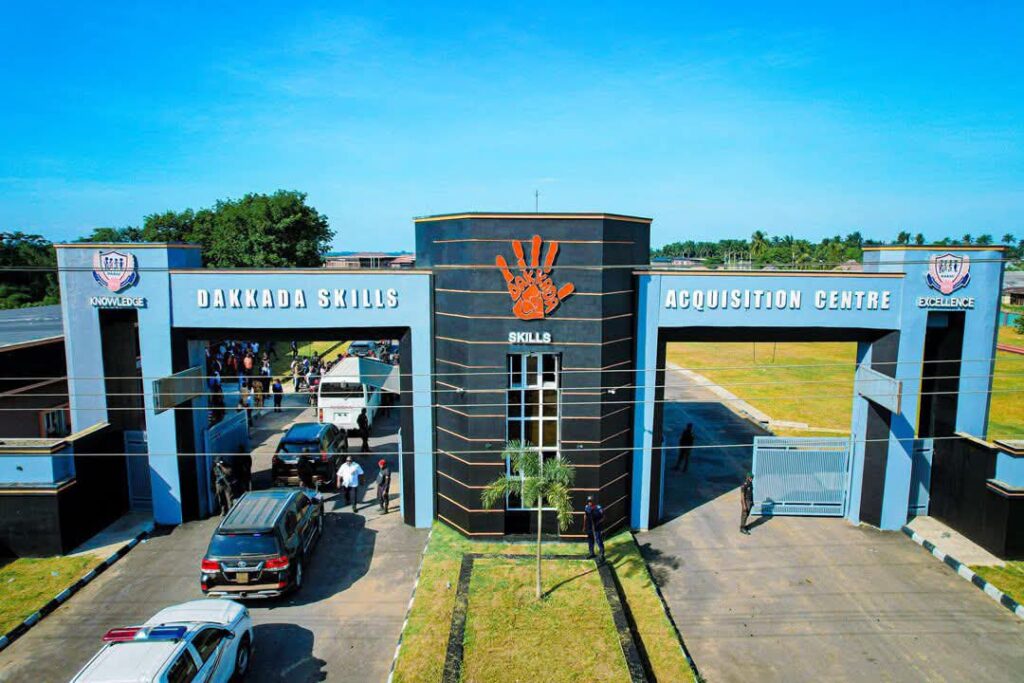
My recent tour of the Dakkada Skills Acquisition Centre at Ikot Ada Idem offers a different way of looking at youth empowerment. The significance of the institution is not simply in the size of its workshops,the range of equipment available or the number of schools (faculties). It is in what happens when a young person enters the centre without a marketable technical skill and leaves with the ability to make, repair, build, design or provide a service that someone is willing to pay for.
That transformation is already occurring at scale. By September 2026, 2,186 young people had graduated from DASAC, according to figures released by the Akwa Ibom State Ministry of Youth Development. The State has borne the cost of their training, feeding and accommodation, with the investment estimated at about ₦1 million per trainee. What began as a skills acquisition initiative has therefore grown into a substantial human-capital programme.
The centre has been designed around practical rather than purely theoretical learning. Its schools(faculties) cover fields including agribusiness, automobile and mechanical technology, industrial safety, ICT, metal technology, wood technology, hospitality and lifestyle management, electrical and electronics technology and civil and building technology. The intention is to equip trainees with skills that can translate into employment, entrepreneurship and self-reliance.
Walking through the facility makes the distinction clearer. Skills are not being taught as abstract subjects detached from the workplace. They are developed through workshops, tools, equipment and practical exercises that allow trainees to become familiar with the processes involved in their chosen trades. That practical orientation is one of the reasons DASAC occupies an important place in the State’s response to the challenge of youth unemployment and the shortage of technically skilled workers.
The range of training also matters because the modern economy does not offer only one route into productive work. A young person may become an automobile technician, an electrician, a welder, a furniture maker, a plumber, a software developer, a fashion professional, a caterer or an agribusiness entrepreneur. By bringing several of these pathways into one institution, DASAC creates room for young people with different abilities and interests to find a practical direction.
Governor Umo Eno’s administration has increasingly placed skills development within a wider strategy of economic participation. DASAC was inaugurated by His Excellency, Pastor Umo Eno, Governor,Akwa Ibom State on May 20, 2024 with the mandate to train youths in various skills and make them self- reliant. Training sessions started in September, 2024 with five schools ( faculties) , which have expanded to nine . The State Government has continued to fund training and expand the youth-development architecture, including new ARISE Youth Development Centres intended to take skills acquisition and entrepreneurship opportunities closer to grassroots communities across the 31 local government areas.
This next stage may prove even more important than the training itself. Skills become economically meaningful when they can be put to work. A trained electrician needs tools. An automobile technician needs equipment. A furniture maker needs materials and machinery. A caterer needs basic production equipment. A fashion designer needs the means to turn knowledge into finished products. Without such resources, even good training can leave graduates facing the familiar gap between knowing a trade and being able to practise it commercially.
This is why the ongoing Governor Umo Eno’s starter-pack initiative is significant. DASAC has announced that Governor Eno approved the release of funds as starter packs for graduates of Cohorts 001, 002 and 003, with the centre undertaking registration and verification of the beneficiaries. The current process requires graduates to provide their information and upload their DASAC certificates before approval.
Beyond the immediate beneficiaries, the value of the Dakkada Skills Acquisition Centre lies in what a larger pool of skilled people can mean for Akwa Ibom’s communities. As more residents acquire competencies in areas such as automobile repairs, electrical work, construction, ICT, wood technology ( carpentry) fabrication, hospitality and agribusiness, communities gain a stronger local supply of practical services. This can reduce dependence on expertise brought in from outside, improve the availability of essential services and strengthen the productive capacity of local economies.
The starter-pack initiative adds another dimension because it helps connect skills development with actual economic activity within communities. When the basic tools and equipment required for different trades become available, skills can translate into workshops, factories, service businesses, production activities and small enterprises operating within local areas. The resulting economic activity can support markets, suppliers, transport operators and other businesses while gradually creating a network of local production and services across the State.
For Akwa Ibom as a whole, the cumulative effect is human-capital development that can strengthen the State’s economic base over time. A population with a larger pool of technically competent people gives businesses access to more local skills, creates conditions for entrepreneurship and can make communities more economically resilient. With more than 2,000 people already trained at DASAC and starter-pack support being processed for graduates, the initiative represents an investment not merely in vocational education but in the productive capacity of communities and the long-term economic resilience of the State.
DASAC is consequently becoming more than a training centre. It is evolving into a bridge between education and livelihood, between technical competence and enterprise. The scale already reached is noteworthy. With more than 2,000 already trained and starter-pack support now being processed for the completed cohorts, Governor Umo Eno’s intervention is moving towards the point where skills acquired at Ikot Ada Idem can increasingly become businesses, services, jobs and incomes across Akwa Ibom.