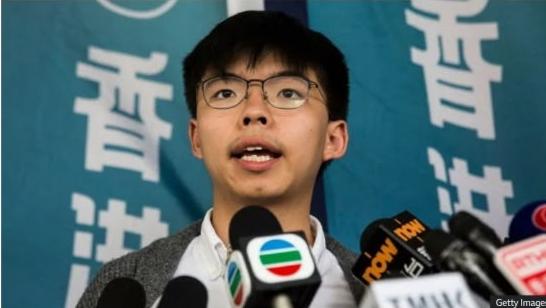
Hong Kong’s pro-democracy movement has suffered another major setback as activist Joshua Wong was sentenced to 10 years in prison for colluding with foreign forces, extending his incarceration despite an anticipated release in January.
The 30-year-old campaigner, who has spent the past six years behind bars, was convicted under Hong Kong’s controversial national security law imposed by Beijing in 2020 following mass pro-democracy protests against China’s growing control of the territory.
Wong’s latest sentence means he will remain in prison for another decade, with only two months and two days of the 10-year term running concurrently with his existing sentence, according to the court.
The sentencing followed his guilty plea in September to charges arising from alleged efforts to lobby foreign governments for sanctions and blockades against Beijing between July and November 2020.
Prosecutors said Wong conspired with fellow campaigners, including exiled activist Nathan Law, in the activities. The two were co-founders of Demosisto, a pro-democracy political party that disbanded in 2020.
Wong’s imprisonment has drawn renewed criticism from rights groups, who view the national security law as an instrument for suppressing political opposition.
Human Rights Watch described the sentence as “cruel and unjust”, while its Asia director, Elaine Pearson, alleged that authorities were stacking charges against prominent pro-democracy figures to keep Hong Kong’s society subdued and limit international reaction.
Wong’s friend and fellow activist Frances Hui, who is now based in the United States, said the ruling was part of a broader effort to erase the contributions of a generation that sought to shape Hong Kong’s future.
“Today’s sentencing is not just about Joshua,” Hui told the BBC, describing the verdict as heartbreaking and outrageous.
Hong Kong authorities, however, maintain that the national security law is necessary to preserve stability, rejecting claims that it has undermined the territory’s autonomy.
Wong’s activism began in his teenage years. At 14, he co-founded Scholarism, a student movement that mobilised more than 100,000 people in 2012 against plans to introduce mandatory patriotic education in schools, forcing the authorities to retreat.
He later emerged as a leading figure in the 2014 Umbrella Movement and co-founded Demosisto in 2016 with Law and Agnes Chow.
Despite his prominence, Wong had resisted being described as the leader of the movement, saying in 2019 that it operated through a broad network of facilitators rather than a top-down command structure.
His legal troubles intensified after the 2019 protests. He was jailed over protest-related offences and later became one of 47 activists charged with conspiracy to commit subversion in 2021, in what became the largest prosecution under the national security law.
The latest sentence against Wong follows the 20-year imprisonment of former media tycoon Jimmy Lai for colluding with foreign forces, the harshest punishment imposed under the controversial legislation so far.
Wong’s case has become a defining example of the confrontation between Hong Kong’s pro-democracy movement and authorities seeking to enforce Beijing’s national security framework.
Source: BBC