
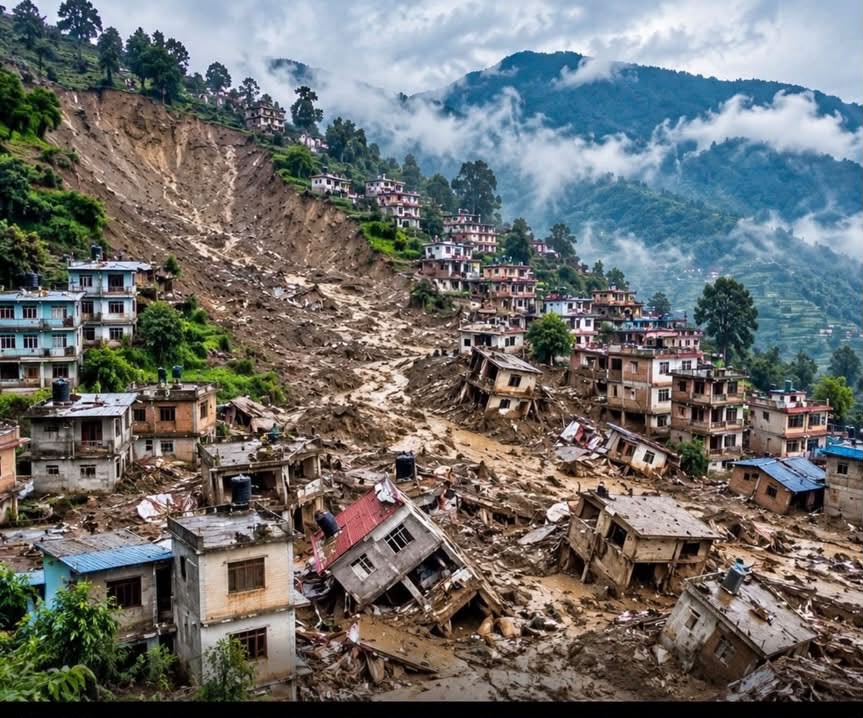
The devastation unfolding along Nepal’s border with Tibet is offering a grim demonstration of how climate change can transform the world’s highest mountains into sources of cascading danger, with glaciers, rock slopes and rivers combining to produce disasters capable of overwhelming communities and critical infrastructure within minutes.
What began with a glacier collapse on August 26 developed into a catastrophic chain of rock, ice, water and debris that swept through Himalayan valleys, destroying homes, roads, bridges and hydropower facilities. The disaster has since claimed more than 1,300 lives in Nepal, while thousands remain missing, according to the latest report by USA TODAY News.
The scale of the destruction has reinforced concerns among scientists that warming temperatures are altering the stability of mountain environments. In a region where communities and major infrastructure are concentrated along narrow valleys, the collapse of ice and rock high above can rapidly become a humanitarian emergency far downstream.
The United States Geological Survey has also helped clarify the nature of the event. What was initially interpreted as possible earthquake activity was later identified as a seismic signal generated by the landslide itself, which registered at magnitude 5.2. Satellite observations showed a substantial section of glacier breaking away at about 5,200 metres before plunging into the valley and gathering rock and sediment. (Al Jazeera)
The consequences demonstrate what scientists describe as a hazard cascade — one natural process triggering another. A collapse of ice and rock can obstruct a river, create a temporary lake or dam, and then unleash a sudden surge when the barrier fails. The resulting flood can carry enormous quantities of mud and debris into settlements and infrastructure with little warning.
That vulnerability is particularly significant because Himalayan valleys are increasingly important corridors for roads, tourism, hydropower and cross-border commerce. At least 12 hydropower projects were severely affected in Nepal, with hundreds of workers feared trapped in tunnels during the disaster. (AP News)
The warning, therefore, extends well beyond Nepal. Mountain regions across the world depend on glaciers and frozen terrain for water supplies while also hosting communities, transport networks, dams and power installations. As temperatures rise, changes in the cryosphere can create new combinations of hazards that conventional flood or landslide planning may not adequately anticipate.
The disaster has consequently renewed calls for stronger mountain monitoring, multi-hazard early-warning systems and greater investment in disaster preparedness. It also underscores the importance of reducing greenhouse-gas emissions, even as vulnerable countries strengthen their ability to cope with climate-related risks that are already unfolding.
The human cost is still being counted. But the larger lesson is becoming increasingly difficult to ignore: the consequences of a warming planet are not confined to hotter temperatures or rising seas. They can also alter the physical stability of mountains, turning remote changes in glaciers and frozen terrain into deadly threats for people living many kilometres away.