South Korea has urged Nigeria to rethink its economic relationship with the Asian country by moving away from dependence on crude oil exports and imported finished products towards manufacturing, technology development and local production.
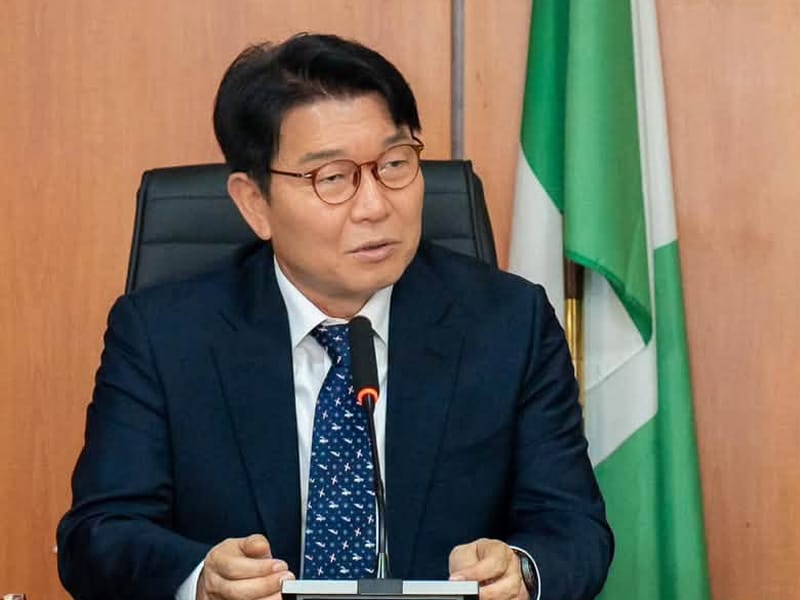
The Korean Ambassador to Nigeria, Jeong Yo-an, said both countries stood to gain more from their relationship if cooperation focused on building industries, transferring technical knowledge and creating jobs within Nigeria.
Speaking during a press briefing in Abuja on Wednesday, the ambassador said trade between the two countries was worth approximately $1.1 billion last year but argued that the existing arrangement, in which Nigeria mainly exports oil and gas while importing Korean vehicles, electronics and machinery, was not enough to unlock their economic potential.
He said South Korea wanted to see more products carrying the ‘Made in Nigeria’ identity, with opportunities for local assembly plants, agricultural equipment manufacturing, digital innovation and maritime development.
Yo-an also called on the Nigerian government to address policy uncertainties affecting foreign investors, particularly in taxation, customs administration and foreign exchange regulations. He identified the need to ratify the double taxation agreement signed by both countries in 2006, saying its implementation would help strengthen investor confidence.
He noted that several Korean companies had maintained business operations in Nigeria over the years. Among them are Daewoo Engineering and Construction, which has participated in major projects such as the Nigeria LNG Train Seven development and the Indorama fertiliser plant.
Other Korean brands, including Samsung, LG, Hyundai and Solpia, also have business relationships with Nigerian partners across manufacturing, energy, clean water and digital technology.
The ambassador encouraged Nigerian businesses to explore opportunities through the Korea Trade-Investment Promotion Agency (KOTRA) office in Lagos, which connects Korean investors with local businesses and helps Nigerian companies identify opportunities in the Korean market.
He also pointed to the cosmetics and beauty sector as an area with considerable commercial potential, given the growing demand for Korean skincare products in Nigeria. Korean manufacturers are expected to participate in the Beauty West Africa exhibition scheduled for November 13, providing an opportunity for Nigerian distributors and business owners to establish direct partnerships.
Beyond commercial activities, Yo-an said education, skills development and entrepreneurship would play important roles in strengthening relations between the two countries.
He explained that South Korea’s own transformation from a country devastated by war in 1953 into a major industrial and technological economy showed what could be achieved through long-term planning and investment in human capital.
However, he cautioned that Nigeria should not attempt to reproduce Korea’s development experience word for word, insisting that any lessons borrowed must reflect the country’s peculiar economic and social realities.
According to him, approximately 2,000 Nigerian government officials have benefited from training programmes in South Korea through the Korea International Cooperation Agency (KOICA).
He also disclosed that KOICA’s Smart School project, implemented alongside the Universal Basic Education Commission, had reached about 8,000 pupils and provided training for more than 300 teachers and school administrators.
Another initiative highlighted was the Abuja Centre for Entrepreneurship, developed through a partnership involving KOICA, the Small and Medium Enterprises Development Agency of Nigeria and the United Nations Development Programme.
The centre, whose groundbreaking ceremony took place in September, is expected to support young Nigerians with business training, mentorship and access to investment opportunities.
Yo-an stressed that the project was not simply about constructing a facility but creating an environment where young entrepreneurs could develop sustainable businesses and connect with investors, markets and private-sector organisations.
He said Nigerian institutions would eventually take charge of its operations, while local trainers would receive the necessary skills to continue supporting entrepreneurs after the Korean assistance programme ends.
Agriculture was also identified as a major area for cooperation, with KOICA and the Food and Agriculture Organisation working on initiatives aimed at creating green employment opportunities for Nigerian youths.
In the technology sector, the ambassador recalled the establishment of the Nigeria-Korea Information Access Centre in Abuja in 2025, an initiative designed to improve digital literacy and provide access to technological resources.
He added that scholarship opportunities, including the Global Korea Scholarship programme and postgraduate fellowships, would continue to support Nigerians seeking advanced education in information technology, public administration, healthcare and other fields.
The ambassador said future partnerships would also target emerging areas such as artificial intelligence, digital content creation and technology-driven businesses, with greater participation from private companies, start-ups and young innovators.
On diplomatic relations, Yo-an described the partnership between Nigeria and South Korea as increasingly important, pointing to the 2024 Korea-Africa Summit in Seoul and the Korea-Africa Foreign Ministers’ Meeting held in June 2026 as significant developments.
He recalled that Nigeria’s Foreign Affairs Minister, Bianca Odumegwu-Ojukwu, represented the country at the meeting, where Nigeria reiterated its preference for partnerships built around shared economic benefits rather than dependence on foreign assistance.
He welcomed Nigeria’s offer to host the seventh session of the Nigeria-Korea Joint Commission in Abuja and acknowledged the contribution of the National Assembly’s Nigeria-Korea Parliamentary Friendship Group.
South Korea, he added, was also pursuing wider economic engagement with Africa, including commitments to increase its Official Development Assistance to $10 billion by 2030 and provide $14 billion in export financing to support Korean companies operating across the continent.
The country is also planning to host another Korea-Africa Summit in 2029.
Meanwhile, cultural exchanges have continued to strengthen ties between both nations. The ambassador disclosed that more than 300,000 people had participated in activities organised by the Korean Cultural Centre Nigeria since its establishment.
He cited the participation of about 1,000 people in this year’s Korean Film Festival and more than 400 young Nigerians at the K-pop Festival in Lagos. The 14th Korean Ambassador’s Cup Taekwondo Championship in Abuja also attracted approximately 350 athletes.
He expressed interest in expanding cultural cooperation to include joint film productions, music collaborations and opportunities for Nigerian creatives to work with their Korean counterparts.
The ambassador further disclosed plans to support Nigerian journalists seeking opportunities to visit South Korea through international media exchange programmes. He also said the Korean Cultural Centre’s partnership with African Independent Television, which has featured Korean dramas and animations since 2023, was expected to resume next year.
Yo-an said the embassy would work towards taking more cultural and educational programmes beyond Abuja, particularly to universities and communities where young people have limited access to such opportunities.
He specifically highlighted Taekwondo as a means of teaching discipline, perseverance and respect, adding that the embassy hoped to revive training programmes for children in disadvantaged communities and schools for pupils with special needs.
The ambassador, who disclosed that he spent 36 years in the military before joining the diplomatic service, said he intended to make practical achievements and the fulfilment of commitments central to his work in Nigeria.
He maintained that the ultimate goal of the partnership was to create employment opportunities, strengthen local enterprises and improve living standards through cooperation that delivers tangible benefits to citizens of both countries.