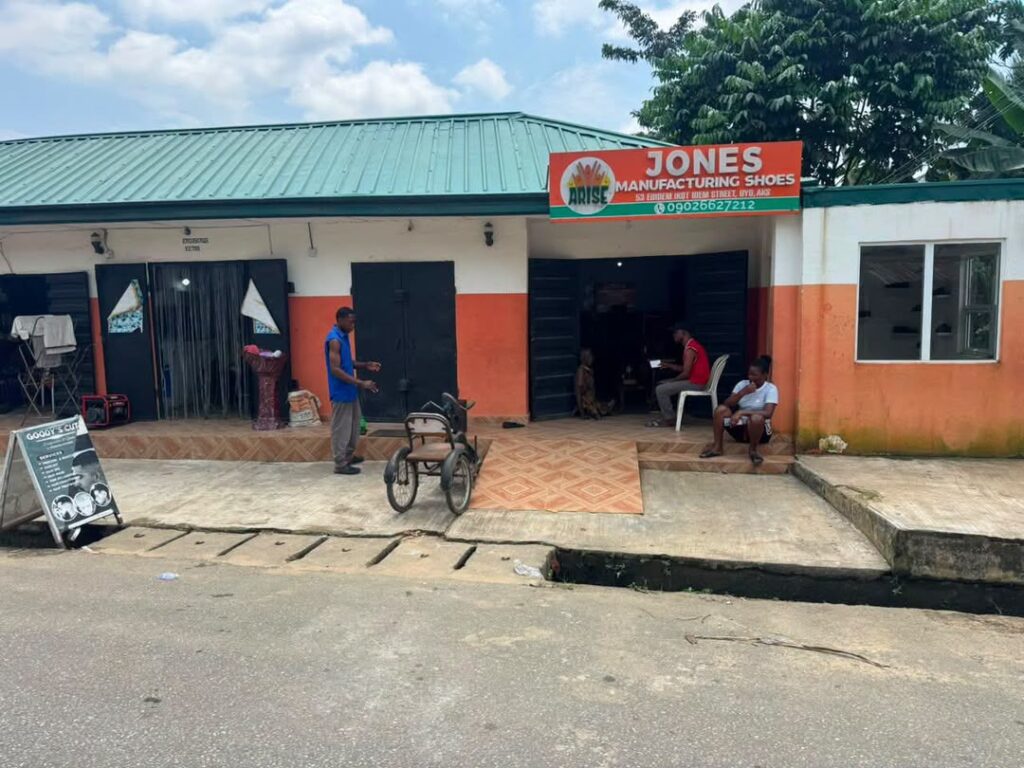
A pair of handmade shoes brought Jones Okon Akpan, a shoemaker with physical disability into the spotlight at Government House, Uyo, in May 2024. The shoemaker, who runs Jones Shoes Manufacturing facility at 53 Edidem Ikotidem Street, off Urua Ekpa road and hails from Ibiaku Itam in Itu Local Government Area, presented one of his products to Governor Umo Eno during the presentation of grants to entrepreneurs who had completed training under the Ibom Leadership and Entrepreneurial Development Centre (Ibom-LED). The encounter became a turning point in the public story of a craftsman with mobility disability whose livelihood was built on skill, persistence and the determination to grow his business.
Akpan was among the beneficiaries of the state’s Entrepreneurship Accelerator Programme, through which hundreds of entrepreneurs received business grants after completing training. Governor Umo Eno, touched by the physically challenged condition of Mr Jones Akpan and driven by compassion approved an additional ₦1 million in support of his shoes manufacturing business alongside a directive for the provision of suitable mobility assistance. The intervention connected business funding with a practical need that affected Akpan’s everyday movement and work.
For Akpan, shoemaking is more than a means of earning an income. It is a specialised craft that requires an understanding of materials, design, finishing and the demands of customers. In my recent visit to his workshop, I saw shelves of footwear, workbenches and shoemaking equipment, reflecting a business rooted in production rather than resale. The enterprise carries the potential to serve customers who value locally made footwear and to demonstrate the capacity of Nigerian artisans to produce shoes for a competitive export market.
The significance of Governor Eno’s intervention lies in the combination of financial support and mobility assistance. A grant can provide working capital for materials, tools and business operations, while suitable mobility can help a person with a physical disability move with greater independence. For an artisan whose work requires access to a workshop, suppliers and customers, both forms of support can make a practical difference to daily business activity.
The assistance also fits into the wider purpose of Ibom-LED, established to develop entrepreneurial capacity and help small businesses grow. Its training programmes cover areas such as business development, record-keeping, marketing and product development. By pairing business education with financial support, the programme seeks to equip entrepreneurs with more than the technical ability to make a product: it also addresses the management skills required to sustain an enterprise.
Governor Eno has also spoken about using local entrepreneurs to meet some of the state’s procurement needs. In 2024, his administration highlighted plans for businesses trained through Ibom-LED’s shoemaking and fashion facilities to produce school footwear and uniforms for public institutions. Such arrangements can create demand for local products, give artisans access to larger orders and connect vocational skills with public-sector purchasing.
For a business such as Jones shoes Manufacturing company , access to reliable equipment, adequate working capital and a stable customer base can influence the scale and consistency of production. The workshop produces comfortable, export-quality footwears displayed along its shelves; a milestone made possible by the administration’s support as part of a programme designed to strengthen local businesses.
There is a wider economic lesson in Akpan’s experience. Small manufacturing enterprises can preserve practical skills, create livelihoods and keep more economic activity within their communities. Shoemaking, in particular, links artisans to suppliers of leather and other materials, equipment technicians, retailers and customers. When a local producer expands, the benefits can extend beyond the person who owns the workshop to others who participate in the production and distribution chain.
Akpan’s story also places the abilities of entrepreneurs with disabilities within the broad conversation about economic participation. Access to finance, appropriate equipment and mobility support can help reduce barriers that have little to do with a person’s professional competence. The central issue is not disability as a personal tragedy, but whether people with the necessary skills and determination have the resources and opportunities to develop their enterprises.
For Governor Umo Eno, the encounter with Akpan illustrated a practical dimension of the administration’s entrepreneurship programme: identifying a business owner’s potential and responding to specific obstacles that affect the ability to work. The support extended to Akpan brought together the programme’s financial component and an individual intervention tailored to his circumstances.
Jones Akpan’s journey remains a story of craft, enterprise and the value of support that responds to real needs. His work gives the story its foundation; the assistance he received provided additional resources for the business and mobility challenges he faced. Together, they offer a human account of how targeted entrepreneurship support can help local producers pursue growth while contributing to Akwa Ibom’s wider ambitions for small-business development.