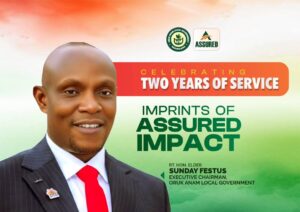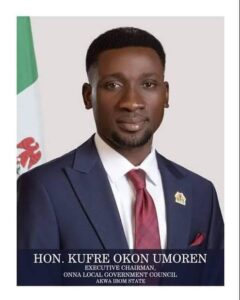
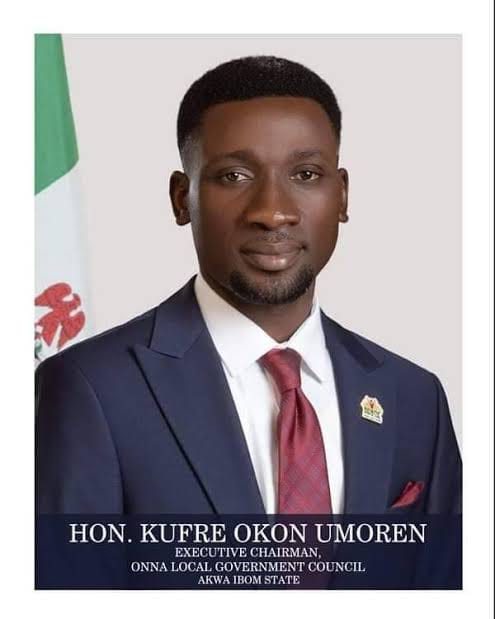
From road rehabilitation and electricity projects to healthcare, education, water supply and youth empowerment, the administration of the Executive Chairman of ONNA Local Government Council, Hon. Kufre Umoren, has recorded interventions across several sectors during its first two years in office.
Details of the projects and programmes were contained in information released by the chairman’s Media Unit, which highlighted interventions undertaken by the council between 2024 and 2026 across infrastructure, human capital development, social welfare and community empowerment.
One of the major infrastructure initiatives is the ongoing construction of a Smart Executive Council building, alongside the award of a contract for internal roads within the ONNA Local Government Secretariat.
The administration has also embarked on extensive grading and rehabilitation of roads across the local government area. The routes listed include Idim Ndid–Okat, Ususu–Ikot Akpet, Ikot Obong–Ikot Ese Ishiet, Itabana–Ikot Ebekpo, Ewa Eto–Ikot Ebiding, Ekpene–Ikot Ibo Ebon, Cammon Street–Ikot Iko Ebon and Ikot Ndidot–Ikot Udo, among others.
Electricity has equally featured in the council’s interventions, with 500KVA transformers provided for Afaha Ubium and Ikot Esse Ishiet communities, while a similar project has been awarded for Ukpana.
At Ikot Mbong, electricity was recently restored after more than three years following the installation of a new power substation facilitated by the council chairman.
Umoren said the return of electricity would help revive economic activities in the community, particularly for barbers, welders, hairdressers and other small businesses that depend on regular power supply.
In healthcare, the administration sponsored the treatment of cancer patients at Uwa General Hospital and organised a three-day free medical outreach and surgical intervention which, according to the Media Unit, benefited more than 2,000 residents.
The council also procured essential drugs and medical supplies for Primary Healthcare Centres across ONNA, approved the construction of a modern health centre at Afaha Ubium and provided wheelchairs for persons with disabilities.
Education has received considerable attention through a combination of financial support, academic incentives and access programmes.
Among the interventions listed are ₦250,000 grants to ONNA Law School graduates and ₦500,000 each to first-class graduates of Akwa Ibom State University from the area.
The administration also facilitated bursary payments for ONNA indigenes studying in tertiary institutions across Nigeria and provided scholarships and educational grants to more than 20 students pursuing Master’s and PhD programmes.
One of the beneficiaries, Mr Charles Samba, a PhD student of Chemical Engineering at the Federal University of Technology, Owerri, received a ₦1.5 million educational grant.
The council also supported more than 500 JAMB registrations, provided free tutorials and CBT training for prospective university students, distributed sanitary pads to girls in secondary schools and implemented a Back-to-School programme involving school uniforms, bags and learning materials for primary school pupils.
Water infrastructure has also been rehabilitated in Awa Ndon, Ndon Eyo, Ikot Akpatek and Ikot Ese Ishiet, with the projects involving elevated tanks, solar pumping facilities and distribution systems.
Beyond physical infrastructure, the administration’s record includes several youth empowerment and employment initiatives.
According to the Media Unit, 16 ONNA youths were trained in the oil and gas sector, with beneficiaries subsequently securing employment in companies operating in the area. Another 20 indigent youths were facilitated into jobs with a private security company.
Five youths were also provided with mini-buses for the ONNA subsidised transport scheme, while 10 small-scale business owners received ₦100,000 grants each.
Other interventions include snail-farming training and starter packs and a ₦700,000 grant to Miss Mkpoikanna Etukudo Ibanga, an emerging music artiste, towards her debut album.
The administration has also introduced welfare measures targeting traditional institutions and community leadership. The Media Unit listed monthly subventions for Village Heads, ₦10,000 monthly stipends for the 42 Village Youth Presidents and stipends for Town Criers.
More than 120 ONNA indigenes have also reportedly been appointed as Special Assistants, Personal Assistants and board members in various agencies, committees and other positions.
In the area of social intervention, the council constructed an ARISE Home for a vulnerable woman and her five children in Ukpana Community.
The administration’s institutional development agenda includes the construction of an ultra-modern Executive Council Chamber, a stores block at the Secretariat and the provision of official vehicles for the Council Leader and Secretary.
Sports has also provided another platform for ONNA’s community engagement. The local government participated in the Akwa Ibom State Sports Festival, where its athletes won gold medals in swimming, athletics, volleyball, football and taekwondo.
The ONNA football team reportedly won gold after defeating Team Etinan in the final, while the local government emerged as the best-performing council in Eket Senatorial District and sixth overall in the state.
The council’s community programmes have also included annual Christmas activities, featuring a children’s Christmas party for primary school pupils, distribution of hampers and rice to stakeholders and community groups, as well as ONNA Day as part of the Christmas Unplugged programme.
Taken together, the projects and interventions listed by the Media Unit point to an administration that has spread its attention across physical infrastructure, human capital development, social welfare and economic empowerment.
The record, however, goes beyond the number of projects executed. Its longer-term significance will depend on how effectively the infrastructure is maintained, how many beneficiaries are able to sustain the opportunities created for them and whether interventions in roads, electricity, water, healthcare and education continue to deliver tangible benefits to communities across ONNA.
For an administration approaching the end of its current two-year record under review, the emerging picture is that of a council agenda that has sought to combine infrastructure delivery with direct interventions targeted at residents, businesses, students, youths, vulnerable groups and community institutions.