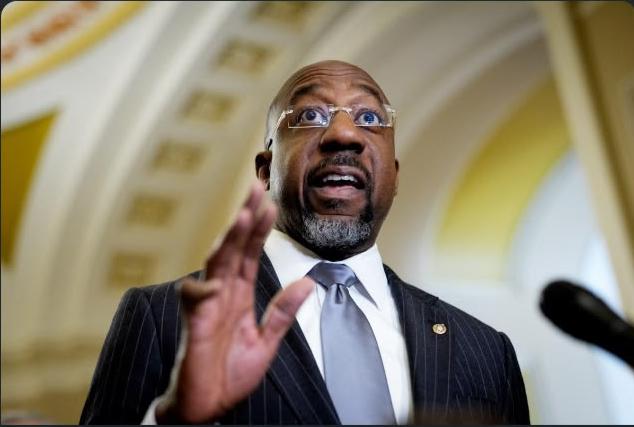
U.S. Senator Raphael Warnock has challenged Democrats to pursue investigations into President Donald Trump’s administration while making the rising cost of living a central priority if the party regains control of the House of Representatives in November’s midterm elections.
Warnock, a Georgia Democrat, argued that investigating alleged corruption and addressing economic hardship were not competing objectives, rejecting warnings that an investigations-led agenda could undermine the party’s electoral prospects.
Speaking on NBC’s Meet the Press on Sunday, Warnock called for accountability across the Trump administration but stopped short of explicitly endorsing a third impeachment of the president.
“We ought to have the investigations to get to the truth behind the most corrupt administration in American history,” he said, insisting that Democrats could pursue accountability while responding to voters’ economic concerns.
His position puts him at odds with former Senator Joe Manchin, who warned that prioritising investigations after the midterms could damage Democratic prospects in the 2028 presidential election.
Manchin, who left the Democratic Party and became an independent, argued in an interview with CNN on Saturday that Democrats would risk appearing more interested in political retaliation than improving the lives of Americans if they made investigations their first order of business.
Warnock, however, maintained that the party must confront both economic pressures and alleged wrongdoing, linking the administration’s policies to the financial difficulties experienced by ordinary Americans.
“The American people are watching themselves get poorer and poorer while Donald Trump, his family, his friends, are getting richer and richer,” he said.
He identified ending the war, stopping tariffs and fixing healthcare as priorities Democrats should pursue alongside investigations, arguing that economic relief and government accountability should form part of the same political programme.
The disagreement reflects a broader debate within the Democratic Party over how to exercise congressional power if voters give it control of the House in November.
Some Democrats fear that another impeachment drive could overshadow policy proposals and allow Republicans to portray the opposition as focused on removing Trump rather than addressing everyday concerns.
Former Obama White House chief of staff Rahm Emanuel has argued against another impeachment, saying it would likely become a political confrontation without producing a meaningful outcome. He has instead advocated investigations that could inform ethics legislation.
Other Democratic politicians have also rejected another impeachment, while some have indicated that the option should remain open.
House Democratic Leader Hakeem Jeffries has declined to rule impeachment either in or out, maintaining that any decision should follow a thorough investigation and be guided by evidence, the law and the Constitution.
The question is particularly significant because Democrats would need to win control of the House to advance an impeachment effort. Although a simple majority in the House can impeach a president, conviction and removal require a two-thirds majority of senators present at trial.
Trump has already been impeached twice. The first impeachment, in 2019, centred on his dealings with Ukraine, while the second, in January 2021, followed the attack on the U.S. Capitol and accused him of inciting insurrection. The Senate acquitted him in both cases.
Beyond the investigations debate, Warnock urged Democrats to invest more heavily in Southern states, arguing that the region could determine whether the party secures majorities in both chambers of Congress.
He cited his campaign activities in North Carolina, South Carolina, Georgia and Mississippi as part of his effort to demonstrate the electoral opportunities available to Democrats in the region.
“The road to a Democratic majority in both houses of Congress is in the South,” Warnock said, warning that the party could miss significant opportunities if it failed to maintain a sustained presence in the region.
With the midterm elections approaching, Warnock’s position presents Democrats with a two-track strategy: investigate alleged abuses of power while offering voters concrete responses to economic pressures. Whether the party can balance those objectives without allowing one to overwhelm the other remains a central question in its contest for congressional control.
Source: Based on a report by Steve Mollman published by Newsweek on October 18, 2026.