Lawyers, accountants, auditors, real estate agents and corporate service providers have been identified as critical channels through which illicit financial flows (IFFs) are moved, concealed and laundered out of Africa, with Nigeria particularly exposed to the damaging practice.
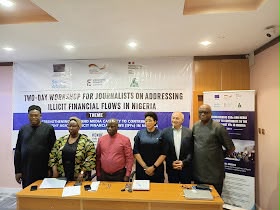
Professor Abdullahi Shehu, a financial crime expert, raised the concern in Uyo at the weekend while presenting a paper, “Typology and Development Impacts of Illicit Financial Flows,” at a two-day capacity-building workshop organised by SecFin Africa in partnership with the Africa Network for Environmental and Economic Justice (ANEEJ) for civil society organisations (CSOs) and media practitioners.
The workshop, titled “Strengthening CSOs and Media Capacity to Contribute to the Fight Against Illicit Financial Flows (IFFs),” was designed to equip participants with practical knowledge and tools to monitor, investigate and advocate against illicit financial flows in Nigeria and across Africa.
Shehu said the fight against illicit financial flows could not be won by focusing exclusively on the individuals who generate or steal the money, stressing that attention must also be paid to the professional and corporate structures that make it possible to conceal, transfer and retain illicit wealth.
According to him, accountants and audit firms, lawyers and notaries, real estate agencies, tax advisers as well as trust and corporate service providers could serve as intermediaries in the movement of illicit funds.
He identified what he described as three major patterns of illicit financial flows from Africa, including situations where corrupt actors rely on foreign enablers, foreign jurisdictions sell financial secrecy, and professional intermediaries provide corporate services through third countries.
The expert’s warning comes against the backdrop of the huge financial losses associated with IFFs on the continent.
He said Africa loses about $50 billion annually through illicit financial flows, according to estimates by the United Nations Economic Commission for Africa and the African Union’s Mbeki Panel, adding that Nigeria alone accounts for about 20 per cent of the estimated loss.
Shehu noted that other research had put Nigeria’s annual IFF losses as high as $17.8 billion, underscoring the scale of resources potentially being removed from productive economic activities.
He explained that illicit financial flows were not limited to money that originated from criminal activities, noting that funds legally earned could also become illicit when illegally transferred, owned or utilised.
The distinction, he said, was important in understanding why tackling IFFs required a broader approach than conventional money-laundering investigations.
Shehu identified trade mis-invoicing as one of the major mechanisms, citing under-invoicing of exports, including crude oil, over-invoicing of imports, multiple invoicing, false description of goods and manipulation of quantity and quality.
He also identified tax evasion and profit shifting, including concealment of taxable income, undeclared offshore accounts, falsification of company records, artificial transfer pricing, excessive management fees and manipulated interest on related-party loans.
The oil and gas industry, telecommunications, manufacturing and extractive sectors, he said, were among areas vulnerable to such practices.
Shehu further linked IFFs to public sector corruption, identifying inflated contracts, ghost projects, payments for unexecuted projects, bid-rigging, bribery, kickbacks and diversion of state assets as major avenues through which public resources could be lost.
In the extractive sector, he cited crude oil theft, production under-reporting, concealment of actual sales and abuses in the allocation of licences and concessions.
He said the criminal economy also generated illicit funds through cybercrime, trafficking, smuggling, kidnapping and extortion, with banking channels, shell companies, real estate and offshore financial centres subsequently used to move or conceal the proceeds.
Shehu stressed that the consequences ultimately reached ordinary Nigerians, as resources lost through IFFs could otherwise be deployed to finance education, healthcare, infrastructure and social protection.
He said the losses also contributed to capital flight, reduced domestic savings, increased pressure on foreign exchange and currency instability, while weakening government institutions and investor confidence.
To reverse the trend, Shehu called for stronger beneficial ownership transparency, urging authorities to ensure that companies disclose their true owners and that information provided in beneficial ownership registers was properly verified.
He also advocated the use of artificial intelligence and data analytics to identify unusual transactions, integration of government databases and stronger monitoring of cross-border financial movements.
The professor called for improved international cooperation in tracing and recovering assets moved abroad, stressing the need for effective information-sharing arrangements with foreign law enforcement agencies.
He urged stronger protection for whistle-blowers and investigative journalists, arguing that the media and CSOs remained important actors in exposing financial irregularities and promoting accountability.
Shehu said combating IFFs was ultimately a collective responsibility requiring stronger institutions, effective prosecution, transparent public finance systems and international cooperation.
He added that the success of the fight should not be measured only by the number of financial crime cases investigated or prosecuted, but also by the extent to which resources were recovered and redirected towards national development.