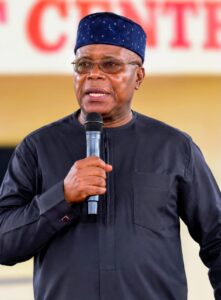

Dr. Arnold Benjamin Udoka belongs to the distinguished generation of Nigerian cultural practitioners who transformed dance from a largely communal and traditional form of expression into a sophisticated field of professional performance, scholarship and national cultural representation.
A dancer, choreographer, playwright, scholar, theatre practitioner and cultural administrator, Udoka has devoted more than four decades to the study, performance, teaching and development of dance in Nigeria. His career has taken him from the villages of Akwa Ibom to the stages of national and international cultural festivals, universities, the National Troupe of Nigeria and some of the most important ceremonial events in the country’s modern history.
Born on August 14, 1958, at Obio Ndot in Oruk Anam Local Government Area, his early education was largely in Abak. He attended Government School, Abak, Bishop Clarke’s Central School, Abak, St. Mary’s Practising School, Ediene, Abak, Queen of Apostles Seminary, Afaha Obong, and later Nigerian Christian Secondary School, Ukpom, from where he completed his secondary education in 1976.
He proceeded to the University of Calabar, where he studied Theatre Arts from 1978 to 1982. Even as a student, however, dance was already becoming central to his professional identity.
Between 1979 and 1981, he served as a Student Demonstrator in Dance in the Department of Theatre Arts, University of Calabar, combining academic training with practical performance and instruction.His early professional experiences also included work as a part-time programmes presenter with Cross River Radio and, during his National Youth Service, as a Producer/Director with the Nigerian Television Authority, Channel 10, Maiduguri, from 1982 to 1983.
But it was his determination to deepen his knowledge of movement and choreography that eventually took his career beyond Nigeria.
Between 1985 and 1987, Udoka studied Dance Studies at the Laban Centre for Movement and Dance, University of London Goldsmiths’ College, specialising in areas including choreography, sociology of dance and dance history. He subsequently taught and worked professionally in Britain, including as a sessional dance teacher and choreographer at the Laban Centre and with other cultural and educational institutions.
His return to Nigeria marked the beginning of a career in which scholarship and performance became inseparable.
At the University of Calabar, he progressed from Graduate Assistant to Assistant Lecturer and subsequently Lecturer, helping to train generations of students in theatre and dance.At the same time, his reputation as a choreographer continued to grow.
One of the earliest indications of his extraordinary creative promise had come much earlier. In 1974, while still a teenager, he created Oyoyo for the Nigerian Christian Secondary School Dramatic Society, Abak. He created works including Ndem Mmong, Ikpafag, We, The Dead, Awake, Aware and Alive, Song of the Sea, and Abaikpa Idehhe Akan Iba.
His work at the National Festival of Arts and Culture (NAFEST) became particularly important to his reputation.
Over the years, Udoka accumulated a remarkable collection of NAFEST honours, including Gold, Silver and Bronze Gong awards in different dance and dance-drama categories. Academic literature on Nigerian dance documents his multiple NAFEST awards and identifies his work as part of the development of dance as an independent professional art form in Nigeria.His 1988 work Abakpa Idehhe Akan Iba, created for Akwa Ibom State, won the Silver Gong at NAFEST ’88, further establishing him as one of the state’s leading cultural ambassadors.
Udoka’s contribution, however, was never confined to the representation of Akwa Ibom.
He became increasingly involved in using dance to communicate ideas about Nigerian identity, unity, history and social development.His philosophy of dance has consistently drawn from Nigeria’s cultural diversity. In his scholarly and professional work, he has treated indigenous dance as a repository of history, philosophy, identity and collective memory.This approach became particularly evident in his work for the National Troupe of Nigeria, where he rose to become Director of Dance and later held senior responsibilities within the organisation.
His professional association with the National Troupe dates back to the early years of the organisation, and records identify him as one of the senior figures responsible for its dance arm.His national assignments have been extensive.
Udoka was involved in major cultural and ceremonial productions including the 1995 African Youths Football Championship Opening Ceremony, the ECOWAS Festival of Culture, the gala performance during President Bill Clinton’s visit to Nigeria in 2000, the Black Heritage Festival in Lagos, the commissioning of the National Stadium, Abuja, and the 8th All-Africa Games Opening and Closing Ceremonies in Abuja in 2003.
He also choreographed for the Commonwealth Heads of Government Meeting in Abuja, among other major national events.
One of the most significant international chapters of his career came with PANAFEST in Ghana in 1997.His dance drama One Earth, One People, created for Nigeria’s participation at the festival, was adjudged the best Nigerian entry and became an important demonstration of the capacity of Nigerian choreography to communicate national identity on an international cultural platform. The production involved 75 artistes drawn from nine State Arts Councils working with National Troupe dancers.
His stature in the Nigerian dance world was such that Professor Laz Ekwueme publicly nicknamed him “Nigeria’s Dance Machine.” He has also been described in professional and media profiles as one of Africa’s foremost dance artists, choreographers and scholars.
Udoka’s influence extends beyond performance into the intellectual study of dance.
He has written and published on dance, theatre, culture and Nigerian identity, arguing for the recognition of dance as a serious artistic and scholarly discipline rather than merely an appendage of theatre.
His academic work has addressed the history, philosophy, sociology and cultural significance of Nigerian dance. His scholarship has contributed to a broader understanding of dance as an instrument of cultural preservation, social communication and national integration.
He has also continued to create.
Among his works are dance dramas and productions such as Mbarra, Rainbow Over the Niger, The Renewal, Nigeriana and other choreographic works performed in Nigeria and abroad.His choreography has also been used in major theatre productions, including works such as Things Fall Apart, Blood Wedding, Salt, Oda Oak Oracle and Salome.
In later years, Udoka continued to contribute to the training of younger Nigerian performers. In 2024, for instance, he served as one of the leading facilitators at a National Troupe of Nigeria training and orientation workshop for new staff and artistes, sharing his professional experience with a new generation of performers.
His continuing relevance is also reflected in his academic work. He has remained with the University of Calabar, where he has taught and researched theatre, dance and cultural studies. His scholarly work continues to explore the place of dance in Nigerian society and the relationship between traditional cultural forms and modern performance.
For Akwa Ibom, Arnold Udoka represents something larger than individual artistic achievement.He is part of the generation that demonstrated that the cultural traditions of the state’s various communities could move from village squares and community festivals to national theatres, international cultural festivals, universities and the global stage without losing their identity.
His career has been a bridge between tradition and modernity, performance and scholarship, local culture and national identity.
As Akwa Ibom marks 39 years of statehood, our PRIDE, Dr. Arnold Benjamin Udoka stands among the state’s distinguished creative pioneers, a dancer, choreographer, playwright, scholar, teacher and cultural administrator whose life’s work has helped place Nigerian dance within the larger conversation of African and world performance.
#AkwaIbomAt39
#IbomLeadingLights
#CelebratingOurHeroesOurPrides
#39Heroes39Prides
#PrideArnoldUdoka
#The39thAnniversaryCollectives
#AkwaIbomStateMinistryOfInformation
#AriseAgenda