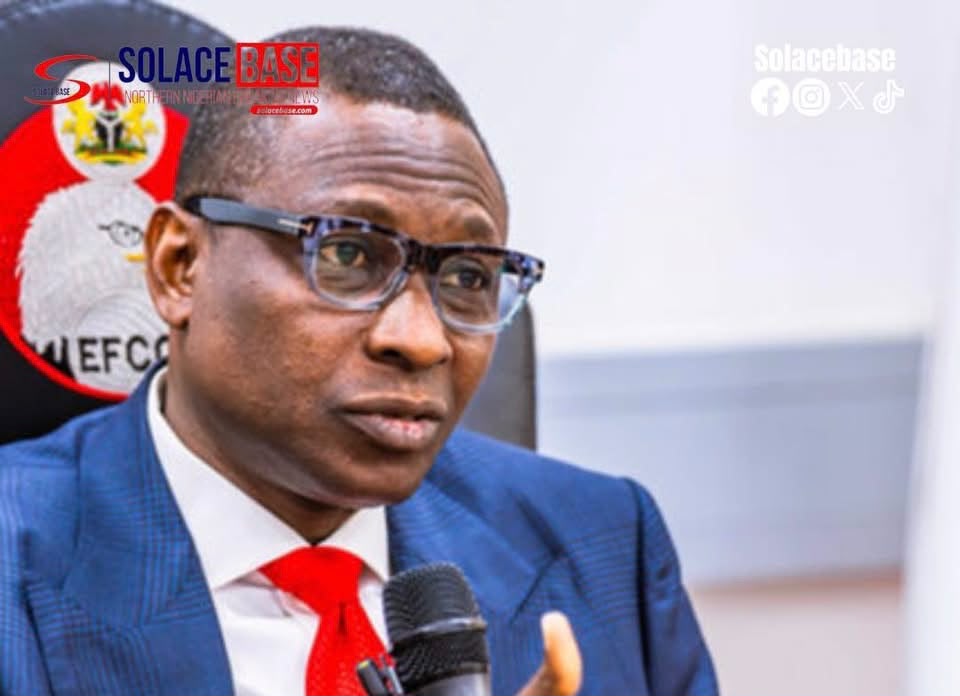
The Economic and Financial Crimes Commission, EFCC, has raised a disturbing question over whether religious titles are increasingly being used to confer moral authority on people accused or convicted of financial crimes, with its Chairman, Ola Olukoyede, revealing that the commission’s case files contain pastors, imams, bishops and sheikhs prosecuted and convicted for economic offences.
Olukoyede made the revelation on Wednesday at the 2026 Second Council Meeting of the Nigeria Inter-Religious Council, NIREC, in Abuja, where he challenged religious communities to confront the uncomfortable intersection between public displays of faith, unexplained wealth and corruption.
According to him, some individuals carrying prominent religious titles have not only been investigated and prosecuted for financial crimes but have also ended up serving prison sentences, yet continued to be addressed by their religious titles even behind bars.
“So many case files, pastor, imam indicted for financial crimes. And some of them are even badly convicted, and they are in jail,” Olukoyede said.
His concern was not limited to the conduct of individuals but extended to the power attached to religious titles, prompting him to suggest a rethink of how such titles are conferred and whether they should continue to command unquestioned reverence when the conduct of their holders comes under criminal investigation.
“And while in jail, they still refer to them as pastor and imam,” he said.
The EFCC boss said the issue had become serious enough to warrant a national conversation, arguing that genuine spirituality should be measured by conduct and integrity rather than robes, titles, public acclaim or self-identification.
“Because the spirit of God is by their fruits, not their appearance. Not what we call ourselves. It is by the fruits,” he said.
Olukoyede recalled an encounter with a suspect who arrived at the EFCC and demanded to see him while introducing himself through a string of religious titles, including reverend, doctor and bishop.
The EFCC chairman said the titles did not influence his handling of the case, stressing that religious status could neither override an investigation nor place anyone beyond the reach of the law.
“So, if you think you’re a Christian or you’re a pastor here, and you commit financial crime, I will be your enemy. I won’t be your friend,” he declared.
He also turned his scrutiny toward worship centres that celebrate spectacular wealth without questioning how such wealth was acquired, warning that religious institutions could inadvertently give social legitimacy to proceeds suspected to have been obtained through corruption.
Olukoyede cited the example of a public servant who allegedly constructed a mosque whose value far exceeded what the official could legitimately have earned over a lifetime, questioning why a religious institution would proceed to celebrate such wealth without interrogating its source.
“A public servant says he has built a mosque that is worth more than his earnings in the next 500 years. And you go there to dedicate it. You are dedicating the process of crime,” he said.
The EFCC chairman further recalled what he described as disturbing findings from investigations into a pilgrimage board during his earlier service, alleging that almost 75 per cent of funds intended for pilgrims had been stolen.
He said the revelations demonstrated why the fight against corruption could not be left exclusively to law-enforcement agencies, arguing that religious institutions possess considerable influence over the values and behaviour of millions of Nigerians.
“While EFCC can investigate conduct and prosecute fraud, faith communities can influence character and cultivate honesty to prevent crime,” he said.
Olukoyede said the central challenge was particularly significant in a country where churches and mosques remain deeply embedded in everyday life, asking whether the intensity of religious observance was being matched by corresponding standards of integrity in public and economic affairs.
“We are a deeply religious people. Our churches and mosques are full,” he said, before asking whether the depth of religious profession had sufficiently translated into integrity in public and economic life.
He stressed that financial crime did not recognise religion or ethnicity, noting that whenever public resources were stolen or misappropriated, the consequences affected Nigerians irrespective of their faith.
Olukoyede therefore urged religious leaders and communities to resist providing moral cover for unexplained wealth and to use their influence to discourage corruption rather than celebrate its proceeds.
The EFCC chairman spoke at the NIREC meeting themed “Shared Sacred Flourishing in Nigeria,” which brought the country’s major religious constituencies together around the need for peaceful coexistence and a more responsible role for faith communities in national development.
Source: This report is a fresh rewrite based on the Nigerian News Agency (NAN) report published on September 23, 2026, on Olukoyede’s remarks at the NIREC meeting.