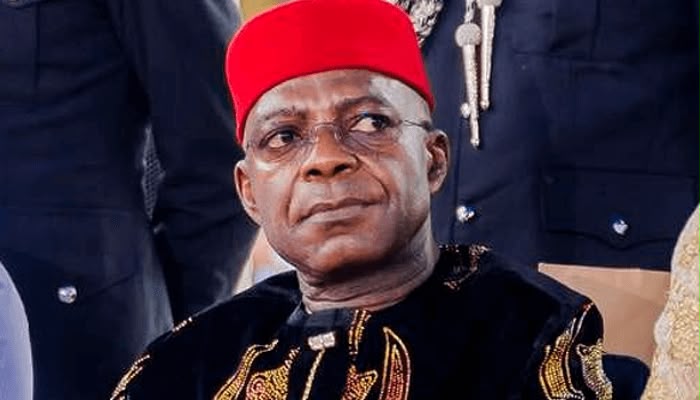
Abia State Governor, Alex Otti, says his administration is deliberately repositioning the state’s economy from dependence on conventional markets to a model driven by manufacturing, digital commerce and technology.
Otti said the shift was necessary because the future of commerce was increasingly moving away from physical stores and traditional trading centres towards technology-enabled production, marketing and delivery.
He spoke in Umuahia at the Igbo Day Lecture and Dinner organised by Ohanaeze Ndigbo Worldwide, where he argued that the transition could enable Abia entrepreneurs to serve markets far beyond Nigeria.
“We are leaving that place of trading. In Abia, we have markets; the markets are important. But we are moving from the market to manufacturing,” the governor said.
According to him, the state is combining manufacturing with digital commerce to create a new economic base in which businesses can produce locally while reaching customers globally.
Otti cited Alibaba as an example of the type of digital commercial ecosystem he envisaged for Abia, saying the state could no longer afford to rely exclusively on the conventional model of operating from physical shops and markets.
He said, “We are leaving that physical store for digital delivery. So, when somebody talked about Alibaba, that’s exactly where we are headed.”
The governor linked the strategy to the changing competitive environment facing Igbo businesses, particularly concerns over the growing participation of Chinese traders in retail markets outside the South-East.
Rather than viewing the development solely as a contest over physical trading spaces, Otti said Abia’s response should be to move its entrepreneurs into areas where technology can expand their reach and competitiveness.
“So, why are the Chinese coming to compete with us? We are moving away from there. And it’s going to start in Abia. So, Abia is both manufacturing and then trading.
“But we are moving from conventional trading to digital trading. That’s where the world is going. You either embrace it or you risk being left behind,” he said.
Otti also pointed to the state’s investment in digital skills as part of the strategy, citing the TechRise initiative through which young Abians are being trained for careers in the technology sector.
He said some beneficiaries were already working remotely for global technology companies from Aba.
“When I spend money here training my young people in digital technology under the TechRise initiative, I know what I am doing. Some of them are already working for Google and Amazon from Aba,” he said.
The governor maintained that Abia’s economic transformation would therefore depend not only on improving physical infrastructure and manufacturing capacity, but also on developing the human capital required to participate in a technology-driven global economy.
The development agenda formed part of discussions at the Igbo Day event, held on the theme, “The Igbo Charter and Development of Ala Igbo.”
In his virtual keynote address, Chairman of the Igbo Charter Committee for Strategic Engagement for National Development, Prof. Kingsley Moghalu, called for the charter to be treated as a non-partisan development framework rather than a political document.
Moghalu identified digital commerce, diaspora engagement, security, investment, promotion of the Igbo language and a shift from dependence on remittances towards productive investment as priorities for the region.
He also advocated true federalism, equitable citizenship and devolution of power, urging Ndigbo to move beyond discussions and begin implementing measurable development objectives.
The President-General of Ohanaeze Ndigbo Worldwide, Senator John Azuta-Mbata, said the event was designed to harness the collective capacity of Ndigbo around a common development strategy.
Azuta-Mbata said the Igbo Charter, developed by more than 67 technocrats and business leaders, provides a framework for engaging the Nigerian government and the international community on issues affecting the region.
He also advocated stronger protection of Igbo culture, including the teaching of the Igbo language in primary and secondary schools across the South-East, while calling on the Federal Government to seek a political solution to the continued detention of Mazi Nnamdi Kanu.
Earlier, Chairman of the occasion, Chief Onyema Ugochukwu, urged Ndigbo to replace complaints about marginalisation with deliberate efforts to build the region’s economic and institutional capacity.
“We must look forward to building a brighter future, moving beyond complaining about those who won’t give us our due, to taking our destiny in our own hands,” he said.
Otti, meanwhile, assured Ohanaeze of his administration’s support, saying the state had recovered from its past challenges and was now positioned for sustained development.
He said the “Njikọ Ka” theme of the celebration, meaning “Unity is Supreme”, underscored the need for collective action in advancing the interests of the Igbo people.
The event attracted Abia Deputy Governor, Ikechukwu Emetu; members of the National Assembly; traditional rulers; clergy; business leaders and other participants from across Igbo communities.