
A government payment can sometimes appear to be little more than a figure in a financial statement. But when it represents gratuities owed to people who spent their productive years working for the state, its significance extends far beyond the amount itself. In Akwa Ibom, the release of ₦100 billion by Governor Umo Eno for payment of inherited gratuities of retirees has given relief to thousands of families .
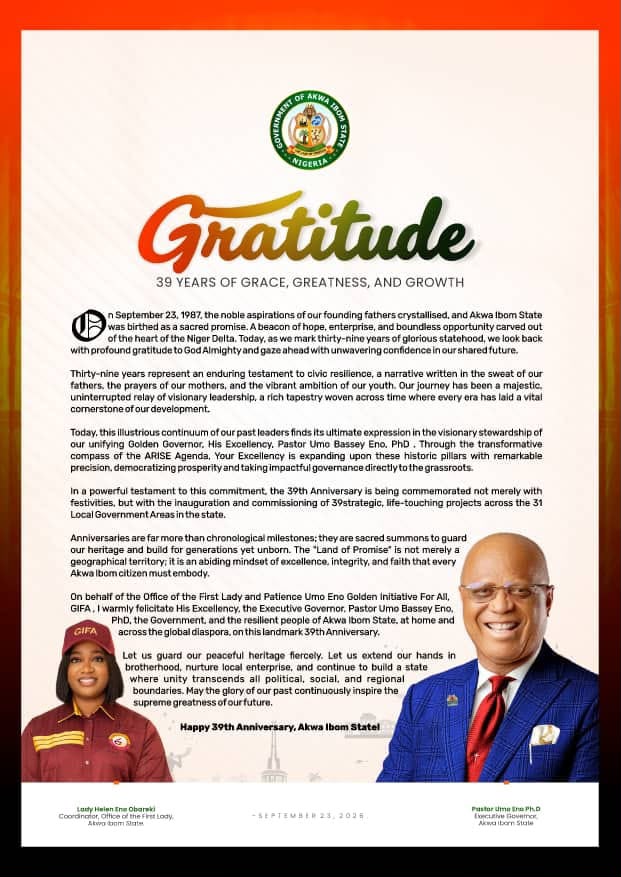
Governor Umo Eno disclosed the figure on 30 September 2026, during the flag-off of the Ibom International Market in Ikot Ekpene. According to the Governor, his administration inherited ₦111 billion in gratuities and other emoluments owed to retirees from 2012 and has released ₦100 billion towards settling the backlog, leaving ₦11 billion to be paid before the end of his first term. The figure represents a substantial reduction in an obligation that has remained outstanding for years.
For many households, gratuity is not simply an additional source of income but a financial resource that can support medical care, housing, education, food, family responsibilities and other needs that become more difficult to meet when regular employment income has ended. Paying the arrears therefore restores access to resources that recipients earned through years of public service.
The effect can also extend into the wider economy. Money received by retirees can be used to purchase goods, pay for services, settle outstanding obligations or support members of their families. In the process, funds move through local communities, reaching traders, pharmacies, transport operators, artisans, landlords and other service providers. The precise impact differs from household to household, but settling a public obligation puts purchasing power back into private hands.
There is also a social dimension to clearing the backlog. Retirement is supposed to mark the transition from active employment to a period in which workers can draw on benefits accumulated during their years of service. When gratuities remain unpaid for prolonged periods, that transition can become financially uncertain. Payment cannot erase the years of waiting, but it converts an unresolved obligation into resources that retirees can actually use.
For the state, reducing the backlog means progressively closing an inherited financial obligation. The administration’s own records show the progression: in April 2026, Governor Eno reported that more than ₦82 billion had been paid from the inherited ₦111 billion backlog, while his September anniversary address put the amount above ₦98 billion. The latest disclosure at Ikot Ekpene puts the figure at ₦100 billion, leaving ₦11 billion, according to the Governor’s account.
The importance extends to the public service itself. Teachers, health workers, administrators, engineers and other civil servants spend decades contributing to the operation of government institutions. The progressive settlement of retirement obligations gives practical expression to the principle that public service carries responsibilities beyond an employee’s final day at work. It also means that a liability attached to previous years of service is being reduced rather than continually carried forward.
The gratuity payments form part of a broader programme of economic and infrastructure investment. At the same Ikot Ekpene event, the Governor flagged off the Ibom International Market, a project planned to include 30 blocks containing 1,200 shops, as well as warehouses, cold rooms, restaurants, an abattoir, administrative facilities, water infrastructure, a police post and internal roads. Together, these initiatives reflect two dimensions of development: creating opportunities for future economic activity and meeting responsibilities owed to citizens who have already served the state.
The ₦100 billion figure is consequently best understood not simply as money released by the government, but as the movement of an accumulated public obligation into the hands of citizens who spent years serving the state. In that sense, the gratuity story forms part of the wider development story, because development is not only about what a government builds, but also about how public commitments affect the economic security of the people to whom they are owed.