There comes a point in every administration when promises must make room for evidence. The speeches have been delivered, plans have been announced and the excitement that accompanies the beginning of a new administration has gradually given way to the more demanding question of what has actually changed.
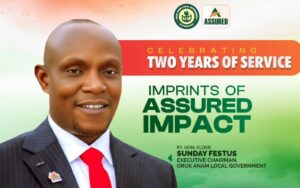
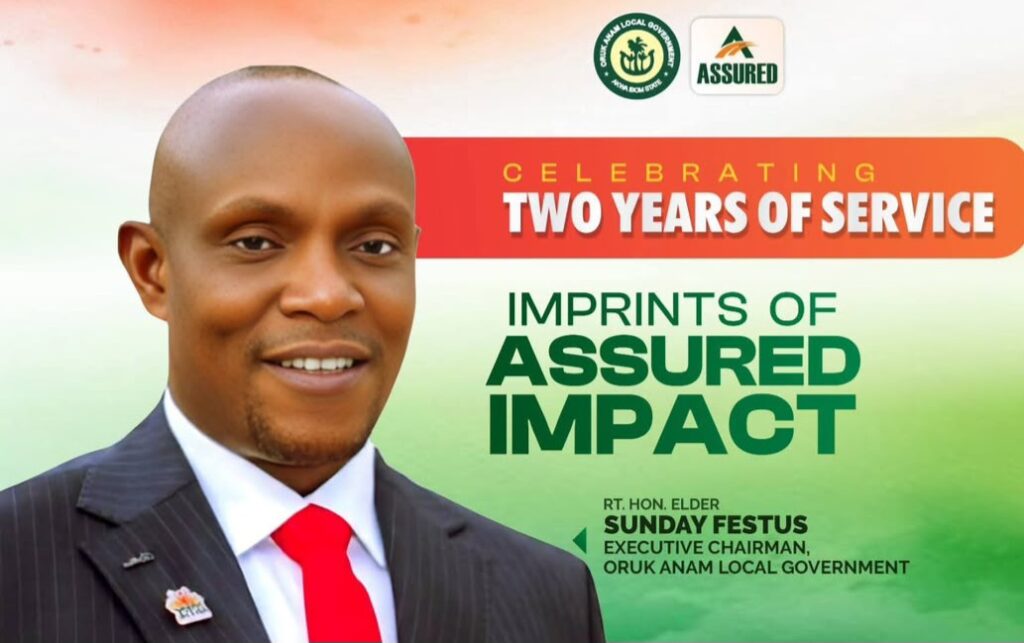
In Oruk Anam, two years into the administration of Rt. Hon. (Elder) Sunday Festus Akpan, the answer is increasingly visible across communities. It is found in roads graded to improve access, hectares brought into cultivation, students supported in their education, women assisted to grow their businesses, healthcare facilities improved, markets taking shape and basic infrastructure reaching communities that have long expected government to come closer to them.
This is the story of the ASSURED Agenda — a development framework that has sought to translate the responsibilities of local government into practical interventions across the Local Government Area.
When Akpan assumed office as Executive Chairman of Oruk Anam Local Government Council on October 7, 2024, he inherited more than an office. He inherited the familiar expectations that confront every local government administration: better roads, safer communities, stronger schools, accessible healthcare, employment opportunities, agricultural development, basic amenities and, above all, a government whose presence could be felt beyond official buildings.
His response was to organise his administration’s development vision around seven pillars: Agricultural Development, Security, Sports Development, Unity, Rural Development, Education and Digital Solutions, and Development of Human Capacity.
Two years later, the significance of ASSURED is becoming easier to understand, not because of the name itself, but because of the growing number of places where the agenda can now be seen in practical terms.
Go to Ikot Akpan Essien, for instance, and the conversation about agriculture takes on a different meaning. The ASSURED Model Farm has developed 27 hectares of land, with cucumber, tomatoes, pumpkin, pepper, watermelon and improved cassava varieties cultivated as part of an effort to demonstrate that agriculture can be approached not merely as subsistence, but as an organised economic activity with the potential to create jobs, generate revenue and strengthen food production.
The results have begun to speak for themselves. The farm has generated more than ₦28 million in revenue, while collaboration with the International Institute of Tropical Agriculture (IITA), the Akwa Ibom State Ministry of Agriculture and other agricultural institutions has brought technical support, improved cassava varieties and modern farming practices into the programme. It is a deliberate attempt to move the conversation from farming as a traditional occupation to agriculture as an economic opportunity capable of contributing to the future prosperity of Oruk Anam.
That same philosophy is evident in the administration’s approach to infrastructure, where development is often best understood through the experiences of ordinary residents. For a farmer, the value of a graded road may be measured by how much easier it becomes to move produce. For a trader, it may mean reaching a market without spending hours navigating difficult routes. For a family, it may simply mean getting home with less difficulty.
More than 40 roads have been graded across the Local Government Area, while the Council Secretariat has undergone renovation alongside the construction of a one-kilometre walkway, perimeter fencing and landscaping.
At Ikot Ibritam, the ASSURED Stopover Plaza/Park is introducing a new layer of commercial and transportation infrastructure, while work continues on 150 open/lock-up shops at Urua Affiong Eshiet, Ibesit Okpokoro. At the Atim-Akpeke-Eto Market, 20 lock-up stores and 40 open stalls have also been constructed, creating additional space for trading activities and giving the local economy new physical points around which commerce can grow.
Then there is the question of electricity, one of those everyday issues that can determine whether a small business opens early or closes early, whether a community remains active after sunset and whether residents have access to basic services. A 500KVA transformer and low-tension lines have been installed to serve communities including Ikot Akpan Essien, Ikot Obong, Ikot Obio Aduak and Ibesit Ikot Ukpong, while solar-powered streetlights have been installed at Etuk Ediene, Ikot Obio Aduak, Ikot Akpan Essien, Ikot Akpan Otuk and Ikot Obong.
These interventions may appear as figures and project descriptions in official records, but their real significance lies in what happens after construction is completed. Infrastructure changes the rhythm of a community when it makes movement easier, commerce more accessible, public spaces safer and everyday activities less burdensome. That is where development begins to move from paper into lived experience.
Yet no administration can build a meaningful future with infrastructure alone. Roads may connect communities, but education prepares the people who will determine what those communities become. That is why the ASSURED story also extends into classrooms, examination centres and the wider educational aspirations of young people.
The administration has awarded ₦14 million in bursary grants to 140 Oruk Anam students and provided scholarships for 1,500 indigenes at Hybro Polytechnic. Exercise books and desks have been distributed to public schools, while 135 prospective university students received free JAMB forms and CBT training. Sanitary pads have also been distributed to girl-child students in secondary schools, addressing a practical need that can affect attendance and participation in school.
The Council has further organised the Oruk Anam Students’ Summit and Convention, sponsored indigenes to More Leadership Academy and DASAC, maintained the Model Primary School at Ikot Ibritam and provided a 30KVA generating set to the Federal University of Agriculture and Technology, Obio Akpa.
Taken together, these interventions reflect a broader understanding of education: that supporting a student is not limited to paying a fee, but may also involve providing learning materials, creating access to examinations, developing leadership capacity and improving the environment in which learning takes place.
The same principle of creating an enabling environment runs through the administration’s security interventions. The Oruk Anam Community Safety Partnership Corps, comprising more than 50 personnel, was inaugurated to strengthen community-level security, while a solar-powered borehole was constructed at the Ikot Ibritam Police Station. Employment opportunities into the Nigerian Army have also been facilitated for constituents.
The objective is bigger than the statistics suggest. Security is ultimately about confidence , the confidence to travel, farm, trade, attend school, operate a business and return home without unnecessary fear. Where people feel safer, economic and social activities have greater room to thrive.
Development, however, is not only about physical structures or economic figures. Communities also need spaces and occasions that bring people together, particularly young people whose talents and energy can either become a force for progress or remain unrealised.
Through the Suntus Unity Tournament, young people from all 16 wards have been brought together through sport and healthy competition, while medal winners from the Akwa Ibom Sports Festival received cash support. The Christmas for Champions Talent Hunt Programme has also provided another platform for young talents to be identified and encouraged.
It is an uncomplicated idea with a deeper meaning: sometimes, a football pitch can achieve a kind of community connection that a conference table cannot. Young people who may never meet under ordinary circumstances can become teammates, competitors and friends, discovering in the process that they belong to something larger than their immediate communities.
The administration’s interventions have also reached individuals in ways that directly affect livelihoods. More than 10 constituents have received brand-new motorcycles, Hon. Saturday Benjamin was empowered with a brand-new car, while three minibuses were provided to constituents. More than 100 youths have benefited from facilitated employment opportunities, and over 131 ad hoc staff have been recruited across the Local Government Area.
For women, monthly Business Support Grants have been sustained through the Office of the Wife of the Chairman, Deaconess Mrs. Juliana Sunday Festus. More than 500 women have benefited from the empowerment programme, implemented in collaboration with Mrs. Ememobong Idiong, wife of the Member representing Oruk Anam State Constituency.
Numbers provide a useful way of measuring the reach of an intervention, but they rarely tell the entire story. Behind every beneficiary is a household, and behind every household is the possibility that a timely intervention can ease a burden, protect a livelihood or open a door that might otherwise have remained closed.
That human dimension is particularly evident in the ASSURED Legacy Homes provided for widows at Utu Ikot Obio Ekpe and Offot Ikot Abasi Esu. The Offot Ikot Abasi Esu home, which includes two bedrooms, a double kitchen, toilets, a solar-powered borehole and lighting, remains ongoing.
On a project document, it is a housing intervention. For the woman who will live there, it is something much more personal: security, dignity and the reassurance of having a place she can call home. This is why some government interventions deserve to be measured not only by their cost or physical size, but by the difference they make in the lives of the people for whom they were conceived.
Healthcare tells a similar story. The Primary Health Centre at Ikot Akpan Essien is undergoing reconstruction, including staff quarters and perimeter fencing, in collaboration with the Akwa Ibom State Ministry of Health. The Primary Health Centre at Usung Atiat has been completed, while the borehole at PHC Ikot Akpan Essien has been converted from electric power to solar power.
But healthcare is not sustained by buildings alone. It requires people who can attend to patients when they arrive. The administration has therefore engaged 33 ad hoc health staff to strengthen manpower and support grassroots healthcare delivery, while immunisation programmes for babies and children have also received support.
These may not always be the interventions that produce the most dramatic photographs, but their importance becomes unmistakable when a mother needs medical attention for her child and finds healthcare closer to home, or when a community health facility can function more effectively because the basic support around it has improved.
There is also a less tangible side of governance that determines whether development is truly rooted in a community. Institutions, traditional structures, faith organisations, youth groups and community leaders all form part of the social architecture through which communities organise themselves and respond to change.
The administration has sustained monthly support for Clan Heads, Village Heads, youth structures and other community stakeholders, as well as the Nigerian Legion, the Supreme Council of Oruk Anam Traditional Rulers, CAN and PFN. At the Paramount Ruler’s Palace in Inen Ikot Ndo, a 500-capacity Palace Hall is under construction and is expected to be furnished, while a parsonage has been completed, furnished and commissioned for The Apostolic Church at Ikot Akpan Otuk.
These interventions may belong to different categories on a scorecard, but they share a common purpose: strengthening the institutions and relationships through which communities preserve their identity, resolve challenges and remain connected.
Not every achievement comes with a ribbon-cutting ceremony, and not every useful government intervention is large enough to dominate a newspaper page. Some simply make government function more efficiently and everyday life a little easier.
Official vehicles have been provided for the Secretary and Leader of Council. A UBA cash point has been facilitated in Oruk Anam, bringing basic financial services closer to residents.
Monthly environmental sanitation is being sustained along the Ikot Okoro–EastWest Road and Ekparakwa–Abak Road corridors, with more than 30 sanitation committee members established and paid monthly.
Nine motorcycles have also been provided for Clan Head palaces and will be handed over during the commissioning of the Palace Hall, while the Council has secured an official APC Chapter Party Office.
Seen individually, some of these interventions may appear modest beside major infrastructure projects. Taken together, however, they illustrate an important reality about local governance: development is not built by one spectacular project alone. It is accumulated through a series of decisions that improve roads, support livelihoods, strengthen institutions, expand access and make public services more responsive to the people.
That brings the two-year assessment to the question that matters most: what has actually changed?
The answer is not contained in a single figure, nor can it be reduced to a list of projects. It is found in the combined effect of an agricultural programme that is already generating revenue, roads opening access to communities, markets creating spaces for commerce, educational interventions easing the burden on students and families, women receiving business support, healthcare facilities receiving attention, security structures being strengthened and young people being given opportunities to participate, compete and build their futures.
Two years is neither the beginning nor the end of a development journey. It is a point at which promises can be measured against performance, intentions against outcomes and plans against the realities experienced by the people.
For the Elder Sunday Festus-led administration, the ASSURED Agenda has moved beyond being an organising concept. It has become a growing body of projects, programmes and interventions spread across Oruk Anam, with several already completed, others ongoing and some designed to produce benefits that will extend beyond the present administration.
The real test, as with every development programme, will be sustainability. Roads must remain usable, agricultural investments must continue to generate value, markets must become productive centres of commerce, educational support must translate into stronger human capacity and infrastructure must be maintained long after the inauguration photographs have disappeared from public view.
That is the challenge ahead, but it is also the opportunity.
Two years ago, ASSURED was an agenda on paper. Today, it can be traced through roads and farms, markets and homes, transformers and streetlights, schools and healthcare facilities, youth programmes and women’s empowerment initiatives. More importantly, it can be traced through people whose daily realities have been touched by one intervention or another.
The farmer who can move produce more easily, the student whose educational burden has been reduced by a bursary, the woman whose business received support at a critical moment, the widow moving into a home of her own, the child with improved access to healthcare and the young person discovering that talent can become opportunity, these are the human measurements that give statistics their meaning.
And perhaps that is where the most compelling part of the ASSURED story lies.
Development is rarely one dramatic moment. It is the accumulation of many smaller changes that, over time, begin to alter how people live, work, learn, move and imagine their future.
Across Oruk Anam, those changes are taking shape.
The story is still unfolding, the work is still continuing and the expectations of the people remain as important as ever. But two years into the journey, the ASSURED Agenda has moved beyond the language of promises and into the more demanding territory of evidence.
Beyond the promises, there are projects. Beyond the projects, there are people. And beyond the numbers, there is a developing story of what purposeful local governance can make possible.
Mercy Udoh is a Journalist, and writes from Ikpe Akpa Ewe, Oruk Anam.