Nigeria’s changing architectural landscape is raising concerns among professionals who believe the country is gradually losing the unique character that once distinguished its buildings.
From traditional houses with spacious verandas, courtyards and carefully designed rooftops to modern developments dominated by plain walls, small windows and similar exterior finishes, the difference is becoming increasingly noticeable in major cities.
What was once an expression of cultural identity, creativity and environmental understanding is increasingly giving way to standardised building designs, with developers seemingly more interested in reducing construction costs and maximising profits than creating distinctive structures.
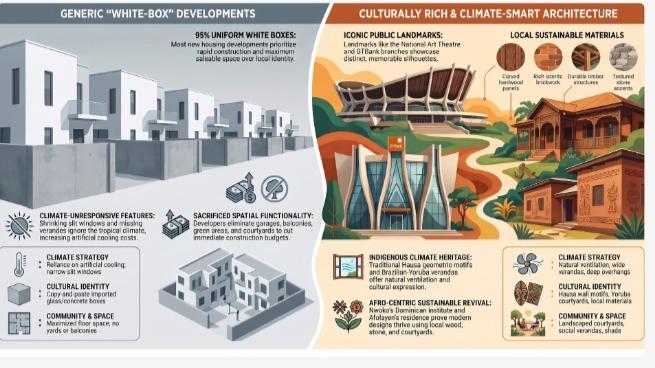
In cities such as Lagos, Abuja, Port Harcourt, Ibadan and Kano, many newly developed residential estates now share almost identical appearances. White-painted duplexes, box-shaped buildings, narrow windows and limited outdoor spaces have become common features of modern housing projects.
The trend has sparked debate about whether Nigerian architects are losing their creative edge or simply working under economic conditions that leave little room for innovation.
Nigeria was once known for buildings that reflected the culture, climate and lifestyle of different communities. Traditional architecture in the northern part of the country featured decorative wall patterns, handcrafted designs and structures suited to hot weather.
In the South, homes often incorporated wide verandas, balconies, courtyards and gardens, allowing residents to enjoy natural ventilation while providing spaces for relaxation and family interaction.
Buildings constructed by Brazilian returnees in places such as Ibadan, Abeokuta and Ijebu-Ode also demonstrated how foreign influences could be blended with local architectural traditions to produce distinctive and durable structures.
Some of these architectural features remain visible in older neighbourhoods, but rapid urban development and the growing preference for modern housing styles are gradually pushing them out.
Among the country’s notable architectural landmarks is the former National Theatre in Lagos, now known as the Wole Soyinka Centre for Culture and Creative Arts. Completed in 1976 ahead of FESTAC ’77, the building remains an example of how architecture can become an important part of a country’s cultural history.
Another example is the Dominican Institute in Ibadan, designed by renowned Nigerian architect and artist Demas Nwoko. The structure combines traditional Yoruba building techniques and locally sourced materials with modern architectural ideas.
The distinctive designs of several Guaranty Trust Bank branches also demonstrate how commercial buildings can develop recognisable architectural identities.
However, experts say such creativity is becoming less common in the residential property market, where developers increasingly favour repeated designs that can be constructed quickly and sold at competitive prices.
Profit-driven development changing the industry
One major factor behind the growing similarity of modern buildings is the rising cost of property development.
High land prices, expensive construction materials, limited access to financing and the pressure to recover investments quickly have made developers more cautious about spending money on unconventional designs.
The Managing Director of Noble Grounds Limited, Olajide Dosunmu, explained that expensive land and infrastructure costs often leave developers with limited resources to experiment with different architectural concepts.
He noted that repeating the same design across several properties is usually cheaper than developing individual structures with different features.
According to him, mass housing projects particularly encourage standardisation because developers want to control expenses and appeal to a wider range of prospective buyers.
Dosunmu, however, pointed to a residential project by filmmaker Kunle Afolayan as an example of how locally available materials can be used to create attractive and distinctive buildings.
The project demonstrates that modern architecture does not necessarily have to depend entirely on imported materials or conventional designs.
Another concern is the gradual disappearance of features such as balconies, garages, gardens and spacious windows.
In many newly constructed homes, windows are noticeably smaller, while some buildings have limited openings that restrict natural ventilation.
This is particularly concerning in Nigeria’s tropical climate, where proper airflow and protection from direct sunlight are important for comfortable living.
The absence of adequate ventilation can increase dependence on air conditioners and other cooling appliances, potentially raising electricity costs for homeowners.
Some developers also reduce outdoor spaces to create additional rooms or maximise the amount of property available for sale.
Architects blame economic pressure and client demands
Members of the architectural profession have argued that the situation should not be interpreted simply as a decline in creativity.
A member of the National Executive Council of the Nigerian Institute of Architects, Adeleke Nadi, attributed the growing popularity of plain and repetitive building designs partly to the financial limitations of clients.
He explained that property owners frequently reject architectural features they consider unnecessary because they want to keep construction expenses within their budgets.
Nadi urged architects to do more to demonstrate the practical benefits of creative designs, particularly where they can improve durability, reduce maintenance expenses and make buildings more functional.
He also called for improvements in architectural education and greater investment in research to help professionals develop affordable solutions without sacrificing originality.
Similarly, the Vice Chairman of the NIA Lagos Chapter, Moniba Odunlami, expressed concern that the pressure to maximise saleable space was encouraging developers to remove important features that contribute to comfortable living.
She identified balconies, courtyards, gardens and outdoor spaces as important elements that improve ventilation, privacy and social interaction.
Odunlami maintained that creating distinctive buildings does not always require expensive materials or complicated structures.
She explained that properly positioned windows, effective shading, functional balconies and well-planned outdoor areas could give buildings a recognisable identity without significantly increasing construction costs.
She also called for cooperation among architects, property developers, government agencies and educational institutions to promote buildings that reflect Nigeria’s culture and environmental conditions.
Calls for a return to personalised architecture
An architect who later ventured into interior design, identified simply as Jemima, has also criticised the growing preference for similar-looking residential buildings.
She highlighted problems such as poor space management, inadequate privacy, weak ventilation and finishing that does not properly consider how occupants intend to use their homes.
Jemima argued that developers should stop reproducing the same architectural concepts across different locations without considering the needs of the people who will occupy the buildings.
She believes the widespread adoption of minimalist white-box designs has reduced the individuality that once made it possible to associate a building’s appearance with its owner’s personality.
She also suggested that wealthy Nigerians may eventually begin seeking more personalised and environmentally friendly designs as the current architectural trend becomes increasingly common.
The house developed by Kunle Afolayan offers an example of this alternative approach.
Situated between Lagos and Ogun states, the property occupies a 920-square-metre plot and incorporates wood, stone, sculptures and other locally and internationally sourced design elements.
The building features high ceilings, large glass openings and spaces designed to maximise natural lighting. It also includes a gym, cinema space and a bedroom with a skylight.
Afolayan explained that the wood used in the project was similar to the type used for railway lines because of its durability.
The development illustrates how contemporary architecture can combine modern comfort with natural materials and individual artistic expression.
Professional training and government support also matter
Beyond the financial challenges facing developers and homeowners, some industry stakeholders believe the quality of architectural education must also be improved.
They argue that universities should give students a stronger understanding of Nigeria’s traditional building systems, local construction materials, climate conditions, cultural history and sustainable development.
Rather than concentrating mainly on technical drawings and foreign architectural trends, students should be encouraged to develop designs that address the country’s specific housing challenges.
The Managing Partner of Sowunmi Williams Development Consultants, Sowunmi Williams, also raised concerns about developers who engage unqualified individuals instead of registered architects.
He argued that the failure to properly involve professionals can affect the quality and originality of buildings.
Williams further identified the rising cost of construction materials and foreign exchange difficulties as obstacles preventing architects from executing some of their proposed designs.
He called for policies that would reduce the cost of building materials and encourage greater investment in architectural innovation.
Ultimately, experts believe restoring Nigeria’s architectural identity will require a change in attitude among developers, property owners, architects and government institutions.
While affordability and commercial returns remain important considerations, they argue that buildings should not be judged only by how quickly they are completed or how much profit they generate.
Proper ventilation, natural lighting, durability, cultural expression and efficient use of space should also influence construction decisions.
For a country with diverse cultures, climates and architectural traditions, the challenge is to embrace modern development without abandoning the features that make Nigerian buildings distinctive.
The concern, therefore, is not that Nigeria should return entirely to old building methods, but that modern architecture should reflect local realities instead of producing identical structures that could be mistaken for developments anywhere in the world.