Educational psychologists have identified a closed mindset as one of the greatest obstacles to learning. The easiest fuel for a closed mindset is the presumption that one has reached knowledge saturation in a particular field, especially after long practice and exposure.
This is not new, nor is it uniquely Nigerian or African. It is a universal human disposition, and the funny part is that if one isn’t careful and watchful, one may not even notice when it has taken hold of the mind. An old legend captures this well. The ancients believed the Strait of Gibraltar marked the end of the world, and tradition held that the Pillars of Hercules standing there carried a warning: Ne plus ultra, “nothing further beyond.” Then the voyages of Columbus and others revealed a whole new world past those pillars, and many other discoveries and conquests followed. When the young King Charles of Spain chose his motto, he kept the pillars but dropped the “ne”, preserving “Plus ultra”, “further beyond.” It remains Spain’s national motto today.
This isn’t just a Spanish story; it is a circumstance all of us have witnessed and will still witness. We have all attended classes, seminars and workshops with the mindset that there is nothing the teacher or speaker will say that we don’t already know, perhaps even better than the teacher. Do you relate?
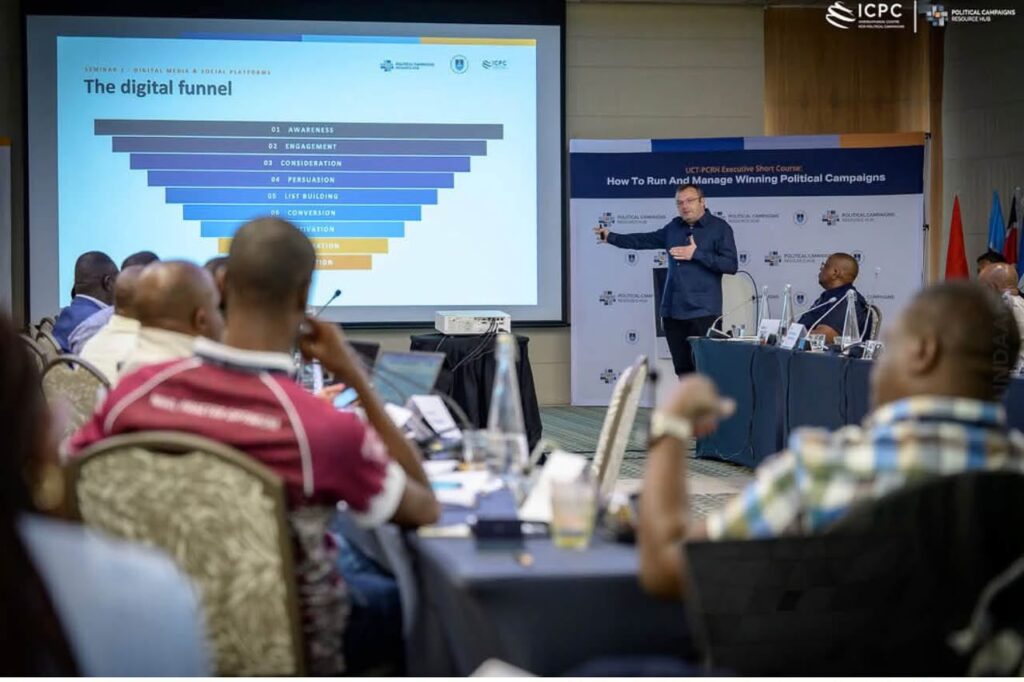
I suspect this was the disposition that filled the room on the first day of lectures at the training on how to run and manage a winning political campaign, organised by the Political Campaign Resource Hub of the International Centre for Political Campaigns. Why do I think so? In that hall were high-level party executives from more than ten African countries, all of whom had participated in several presidential campaigns in their countries. Some represented governing parties, others the opposition, but all were very experienced. I learnt early in life from my psychologist father that past knowledge and experience are often the greatest antagonists of new knowledge. Their experience would have taken the front seat in their heads and asked, “Let me hear what they will teach that I do not already know.”
Glen Mpani, a graduate of the Harvard Kennedy School of Government, started the session by asking what we thought was a simple question: What is a political campaign? The class first went dead quiet, then answers began to fly around. Glen ruled all of us out of order before defining it as “an organisation built to change political behaviour sufficiently to achieve a measurable political objective within a fixed period of time.” At that point, everyone sat up and knew we were in for a ride, and a bumpy one at that. That module set the stage for more than 13 other modules packed into the programme. The combination of instructors was superb. From Prof. Bob Mattes of Afrobarometer fame and Associate Prof. Momar Dieng to Dr. Delta Nduo and Jonathan Moakes, all of them were on fire and delivered maximally.
One key takeaway for me, and I guess for most, if not all, of us, was the realisation of the indispensability of data in political campaigns. Without data, and its effective interpretation and use, politicians would be like a pilot flying blind, without navigational aids. Data is so powerful that entire elections depend on it. The simple, logical questions politicians should ask themselves are: What are the numbers saying? And how do I use those numbers to my advantage?
Those of us who walked into that hall thinking we had reached our ne plus ultra walked out having discovered our plus ultra. There is always more beyond, for those humble and courageous enough to sail past the pillars
Ini Ememobong