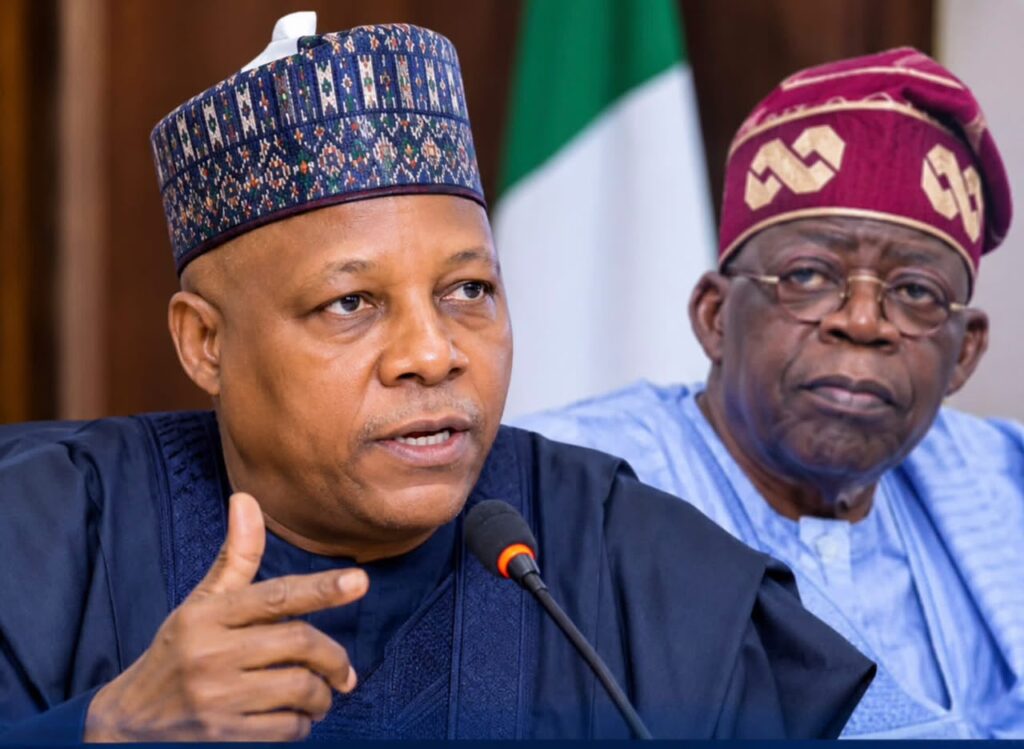
Vice-President Kashim Shettima has acknowledged the economic hardship confronting Nigerians but defended the Tinubu administration’s major reforms, saying the government was compelled to take difficult decisions to prevent a deeper economic crisis.
Shettima specifically cited the removal of petrol subsidy and the unification of multiple exchange rates as measures he said were necessary when President Bola Tinubu assumed office in 2023.
The Vice-President spoke in Lagos after meeting with Tinubu, who recently returned to the country from his annual vacation.
According to Shettima, the administration inherited an economy under severe pressure, with foreign reserves, as he put it, at about $3.9 billion — an amount he said was insufficient to finance fuel imports for one month.
He said the situation required decisions that would inevitably impose immediate costs on citizens, but argued that the government had to act to avert what he described as an impending economic collapse.
“The withdrawal of the fuel subsidy, the realignment of the multiple exchange rates, were far-reaching decisions,” Shettima said.
He added: “The economy was actually teetering on the verge of collapse. He saved the economy.”
The Vice-President therefore appealed to Nigerians to view Tinubu’s policies within the circumstances in which they were introduced, saying, “It is absolutely essential that Nigerians need to be generous to this poor man.”
Shettima, however, acknowledged that the reforms had come with significant hardship for citizens, saying the Federal Government was aware of the difficulties and was working on measures to cushion their effects.
“We appreciate the pains Nigerians are going through, but tough times do not last forever; tough people do,” he said.
He listed planned interventions including 10,600 electric tricycles in the North-East, e-logistics in the North-West, as well as 300 buses and e-taxis intended to reduce transportation pressure.
Shettima also identified the Nigerian Education Loan Fund as one of the administration’s interventions for students from low-income backgrounds.
While defending the economic programme, the Vice-President said the administration was conscious that political activities were increasing ahead of the 2027 general election.
“Politics is in the air, but we’ll combine politics and governance,” he said.
The remarks effectively placed the administration’s economic record at the centre of its emerging 2027 political narrative, with Shettima asking Nigerians to weigh the immediate hardship against what he described as the long-term objective of stabilising the economy.