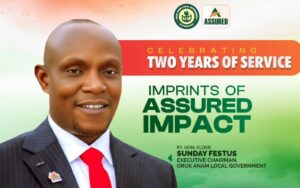
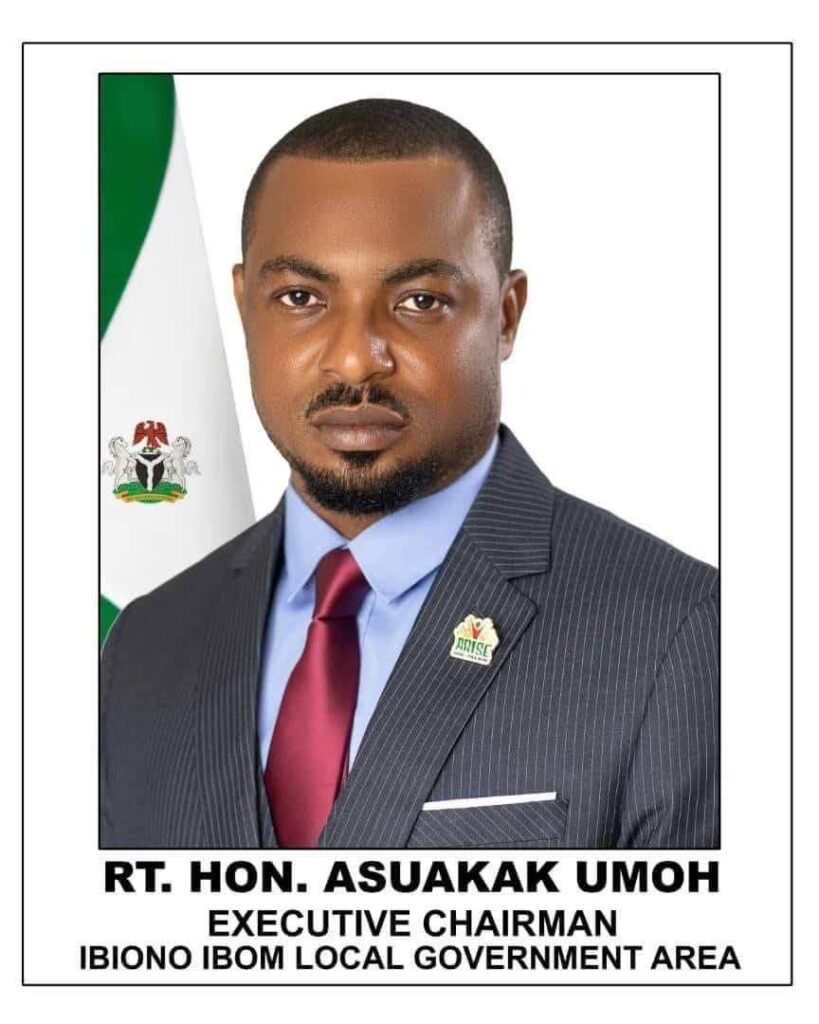
Two years into Rt. Hon. Asuakak Umoh’s administration of Ibiono Ibom Local Government Area, the emerging scorecard goes beyond the construction of public facilities to a broader pattern of intervention that cuts across electricity, roads, water, education, youth engagement and social welfare.
An assessment of the administration’s performance, based on records made available by Mrs Roseline Etukudo, Director of Social Development, Education, Information, Sports and Culture Directorate, Ibiono Ibom Local Government Area, shows an administration that has combined physical infrastructure with recurring financial support to teachers, youths, students, business owners, women and vulnerable groups.
One of the more consequential aspects of the administration’s record is its intervention in electricity supply. The records indicate that transformers were installed at Use Ikot Antono, Ikot Anya Ono, Aka Ikot Udo Eno, Ibiaku Inyang Isong, Ikot Amba and Awat Nkang, with more than 19 villages re-electrified or reconnected to the national grid.
A second round of intervention saw transformers installed at Udioho Ntan, Usuk Ntan, Ekere Mbibiong, Ikot Mkpo and other locations, with more than 18 additional villages listed as beneficiaries of re-electrification or reconnection. Integrated security solar lights were also provided at the new substations.
The significance of the electricity interventions lies beyond the number of transformers installed. Reliable power can affect small businesses, household welfare, community security and local economic activity. The real test, however, will be whether the infrastructure remains functional and translates into sustained economic benefits for the affected communities.
The administration has also spread its infrastructure agenda across water, roads and public facilities. Among the projects listed are the solar-powered water project at Usuk Ibiaku, construction of a reinforced concrete box culvert at Etak Ikot, repairs and maintenance of the Oko Ita-Itak Road covering the Ikpa, Ikot Usen and Ikpa Ikot Uboh stretches, as well as regular grading of rural roads.
Water interventions have also extended to the council’s own facilities and host communities, including reticulation from the Council Secretariat, a borehole, stanchion and water storage tank at the Traditional Rulers’ Council complex.
At the council level, the administration has renovated the Ibiono Ibom Council Multipurpose Hall, furnished the Legislative Chambers, procured a 100kVA Perkins diesel generator for the Secretariat and supplied 30 new tables and chairs for council offices.
The Traditional Rulers’ Council complex at Ikpa has received particular attention, with the records listing construction of the office complex, a bar and restaurant, a 0.45-kilometre access road, water facilities, solar street lights and furnishing. The administration has also renovated the Legislative Chamber and overhauled furniture in the Executive Chairman’s office, while two official vehicles were presented to the Leader of the Legislative Council and the Secretary of Council.
Healthcare forms another component of the scorecard, with the ongoing renovation and remodelling of Idoro Comprehensive Health Centre, including a new gatehouse, solar power and the purchase of medical equipment.
But the distinction between completed and ongoing projects remains important in assessing the administration fairly. The Ibiaku Ikot Udom Civic Centre and the Idoro health facility are listed as ongoing projects. Their ultimate value will therefore be measured by completion, functionality and the quality of services they deliver, rather than by the expenditure already committed to them.
Education presents perhaps the clearest people-centred dimension of the administration’s interventions. Teachers serving in hard-to-reach primary schools receive a monthly ₦50,000 stipend, while 12 indigent students in tertiary institutions are listed as beneficiaries of a full university scholarship scheme.
The administration has also distributed school shoes to 1,100 pupils in 11 public primary schools and 550 uniforms to pupils in five public primary schools. The provision of 64 brush cutters to public primary schools and the inauguration of school-based sanitation committees are intended to improve the physical environment in which pupils learn.
Regular termly meetings with head teachers also feature in the records, while financial support has been extended to Ibiono Ibom indigenes studying at law school, medical school and postgraduate levels. Fifteen indigenes have additionally been sponsored to undergo skills acquisition at the DAKKADA Skills Acquisition Centre.
The administration’s human-capacity and social-welfare interventions are equally notable for their recurring nature. Sixty-four youths engaged under the School-Based Sanitation Committee receive ₦60,000 monthly, while another 100 youths under the Sanitation Committee receive ₦30,000 monthly. Thirty members of the Media Committee and 40 casual workers are also listed as beneficiaries of monthly payments.
For entrepreneurs, the records show ₦500,000 grants to 30 business owners and another ₦200,000 grants to 30 small-scale business owners. The administration also provided ₦1 million to IWADU Women Multi-Purpose Cooperative Society and an annual ₦500,000 support package to the Ibiono Ibom Military Widows’ Multi-purpose Cooperative Society.
Support has further extended to community life, with sponsorship of football competitions across zones, free PMS provided to commercial motorists and the establishment of what is described in the records as the first Moni Cash point in Ibiono Ibom.
Taken together, the interventions reveal an administration pursuing two tracks simultaneously: creating physical assets while deploying direct assistance as a means of cushioning economic pressure and expanding access to opportunities.
That approach, however, also raises questions about sustainability. Recurring allowances, grants and welfare payments can provide immediate relief and create opportunities, but their longer-term developmental value will depend on whether beneficiaries can translate such support into sustainable livelihoods and economic independence.
The same sustainability question applies to infrastructure. Roads require maintenance, transformers require servicing, water systems need functioning management structures, and public buildings must remain useful beyond the period in which they are commissioned.
At the two-year mark, therefore, Umoh’s record presents a broad development footprint, with electricity, education, roads, water, healthcare, institutional infrastructure and social interventions forming its major pillars. More importantly, the spread of the interventions across communities suggests an attempt to combine visible projects with direct responses to everyday needs.
But the stronger measure of the administration will increasingly shift from the number of projects and beneficiaries recorded to the quality, durability and measurable impact of what has been delivered.
Two years may be enough to establish a direction, but not enough to deliver a final verdict. For Ibiono Ibom, the critical test going forward is whether the projects underway can be completed, existing infrastructure maintained, welfare interventions sustained and the emerging investments in people and communities converted into lasting improvements in the lives of residents.