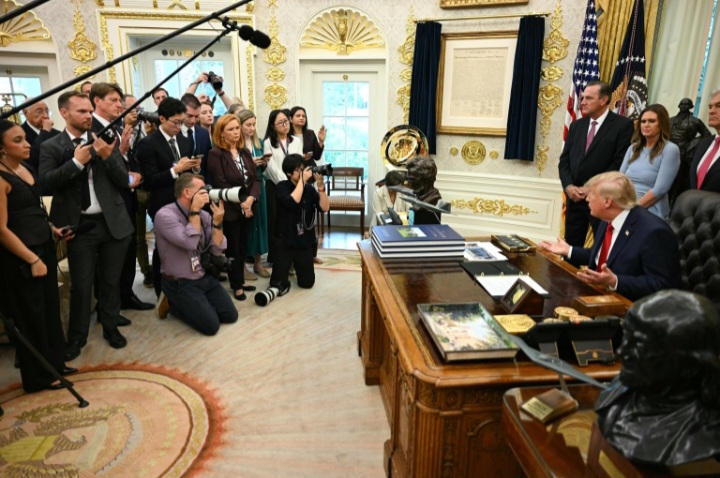
US President Donald Trump has confronted The Independent journalist Andrew Feinberg in the Oval Office, warning him to be careful and questioning his mental state during a tense exchange over the administration’s proposed whistleblower reward scheme.
In an account published by The Independent, Feinberg said the confrontation began when he challenged Trump over plans to offer rewards of up to $30,000 to people who report suspected fraud involving government-funded programmes.
The reporter questioned the need for the proposed initiative, noting that the United States already operates a whistleblower mechanism under the False Claims Act, which allows individuals to help the government recover money lost to fraud and receive a share of the recovered funds.
Feinberg argued that the existing law offers substantially higher potential rewards than the one per cent Trump cited for the administration’s proposed programme. The journalist said the president responded that the new arrangement would attract tipsters because the amount involved was significant.
Vice President JD Vance intervened during the exchange, disputing Feinberg’s position and describing his question as dishonest. The disagreement escalated as Trump questioned the reporter’s identity, despite Feinberg saying he had already introduced himself as a journalist with The Independent.
According to Feinberg’s account, Trump later warned him to be careful and subsequently described him as a “sick person,” adding that he believed something was wrong with him.
The confrontation continued beyond the president’s remarks, with Feinberg reporting that members of Trump’s team also directed personal attacks at him. He said a White House rapid-response official used an offensive slur against people with intellectual disabilities, while Vance referred to him as an “imbecile” in a post on his official government account.
The proposed reward scheme was presented during an event involving Nick Shirley, a conservative YouTube personality whose videos drew attention to allegations of fraud involving childcare and home healthcare businesses in Minnesota operated by or associated with Somali-Americans.
Feinberg said the claim that the United States had never offered incentives to expose fraud was inaccurate, pointing to the longstanding False Claims Act and its provisions for whistleblowers who bring cases on behalf of the government.