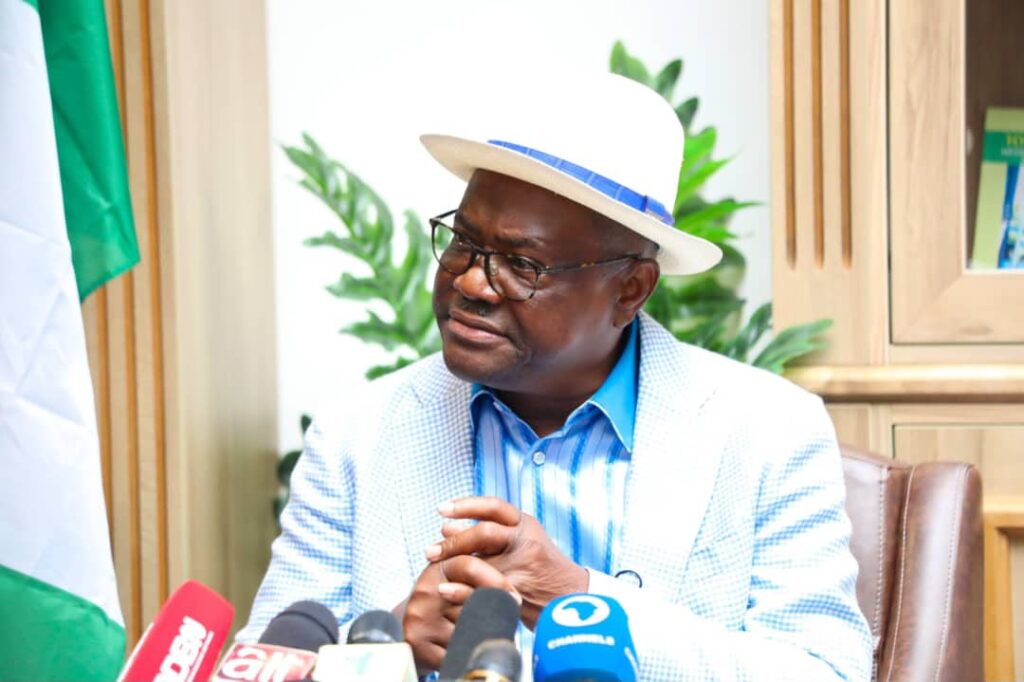
The battle over how President Bola Tinubu’s 2027 re-election campaign should be organised has opened a fresh political fault line between FCT Minister Nyesom Wike and governors of the ruling All Progressives Congress (APC).
Wike has rejected demands that his political mobilisation should conform to the structure or interests of the APC, insisting that his support is for Tinubu’s presidential bid and does not amount to joining the ruling party.
The development follows a declaration by the Progressive Governors Forum, led by Imo State Governor Hope Uzodimma, that APC governors would not support political alliances capable of weakening the party or its candidates in the 2027 elections.
But Wike, speaking on Arise News’ Prime Time on Tuesday, maintained that President Tinubu was aware of his activities and the cross-party “Rainbow Coalition” he is building to support the President.
“There is nothing that I do that I don’t tell Mr. President,” Wike said, while stressing that he remained a member of the Peoples Democratic Party (PDP).
He also drew a distinction between presidential and sub-national contests, arguing that supporting Tinubu does not require the PDP or politicians associated with the coalition to abandon candidates in governorship, National Assembly and State House of Assembly elections. Wike subsequently reiterated the position in a statement issued by his Senior Special Assistant on Public Communications and Social Media, Lere Olayinka.
The FCT minister was particularly dismissive of criticism from APC governors, declaring, “I’m not answerable to APC governors.” He argued that politicians facing difficulties within their states should resolve such disputes locally rather than making them part of the President’s re-election campaign.
Wike also challenged the argument that voters could not support Tinubu for president while backing candidates from other parties in the same election cycle. He cited the 2023 results in Imo, Abia, Enugu and Ebonyi as examples of voters splitting their choices between presidential and legislative contests.
The disagreement has placed Wike’s Rainbow Coalition at the centre of an increasingly public debate over whether cross-party mobilisation for a presidential candidate can operate alongside competing party structures at state and legislative levels. The APC governors have said their campaign commitment covers APC candidates across the ballot.
Wike, however, insisted that the coalition had “nothing to do with the APC”, describing it instead as a platform through which politicians from different parties could mobilise support for Tinubu.
The former Rivers State governor also took aim at Uzodimma, questioning the governor’s criticism of his political strategy and pointing to Tinubu’s performance in Imo during the 2023 presidential election. He similarly dismissed concerns over his activities in Rivers State, where he said the Rainbow Coalition had contributed to what he described as greater political stability.
On the wider South-South contest, Wike identified Bayelsa as a state where he believed the coalition could mobilise support for Tinubu, claiming that elements of the PDP structure in the state were working for the President.
The exchange has consequently shifted the Rainbow Coalition debate from a question of individual political allegiance to a broader contest over whether Tinubu’s 2027 presidential mobilisation can accommodate competing party interests in the governorship and legislative races.