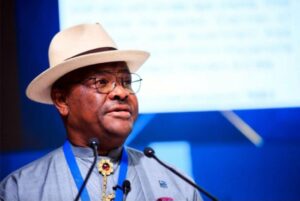
Minister of the Federal Capital Territory (FCT), Nyesom Wike, has admitted deliberately working against the Peoples Democratic Party (PDP) in the 2024 Edo governorship election to stop former governor Godwin Obaseki from deciding who succeeded him.
Wike, who said he had no regrets about his role in the outcome, disclosed that he rejected repeated appeals for support from the PDP candidate, Asue Ighodalo, despite acknowledging that he was a good candidate, because he did not want Obaseki to return to power through a successor.
The minister made the revelation on Monday at a stakeholders’ meeting of the rainbow coalition in Abuja, where he credited an alliance between elements of the PDP and the All Progressives Congress (APC) with helping the ruling party defeat the opposition in Edo State.
“In the last election that took place in Edo State, the victory was as a result of the coalition between the legacy of PDP and the APC,” Wike said.
He admitted that his opposition to Ighodalo was driven more by his determination to frustrate Obaseki’s succession plan than by any reservations about the candidate’s qualifications.
“We had to work together to make sure that the former governor, Governor Obaseki, did not produce his successor. And that is the truth. I was behind it, and I don’t have any regrets about it,” he said.
In a striking account of how the political battle unfolded, Wike disclosed that Ighodalo visited his residence more than three times in a bid to secure his backing but left without the support he sought.
According to the minister, he told the former banker that his candidacy had become inseparable from Obaseki’s political ambitions, making it impossible for him to support the PDP ticket.
“He came to my house more than three times. I said, ‘Listen, you’re a good candidate, but for this election, I’m sorry, because this election is between us and the man who is bringing you, called Obaseki, ungrateful person, so returning you is like bringing him back, so I’m sorry. You have to fail,’ and he failed,” Wike said.
The admission offers a revealing account of how personal and intra-party rivalries shaped the Edo contest, with Wike openly acknowledging that he was prepared to oppose a candidate from his own party to prevent a political adversary from retaining influence after leaving office.
Although he remains a PDP member, Wike said his decision to work against the party’s candidate demonstrated how political coalitions could cut across party lines when interests converged.
He maintained that the alliance between PDP elements and the APC was decisive in the victory of Governor Monday Okpebholo, adding that both Okpebholo and Senator Adams Oshiomhole, who represents Edo North, could attest to the arrangement.
“The truth of the matter is that it has been there, depending on how it is worked out. So the governor today, Senator Okpebholo, will know sincerely that it was that coalition,” he said.
Wike’s disclosure comes as political actors intensify efforts to build alliances ahead of the 2027 general elections, with the minister using the Edo experience to argue that coalitions can determine electoral outcomes regardless of formal party affiliations.
His account also raises fresh questions about party loyalty and the influence of powerful political figures in determining who gets elected, particularly when internal rivalries take precedence over a party’s official candidate.
For Ighodalo, Wike’s account amounts to an admission that his defeat was not merely a contest between competing candidates but also a struggle over whether Obaseki would retain political influence beyond his tenure.