Idongesit Ashameri
On the morning of September 17, 2026, families who had been told to return later gathered outside a Nigeria Security and Civil Defence Corps (NSCDC) facility in Minna, Niger State, expecting to collect their sons. Instead, they were directed to the General Hospital morgue. Thirty-seven detainees, including teenagers, arrested during anti-illegal mining operations on September 15 and 16, had died in custody.
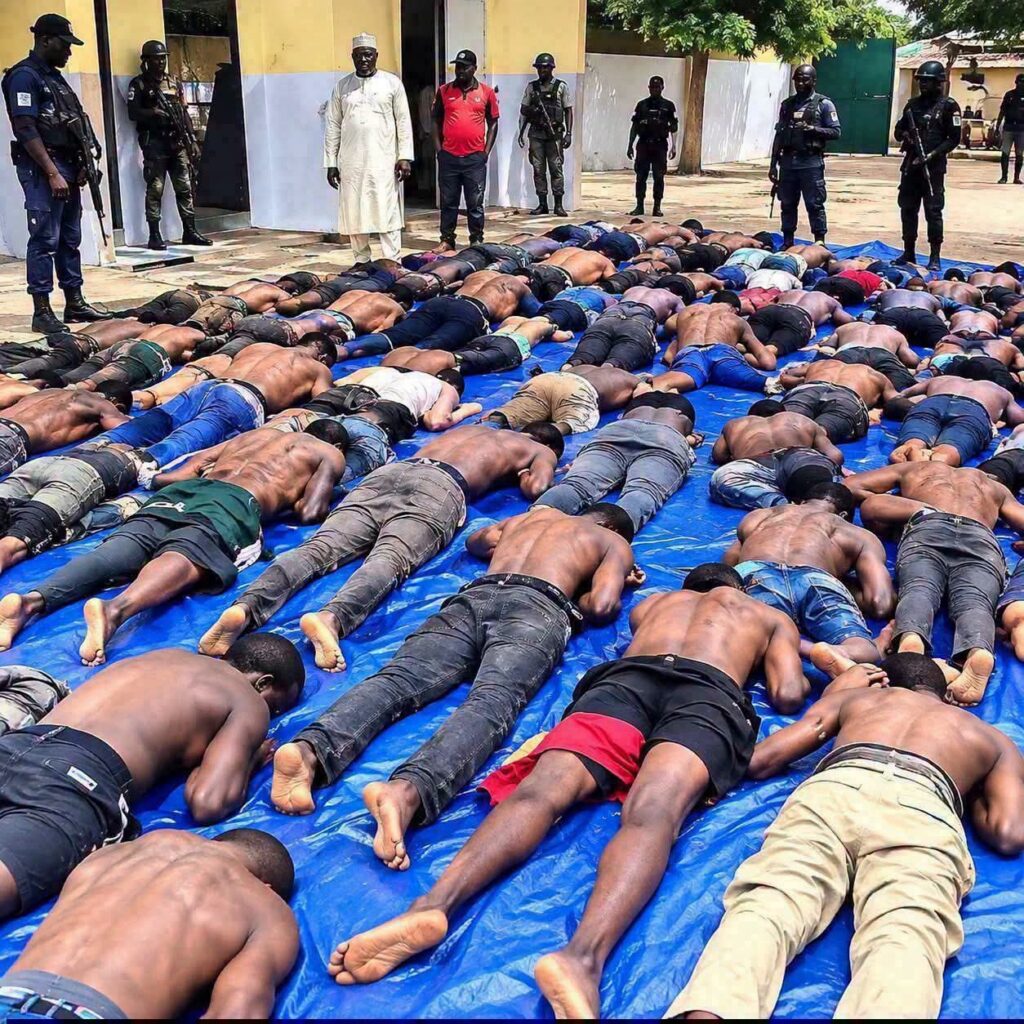
The victims were among suspects arrested during NSCDC operations against illegal mining in the M.I. Wushishi and Lukoto areas of Minna. Niger State Governor Mohammed Umaru Bago later disclosed that 67 detainees had been held in a single cell. He declared three days of mourning and ordered a state committee of inquiry, forensic examinations and autopsies. The scale of the deaths, and the discrepancy between the official figures and what journalists witnessed at the morgue, immediately raised questions about what happened inside the detention facility.
The first official explanation came from the Niger State Command. Its Commandant, Suberu Siyaka Aniviye, said the Corps suspected that a disease outbreak had caused the deaths and that the bodies had been deposited at Minna General Hospital for medical examination to establish the actual cause. The National Headquarters subsequently made clear that no definitive cause had been established and that any attribution to disease remained subject to medical and laboratory confirmation. That distinction is significant: the State Command’s preliminary explanation was not adopted by the national leadership as an established medical finding. (TheCable)
Governor Bago’s reaction exposed another serious gap. He said the state government had not been informed of the operation or the detention of the miners before the deaths became known. That does not, by itself, establish that the NSCDC National Headquarters or the relevant zonal commands were also unaware. But it raises an important question about the chain of command: who authorised the operation, who was informed before the arrests, who knew that 67 people had been detained and who approved the conditions under which they were held?
The question becomes more compelling because the National Headquarters did not simply endorse the Niger Command’s initial account. Instead, it ordered a high-powered investigation into the condition of the suspects when they were arrested, their period in custody, the detention conditions and the medical attention provided to them. The available public record does not establish that Abuja authorised the operation. Equally, it does not yet establish that the relevant zonal commands were unaware. Those are questions the investigation must answer by reconstructing the communication and authorisation trail from the field to the State Command, the zonal commands and National Headquarters. (TheCable)
The National Headquarters’ response went beyond correcting the initial narrative. Commandant General, Prof. Ahmed Abubakar Audi, ordered the Niger State Commandant to step aside and report to Abuja with senior officers responsible for Operations, Mining, Legal, Intelligence and Investigation. A new commandant was deployed to take charge of the Niger Command. The Corps subsequently took personnel linked to the incident into protective custody at its Abuja headquarters for interrogation and administrative disciplinary proceedings. The number under investigation later rose from 21 to 24 after three additional officers were identified and suspended. (TheCable)
The disciplinary response was subsequently widened. NSCDC said all 24 personnel linked to the incident were being held at National Headquarters and would be subjected to interrogation and administrative disciplinary action before being made available to the presidential independent investigation committee and other investigative panels for further investigation and possible prosecution. Audi also said personnel found culpable would face the full weight of internal disciplinary measures and the law. The Corps ordered its flag to be flown at half-mast across its formations for three days in honour of the victims and as a stated resolve to purge the system of personnel responsible for misconduct. (TheCable)
The composition of those facing investigation is important. The personnel identified include the suspended Niger State Commandant and officers connected with arrest, investigation, intelligence, legal duties, station guard and day and night supervision. This means the investigation is not confined to the question of how the detainees died; it extends to the wider chain of arrest, processing, detention and supervision. The Federal Government’s independent committee has similarly been mandated to establish the circumstances of the arrests and detention and determine whether negligence, misconduct or other wrongdoing occurred. (Channels Television)
The Federal Government subsequently widened the accountability mechanism. Following President Bola Tinubu’s directive, Interior Minister Olubunmi Tunji-Ojo constituted a 10-member independent committee to investigate the deaths, including the identities of the deceased, their arrest and detention, and the cause and circumstances of their deaths. The committee was inaugurated on September 22 and given two weeks to complete its assignment. The minister also warned that anyone who attempted to destroy or conceal evidence, intimidate witnesses or obstruct the investigation would face the full force of the law. (Channels Television)
The timing of the tragedy also deserves scrutiny. Barely days before the fatal incident, the Niger State Command had publicised capacity-building programmes involving its personnel, including a five-day retreat and symposium for Arms Unit Commanders and specialised training on operational deliverables and evidence-based research techniques. The Command had urged participants to apply the knowledge acquired in their duties, with emphasis on discipline, professionalism and operational standards. The investigation should therefore establish which officers involved in the September 15–16 operation had undergone relevant training, what procedures they were expected to follow and whether those procedures were observed in the arrest, processing, supervision and detention of the miners.
Survivors’ accounts have meanwhile challenged the initial disease explanation without, at this stage, conclusively establishing the medical cause of death. Dauda Shehu, who survived, told the Associated Press that about 65 detainees had been packed into an overcrowded and poorly ventilated cell where they struggled to breathe. Other survivors described detainees banging on the cell door and pleading for air. Reuters separately reported survivor allegations that an unidentified substance was sprayed into the cell shortly before detainees began collapsing. Those claims are now among the matters requiring forensic and independent investigation. (AP News)
The accounts of overcrowding are particularly significant because the Governor confirmed that 67 people had been detained in the facility. Reuters reported that survivors described nearly 70 people being held in a cell measuring about five square metres. Three bodies reportedly underwent autopsies, with findings including blistering and the discharge of brown fluid, although a definitive cause of death had not been established at the time of the report. (Reuters)
A relative of one victim has understandably questioned how a disease could have killed so many detainees without apparently affecting the officers guarding them. That question, however emotionally compelling, should remain a question rather than become a medical conclusion until the forensic investigation establishes what happened.
Abdullahi Dalhatu, whose son survived, told the BBC that the boy was near a small window and therefore escaped the worst of the conditions. He said his son’s friend collapsed and that detainees repeatedly knocked on the door for help. Such testimony is consistent with other survivor accounts of overcrowding and difficulty breathing, although individual accounts still require independent corroboration.
The human cost cannot be reduced to statistics. Shafa’atu Suleiman lost two sons. At Minna General Hospital, she mourned one of them and said: “This is injustice. We will not forgive them.” She said she had visited her son in the crowded cell and alleged that relatives were prevented from bringing food to detainees. She also alleged that officials demanded ₦100,000 for their release. Those allegations require investigation, but they illustrate the level of distrust and anguish now surrounding the incident.
Other families suffered similar losses. Musa Aliyu lost two sons, Ibrahim, 17, and Abubakar, 12. Lawal Mohammad’s 15-year-old son, Suleiman, also died. Amnesty International has called for the investigation to examine the circumstances surrounding the detention of minors among those who died and to determine whether their arrests and detention complied with Nigerian law and applicable human-rights standards.
The deaths triggered protests in Minna. Demonstrators attacked public property and vehicles with stones and sticks before security forces moved to disperse them. The state government subsequently imposed a curfew. The protests reflected public anger over the deaths, although allegations that security forces used live ammunition against protesters also require independent investigation. SERAP subsequently called for accountability and warned against responding to custodial deaths with further loss of life during protests.
The Nigerian Bar Association called for a “thorough, independent, transparent and credible investigation” and said the inquiry should also examine the wider illegal-mining economy, including who owns, controls, finances and profits from mining operations. That intervention broadened the debate from the immediate circumstances of the deaths to the larger question of whether enforcement is reaching the financiers and beneficiaries of illegal mining rather than disproportionately affecting the labourers at the bottom of the chain.
Amnesty International also demanded an independent investigation and questioned the use of the description “illegal miners” for people who had not been convicted by a court. The distinction is important. Suspects may be arrested and investigated in accordance with law, but guilt remains a matter for competent judicial determination. Whatever offences the detainees may have been suspected of committing, their detention did not remove their right to life or humane treatment.
SERAP has also petitioned United Nations Special Rapporteurs over the incident, citing concerns about the deaths in custody and the subsequent handling of protests. The organisation’s intervention reflects a growing concern that the Minna deaths should not be treated simply as an isolated administrative failure but examined within the broader context of custodial accountability and protection of human rights.
That broader context is troubling. In December 2025, the Coalition Against Tiger Base Impunity (CAPTI) alleged that more than 200 people had been killed or disappeared in connection with the Imo State Police Anti-Kidnapping Unit, popularly known as Tiger Base, between 2021 and 2025. Amnesty International subsequently documented allegations involving torture, prolonged arbitrary detention, enforced disappearance and deaths in custody. Its February 2026 report identified 42 named victims. These are allegations and documented cases that require appropriate investigation and should not be presented as proof that every allegation against the unit has been judicially established.
Other cases have similarly raised concerns about accountability for deaths in security custody. The ICIR reported on August 30, 2026, citing CAPTI’s “Tiger Base Files”, that the group had documented allegations involving more than 200 deaths in custody and enforced disappearances. The report cited individual cases, including that of Japhet Njoku, a security guard who was allegedly arrested in March 2025, detained for nearly two months and later died. These allegations have been disputed or remain subject to investigation and should be distinguished from established judicial findings.
The military has also faced allegations concerning deaths and treatment of detainees. Amnesty International has alleged that thousands of people died in military custody during the Boko Haram insurgency in the North-East. The Defence Headquarters rejected the allegation as spurious and challenged Amnesty to substantiate its claims. The dispute illustrates why independent investigations, documentary evidence and judicial scrutiny matter in determining responsibility for deaths in custody.
Individual cases have nevertheless continued to raise questions. TheCable reported in April 2025 that Ernest Owoicho, a 35-year-old nurse and father of two, was arrested by troops of Operation Whirl Stroke in Benue State and died less than 24 hours later. His family alleged that his body showed signs of severe beating. The military’s response to the specific allegations should be considered alongside any independent investigation.
The Wawa Military Barracks in Niger State has also attracted scrutiny. TheNiche reported in July 2026 that the Rule of Law and Accountability Advocacy Centre had petitioned the National Human Rights Commission over allegations of arbitrary detention, enforced disappearance, torture and prolonged military detention of civilians at the facility. Former detainees and relatives alleged poor sanitation, inadequate food, lack of medical care and physical and psychological abuse. These remain allegations requiring appropriate investigation.
The Department of State Services has similarly featured in allegations concerning security operations in the South-East. In a December 2024 report, the International Society for Civil Liberties and Rule of Law alleged that more than 32,300 civilians had been killed by security forces and other armed actors in the region between August 2015 and December 2024. Those figures are Intersociety’s estimates and allegations and have not been independently established in their entirety.
Amnesty International separately documented the account of Nwaoma, a 23-year-old woman from Enugu, who said DSS operatives abducted her and two siblings from their home in November 2021 and that she was subsequently detained at facilities in Enugu, Abuja and Wawa Barracks. Her testimony formed part of Amnesty’s wider documentation of alleged arbitrary detention, torture and enforced disappearance in the South-East. Again, the account is an allegation documented by Amnesty and should be distinguished from a judicial finding.
The Economic and Financial Crimes Commission has also faced scrutiny over deaths involving suspects. In June 2026, the EFCC rejected claims that Asar Michael Sesugh, one of 26 suspected cybercrime suspects arrested in Makurdi, died in its custody. The commission said Sesugh escaped from its holding facility and was later killed during an alleged exchange of gunfire with EFCC operatives while they attempted to rearrest him. The commission maintained that he did not die in its custody.
The commission has, however, previously confirmed a death after a suspect was taken into its custody. TheCable reported in June 2016 that Desmond Nunugwo, arrested in Abuja over an alleged ₦91 million fraud, died after spending several hours in EFCC custody. The commission said he was taken to hospital after complaining of discomfort and was pronounced dead there, adding that the matter had been reported to the police for investigation.
The pattern is not limited to formal security agencies. Amnesty International has also documented deaths among detainees at the Yikpata NYSC camp in Kwara State, where it alleged that hundreds of displaced Fulani pastoralists, including children, were held in overcrowded and unsanitary conditions. The organisation attributed deaths to acute malnutrition, disease and inadequate medical care and called for an independent investigation.
The recurring concern across these cases is not that every allegation has been proven or that every security institution operates in the same manner. It is that death in state custody repeatedly raises the same basic questions: who was responsible for the detainees, what condition were they in, what medical attention was available, who monitored the facility and what happened when signs of distress appeared?
Nigeria’s custodial congestion adds another dimension. In February 2026, the Nigerian Correctional Service disclosed that 80,812 inmates were being held across the country’s custodial centres, including 51,955 awaiting trial. The figures underscore the pressure on Nigeria’s detention infrastructure and the longstanding problem of holding large numbers of people who have not been convicted. Stakeholders have repeatedly linked the congestion to delays in investigation and prosecution, repeated adjournments, inadequate legal representation and insufficient use of non-custodial measures.
The historical parallels are sobering. In 1980, about 50 suspects reportedly suffocated in a police transport van in Lagos in the incident popularly remembered as the “Black Maria” tragedy. More than four decades later, the Minna deaths have again placed overcrowding, ventilation, supervision and the protection of detainees’ lives at the centre of national attention.
The illegal-mining dimension must also not be lost. Enforcement cannot end with the arrest of the people at the bottom of the mining chain while the financiers, owners, buyers and powerful beneficiaries remain outside the reach of law enforcement. Evidence from different parts of Nigeria has shown the involvement of local and foreign actors in illegal mining networks. The Nigerian Bar Association’s call for the investigation of those who own, finance and profit from illegal mining therefore deserves attention alongside the inquiry into the deaths.
But enforcement against illegal mining cannot justify unlawful or inhumane detention. The State has the authority to arrest and investigate suspected offenders, but that authority carries an equally serious obligation to protect those in custody. The circumstances described by survivors — overcrowding, difficulty breathing, pleas for assistance and alleged delays in obtaining medical intervention — demand answers about the training, supervision and emergency-response capacity of the personnel responsible for the facility.
This is where the recent training of NSCDC personnel in Niger State becomes relevant. The Command had shortly before the incident publicised capacity-building programmes for its officers and urged them to apply the knowledge acquired with discipline and professionalism. The investigation should establish whether officers involved in the Minna operation participated in those programmes, what relevant custodial or operational standards they had been taught and whether those standards were followed. Training on paper has little value if officers fail to apply basic principles of humane custody when lives are at risk.
Emergency response is equally important. Any facility holding dozens of detainees should have basic safeguards for ventilation, medical emergencies, communication, evacuation and rapid intervention. The central question is not merely whether such procedures existed at the Minna facility, but whether they were available, whether officers understood them and whether they were activated when detainees began showing signs of distress.
Yet it would be wrong to allow the Minna tragedy to define the entire NSCDC. The Corps has an established statutory role in protecting critical infrastructure, disaster response, public safety and other areas of national security. Its Mining Marshals have also carried out extensive enforcement against illegal mining, with hundreds of arrests and prosecutions reported since the initiative began. The Corps has participated in rescue operations and other public-safety interventions. The appropriate response to a grave institutional failure is therefore accountability and reform, not the wholesale dismissal of an institution whose legitimate responsibilities remain necessary.
The path forward requires more than another committee. Nigeria needs enforceable standards for every place where the State holds people against their will. Detention facilities should be subject to regular and unannounced independent inspections. Custody registers should be digitised and accessible to authorised oversight bodies. Every detainee should have prompt access to medical assessment, legal representation and a documented record of the time, place and circumstances of detention. Officers assigned to custodial duties should receive specialised training and be held personally accountable for serious breaches of established standards.
The fight against illegal mining must also move beyond the easiest targets. Investigators should follow the money, identify the financiers and buyers, trace the supply chains and prosecute those who profit from illegal extraction where evidence supports such action. Arresting labourers without dismantling the networks that finance and profit from illegal mining risks treating the symptoms while leaving the underlying system intact.
Most importantly, the Minna deaths require an investigation that follows evidence wherever it leads. If officers directly responsible for the detainees breached their duties, they should face the appropriate consequences. If supervisory officers failed in their responsibilities, the chain of accountability should extend to them. If the investigation establishes that information was withheld from higher command, that too should be addressed. And if any superior officer knew of the operation or the deteriorating condition of the detainees and failed to act, responsibility should follow the evidence upward.
The deaths of 37 people in a Minna detention facility are therefore not merely a Niger State tragedy. They expose a national question about what happens to people once the State takes away their freedom. Shafa’atu Suleiman’s words — “We will not forgive them” — capture the depth of the grief, but grief alone cannot establish responsibility. What Nigeria owes the victims and their families is something more concrete: an independent determination of how they died, a transparent account of who knew what and when, lawful consequences for anyone found responsible, and reforms strong enough to ensure that another custodial cell does not become another place of mass death.