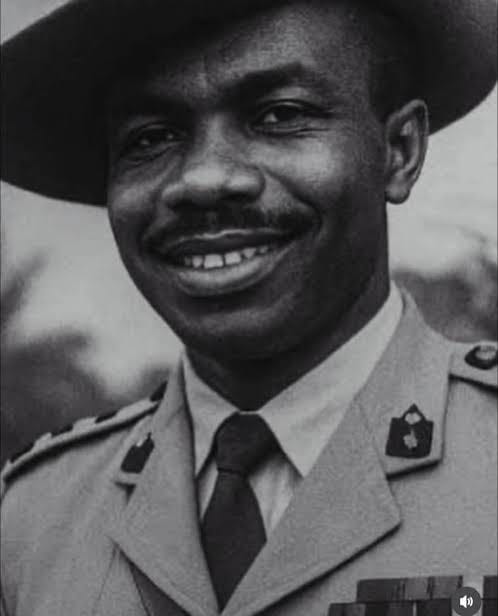
Some men become part of history because they held important positions.Others become history themselves.
Brigadier Wellington Bassey belonged to the second category.
Long before Nigeria became an independent nation, before Nigerians began to occupy the highest command positions in the country’s armed forces, Wellington Bassey had already broken one of the most formidable barriers of colonial Nigeria.
He became NA/1, the first formally numbered Nigerian commissioned officer in the Nigerian Army.
His commission marked a turning point in the history of Nigeria’s military establishment. At a time when the officer corps of the colonial military was overwhelmingly British, Bassey rose from the ranks to become an officer, opening a path that would soon be followed by some of the most consequential names in Nigerian military history, including Johnson Thomas Umunnakwe Aguiyi-Ironsi and Samuel Adesọji Ademulegun.
Born in 1918, Wellington Bassey, from present day Nsit Ibom Local Government Area, joined the Nigerian Army in 1936, entering an institution in which Africans were largely confined to non-commissioned ranks and in which the highest levels of command remained the preserve of expatriate officers.
For more than a decade, he served and rose through the ranks before the colonial military establishment finally opened the officer corps to indigenous Nigerians.
On 30 April 1949, Wellington Bassey was commissioned a Second Lieutenant by King George VI after completing officer training in Warwick, England.It was an extraordinary moment which marked the beginning of a new era in which Nigerians could progressively assume command responsibility in an institution that had previously been structured primarily to serve colonial interests.
Bassey was soon followed by Aguiyi-Ironsi as NA/2 and Ademulegun as NA/3 on 12 June 1949. Their commissions marked the early stages of the Africanisation of the Nigerian officer corps.
He acted as Aide-de-Camp to Sir John Macpherson who was the colonial Governor General of Nigeria between 1954 to 1955.
Bassey’s career subsequently placed him at the centre of some of the most important transitions in Nigeria’s military history.
When Nigeria attained independence in 1960, the Nigerian military was itself undergoing transformation. The Nigerian Military Force had become the Royal Nigerian Army and, following the country’s transition to a republic in 1963, became the Nigerian Army. The gradual transfer of command from British officers to Nigerians was one of the defining institutional changes of the period.Bassey was part of that transition.
He was also an officer of many firsts in the Nigeria Army.
As a Captain, he became the first Commandant of the Boys Company, the institution that evolved into the Nigerian Military School, Zaria.The school was established to combine military and academic education and to produce the indigenous manpower required to replace departing British colonial personnel.
In September 1962, as a Lieutenant Colonel, he became the first commander of the Federal Guards Company (now known as Presidential Guards Brigade), an elite formation established to provide protection for the federal seat of government and senior state institutions.
The Federal Guards represented the growing confidence of the Nigerian state in its own military personnel at a time when the country was still only two years into independence.
Bassey was therefore helping to build an institution whose history would become inseparable from the history of Nigeria itself.
His career continued through one of the most turbulent periods in the nation’s post-independence history.
At the time of the January 1966 military coup, Bassey was commanding the Regimental Depot in Zaria. Following the emergence of Major General Aguiyi-Ironsi as Military Head of State, he was appointed Brigade Commander of the 1st Brigade in Kaduna, taking over from Brigadier Samuel Ademulegun, who had been killed during the coup.
The appointment placed Bassey at the centre of the extraordinary military and political crisis that engulfed Nigeria in 1966.
It was a period in which military command, national politics and ethnic tensions became dangerously intertwined.
His military career came to an end around the period immediately preceding the Nigerian Civil War.
Yet retirement from active military service did not bring an end to his public service.
Bassey subsequently served Nigeria in diplomatic capacity, including as Consul and later as Nigerian Ambassador to Equatorial Guinea.
Wellington Bassey’s significance is not confined to military history only.His name has become part of the geographical memory of Akwa Ibom and the Nigeria Army.
In Uyo, Wellington Bassey Way is one of the major roads in the state capital, and leads to the Government House.
More significantly, the Presidential Guards Brigade is quartered at Camp WU Bassey in Abuja, and the Nigerian Army’s Ibagwa, Abak barracks bears his name.The barracks, today known as Wellington Bassey Barracks, commemorates the pioneering soldier’s contribution to the Nigerian military.
He died in 1995.
For Akwa Ibom, Wellington Bassey’s story is that of one of its earliest sons attaining national prominence through the military profession.
For Nigeria, it is the story of a pioneer.
As Akwa Ibom marks its 39th anniversary, Brigadier General Wellington Bassey is remembered as among the state’s historic leading lights as a HERO, a soldier whose name is permanently linked to the difficult transition from colonial military service to Nigerian command.
His legacy lives on, in the history of the Nigerian Army, in the Guards Brigade, in the Wellington Bassey Barracks, Ibagwa, on Wellington Bassey Way, Uyo.Above all, it lives in the historical record of NA/1, the number that announced the arrival of a new generation of Nigerian officers.
#AkwaIbomAt39
#IbomLeadingLights
#CelebratingOurHeroes
#39Heroes39Prides
#HeroWellingtonBassey
#The39thAnniversaryCollectives
#AkwaIbomStateMinistryOfInformation
#AriseAgenda