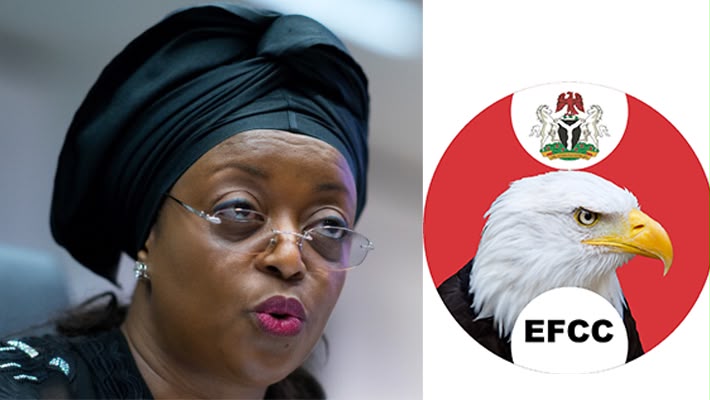
The Economic and Financial Crimes Commission (EFCC) has asked the Federal High Court in Abuja to treat former Petroleum Minister Diezani Alison-Madueke’s recent acquittal in the United Kingdom as having no bearing on her ongoing challenge to the forfeiture of her assets in Nigeria.
The commission’s position was contained in a further counter-affidavit filed on October 5 in opposition to Diezani’s bid to place the UK court’s decision before the Nigerian court as a subsequent development in her case.
Diezani was acquitted by the Southwark Crown Court in London on June 17, 2026, of criminal allegations of bribery brought against her in the UK.
But the EFCC argued that the British proceedings and the Nigerian case are separate matters and should not be conflated.
The commission maintained that the UK case was not before any Nigerian court and, therefore, could not determine the issues arising from Diezani’s challenge to the EFCC’s actions concerning her property.
The response followed an application by the former minister seeking permission to introduce the acquittal into the proceedings as a material development that occurred after her earlier court processes had been filed.
Through her counsel, Mike Ozekhome, Diezani argued that the development was relevant to questions surrounding conviction, fair hearing, due process and the propriety of continuing to deprive her of property.
She also made clear that she was not asking the Federal High Court to sit on appeal over the decision of the Southwark Crown Court or to treat the UK acquittal as automatically determining the Nigerian proceedings.
The EFCC, however, urged the court to reject that argument, insisting that the British judgment does not alter the issues in the suit.
In the further counter-affidavit filed through Oyakhilome Ekienabor, a litigation officer in the law firm of Mofesomo Oyetibo, counsel to the commission, the EFCC described the UK proceedings as unrelated to the substantive case before the Abuja court.
The commission further narrowed the subject of the forfeiture proceedings, arguing that the order in question concerned jewellery and did not cover other classes of assets or properties belonging to the former minister.
According to the EFCC, the attempt to introduce evidence of the UK acquittal alongside other matters contained in Diezani’s supplementary affidavit could distract the court from the actual questions raised by the suit.
It consequently asked the court to discountenance the supplementary affidavit to the extent that it seeks to rely on the UK acquittal.
At Tuesday’s proceedings, Queen-Ubokutom Uwe, who represented Diezani, informed the court that the defence team had only shortly before the hearing received the EFCC’s further counter-affidavit.
EFCC counsel, Paul Mgbeoma, told the court that the commission was ready to proceed with the matter.
The dispute therefore leaves the Federal High Court to determine whether Diezani’s acquittal in Britain qualifies as a material subsequent development in the Nigerian proceedings—or remains a separate judicial outcome with no bearing on the property dispute before it.