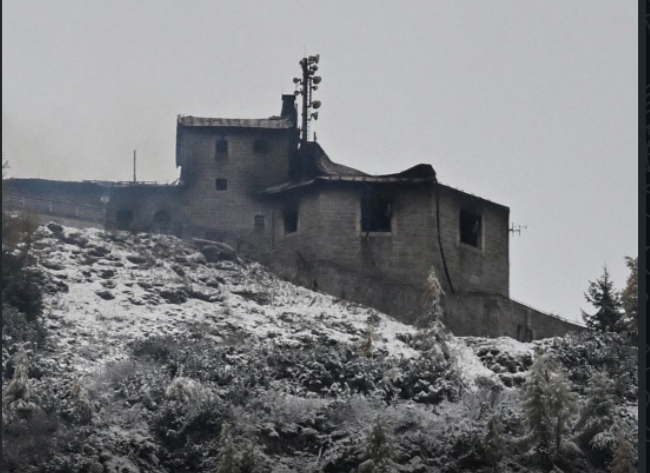
Germany is facing a difficult decision over the future of Adolf Hitler’s former mountain retreat, the Eagle’s Nest, after a fire destroyed much of the historic building in Bavaria last month.
The site, officially known as Kehlsteinhaus, was constructed in 1938 during the Nazi era and served as a meeting place where Hitler entertained senior Nazi officials and other important visitors. Its historical connection to the regime has made its future a subject of controversy.
The fire, which occurred on October 23, is suspected to have been deliberately started. Police say the building was largely destroyed, while a 33-year-old man with a history of mental illness has been taken into a secure psychiatric facility over allegations of arson.
The incident has reopened discussions about whether the remains should be cleared completely, rebuilt or preserved in a different form. While some historians believe the mountain should be returned to its natural state, others argue that removing the structure could create room for extremist groups to turn the location into a place of Nazi nostalgia.
Professor Richard J. Evans of the University of Cambridge believes the best option is to remove the remaining rubble and allow nature to reclaim the site. He described the building as a Nazi vanity project, arguing that preserving it is unnecessary given its historical background.
However, officials in Bavaria are more interested in rebuilding the structure. State Interior Minister Joachim Herrmann and Arts Minister Markus Blume have both expressed support for restoring the site, although the government has ruled out using public funds to finance the project.
Sven Keller, director of the Obersalzberg Documentation Centre, warned that simply demolishing the remains would not erase the site’s historical significance. He pointed to the destruction of Hitler’s nearby Berghof residence in the 1950s, explaining that the location continued to attract interest despite the building’s removal.
History professor Isabel Heinemann has proposed a different approach, suggesting that the authorities should document the damage caused by the fire and preserve selected historical sections while incorporating modern architectural designs. She believes a complete reconstruction would risk restoring the ideological appearance associated with Nazi Germany.
Before the fire, the Eagle’s Nest was one of Bavaria’s popular tourist destinations, attracting tens of thousands of visitors annually. It operated as a restaurant, with tourists travelling by bus before using a historic lift built into the mountain to reach the site.
Although the building was destroyed, the nearby Obersalzberg Documentation Centre, established in the 1990s to educate visitors about Nazi crimes, escaped the fire.
The controversy comes amid growing concerns over the resurgence of far-right politics in Germany and neighbouring Austria. Recent disputes over Nazi-era memorials have also intensified questions about how both countries should preserve historical evidence without allowing extremist groups to glorify the past.
For Germany, the challenge is no longer simply deciding what should happen to a damaged building. It is finding a way to confront one of the darkest periods in its history without turning a former symbol of Nazi power into a monument of admiration.