
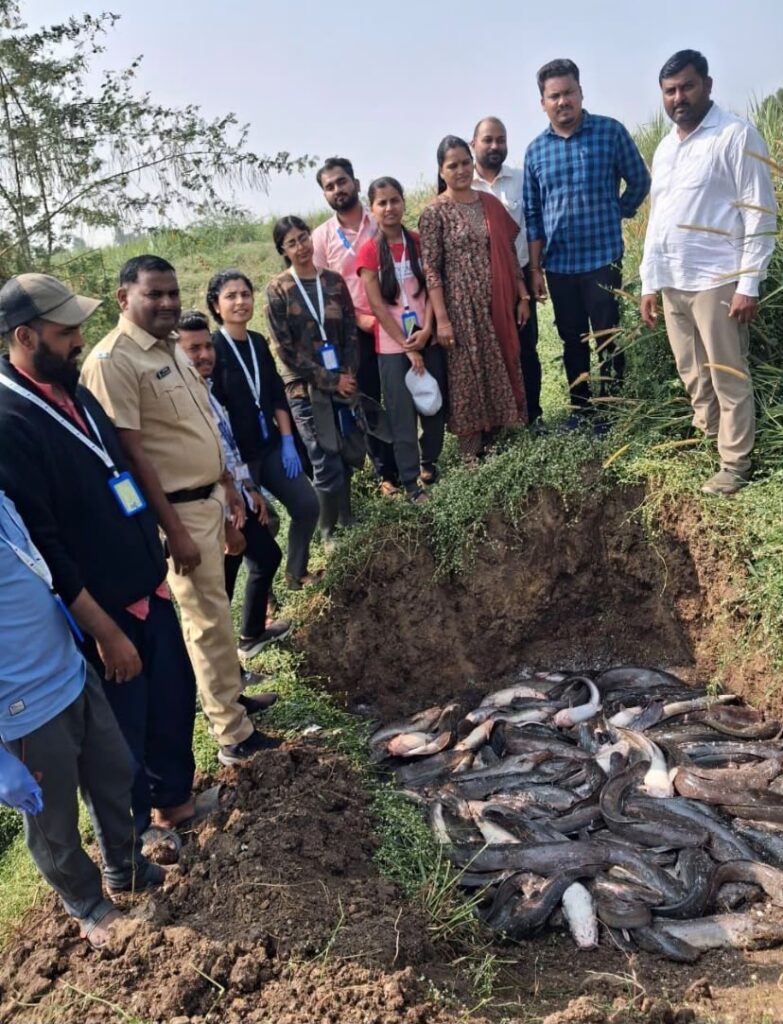
Indian authorities have destroyed more than 36 tonnes of banned Thai Mangur, or Thai catfish, after raiding 11 ponds where the fish was allegedly being illegally farmed in Nagpur, Maharashtra.
According to NDTV, the Fisheries Department carried out the operation in the Chicholi-Mahadula area of Parshivni taluka after receiving information about the illegal farming and sale of the fish. Officials reportedly used Google mapping to identify suspected ponds and deployed dummy customers to verify reports of illegal cultivation and sales before launching the raids.
The operation was led by Fisheries Department Assistant Commissioner Shubham Komrewar, with the assistance of about 25 local fishermen. The fishermen used nets to remove the fish from the ponds, after which more than 36 tonnes were reportedly buried in pits and destroyed.
The Times of India reported that the fish was found in 11 illegal farms in Chicholi-Mahadula and described the operation as part of a continuing crackdown on the species, which remains commercially attractive because of its rapid growth and market demand.
The scale of the crackdown is larger than the latest seizure. NDTV and The Economic Times reported that approximately 51 tonnes of Thai Mangur had been destroyed in the Nagpur region over the preceding three months, indicating that illegal cultivation has persisted despite the prohibition.
The fish is prohibited in India because of concerns over its impact on native aquatic species and biodiversity. A National Green Tribunal document states that the breeding and culture of exotic catfish, including Thai Mangur associated with Clarias gariepinus, are prohibited across Indian states and Union territories.
The concern is essentially ecological: an introduced species can compete with native fish for food and habitat and may alter aquatic ecosystems if it escapes from farms into rivers, lakes and other natural water bodies. India’s National Fisheries Development Board has also documented the prohibition on African catfish culture because of concerns about conserving native species and protecting biodiversity.
There is also an important distinction between the banned exotic catfish and India’s indigenous Clarias species. The National Green Tribunal has specifically noted the need to distinguish Clarias gariepinus – the exotic African/Thai Mangur commonly referred to in such enforcement actions – from the native Indian Magur, Clarias batrachus.
Despite the ban, the species continues to attract some fish farmers because it grows quickly and can tolerate relatively poor water conditions, making it commercially appealing. Indian authorities therefore face the challenge of enforcing environmental restrictions while dealing with an established market for the fish.
The Economic Times said the latest Nagpur operation involved more than 36,000 kilograms of fish and described the enforcement action as a response to illegal farming and sales. It also confirmed the department’s estimate that about 51 tonnes had been destroyed in the region within three months.
Authorities have reportedly filed a complaint seeking action against the owner of one of the farms, while the Fisheries Department is expected to continue monitoring ponds and suspected illegal aquaculture sites across Nagpur.
The Nagpur crackdown illustrates the wider problem facing countries that introduce non-native species into commercial aquaculture: a fish that may be profitable to farmers can become an ecological threat when it escapes into natural waterways. For India, the destruction of the seized fish is therefore being presented not merely as a fisheries enforcement exercise, but as an attempt to protect native aquatic biodiversity.