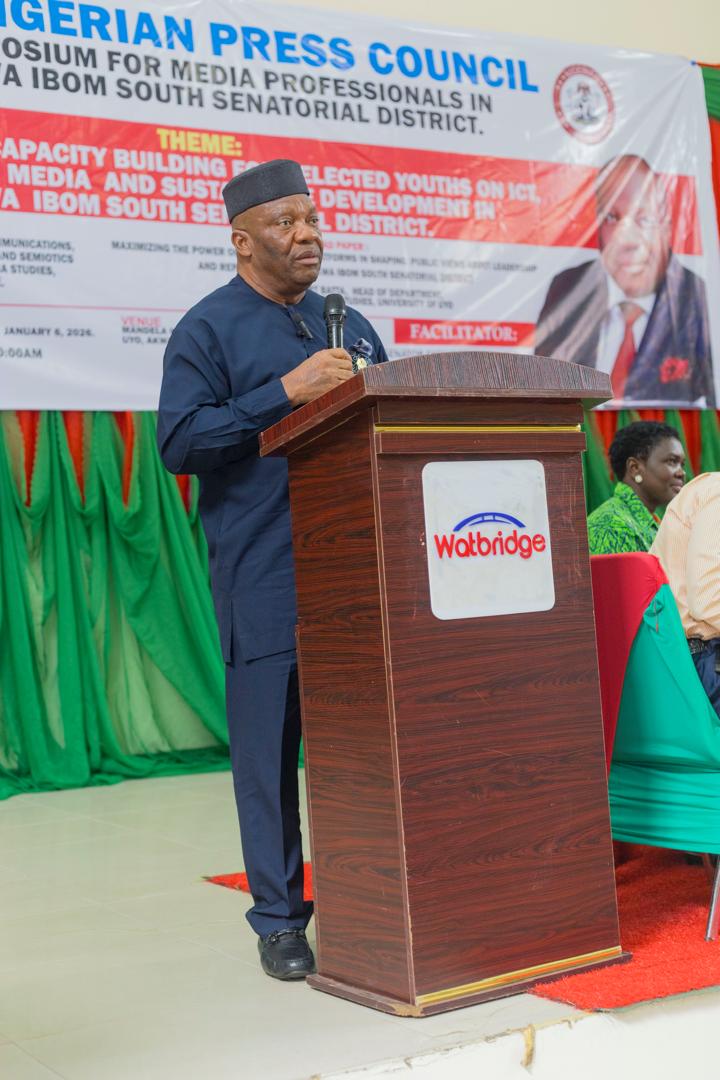
Media Must Build Democracy, Not Destroy It — Sen. Sampson As He Trains, Unveils Trust Fund for Journalists
Senator representing Akwa Ibom South, Ekong Sampson, has charged Nigerian journalists to embrace their responsibility as builders of democracy, warning that the media’s enormous power must be exercised with restraint, truth, and purpose.
He spoke at a media training organized by the Nigerian Press Council (NPC) and facilitated by his office on “ICT, Strategic Media Engagements and Sustainable Development,” held at Watbridge Hotels and Suites, Uyo on Thursday.
Addressing participants, Sampson identified the media as central pillars of the democratic process, not peripheral observers.
Recalling his insistence on voting during the last election of the Nigeria Union of Journalists, the Senator, who is a long-standing member of the union, said, “I voted to make a statement that the media can form family. The media plays a key role in our society and is part of the electoral framework.”
The Senator, who is Chairman of the Senate Committee on Solid Minerals, said his continuous engagement with journalists was intentional, aimed at creating spaces for reflection, learning, and recalibration in a rapidly evolving information landscape. He assured participants that such interactions would be sustained throughout his tenure in the National Assembly.
Tracing the evolution of Nigerian journalism from the era of Iwe Iroyin to the dominance of digital media, Sampson acknowledged the revolutionary impact of technology but warned against its misuse.
In his words, “The media can build empires and the media can also bring down empires. I therefore want to use this medium to urge media practitioners to prioritize truth, objectivity, and bridge-building.”
While cautioning that reckless reporting ultimately harms society, the lawmaker also urged journalists to interrogate global political developments, such as the Venezuelan crisis, as part of broader debates on sovereignty and global governance.
Reaffirming his legislative priorities, Sampson said education remains the foundation of journalism and national development. “Without education, there is no journalist,” he said, explaining that his interventions in scholarships and grants are driven by a belief that Nigeria’s path to greatness lies in human capital development.
He used the occasion to unveil plans to establish a Journalists’ Trust Fund in Akwa Ibom State to support the welfare, training, and professional development of media practitioners, saying the initiative would institutionalize support and strengthen professionalism in the sector.
Earlier, Chairman of the Association of Akwa Ibom South (Eket) Senatorial District Media Professionals, Dr. Edet Okpo, described the program as a deliberate shift from tokenistic empowerment.
“This is not about sharing rice. This is intellectual empowerment. This is innovation. Thank you, distinguished Senator Ekong Sampson, for your consistency in media capacity building since 2024,” he said.
Okpo said the symposium was designed to align journalists’ skills with contemporary realities in ICT, strategic communication, and sustainable development, as well as strengthen their mandate to promote transparency, accountability, and impact in governance.
In his keynote address, Professor Peter Esuh, Dean of the Faculty of Communication and Media Studies, University of Uyo, warned that digital technology has eroded traditional gatekeeping while amplifying ethical risks. He urged journalists to balance ICT competence with research, critical thinking, and ethical judgment to curb misinformation.
Delivering the lead lecture on “Maximizing the Power of Digital Media Platforms in Shaping Public Views About Leadership and Representation in Akwa Ibom South Senatorial District,” Professor Herbert Batta, Head of the Department of Information and Media Studies, University of Uyo, called for a shift from episodic reporting to development-focused journalism. He said the media’s real power lies in sustained engagement that tracks policies and outcomes, not fleeting outrage.
Also delivering a lecture on “X-Raying Public Interest and Expectations in Good Governance Through Legislation and Engagements,” Dr. Idongesit Ashameri, journalist, PR, and Media Consultant, urged journalists to see themselves as “public interest cartographers,” noting that media professionals are tasked with mapping the gap between legislative promises and citizens’ lived experiences. She warned against self-censorship and performative governance, stressing that society suffers more from poor implementation than lack of laws.
Ashameri called for investigative, beneficiary-centered, and data-driven reporting that X-rays legislation, budgets, and public engagements, arguing that accountability journalism remains democracy’s strongest corrective mechanism.
The event climaxed with the conferment of the Outstanding Public Service and Effective Representation Award on Senator Sampson by the Association of Eket Senatorial District Media Professionals.