The Democratic Party may have found a new strategy for challenging Republican dominance in traditionally conservative states, following a major electoral breakthrough in South Carolina that party leaders believe could shape their approach to the 2028 presidential election.
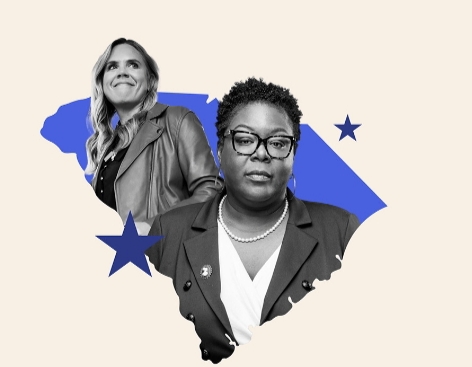
The victory of Dr Annie Andrews, who became the first Democrat to represent South Carolina in the US Senate in more than two decades, has attracted national attention. Her success is being viewed as evidence that Democrats can make significant gains in Republican strongholds by focusing on issues that directly affect voters rather than relying heavily on party loyalty.
Andrews defeated Republican incumbent Darline Graham in the 2026 midterm elections after building her campaign around affordable healthcare, better-funded public schools and the concerns of ordinary families. A paediatrician and mother of three, she also strongly defended abortion rights and criticised Republican leadership in Washington.
Her campaign deliberately reached beyond traditional Democratic supporters, engaging rural communities, independent voters and even Republicans who were dissatisfied with their party’s direction.
Ryan Barto, a communications director for Andrews’ campaign, said her background as a mother and medical professional helped voters connect with her beyond political party affiliations. According to him, she spent time discussing issues such as struggling rural hospitals and rising diesel costs with local communities.
The campaign’s success was also supported by an extensive grassroots network established by the South Carolina Democratic Party. Its chairman, Christale Spain, used the state’s position as the first presidential primary state to attract national political figures, funding and media attention.
Through a programme known as On the Road, Democratic leaders travelled beyond major political centres to interact with residents across the state. The initiative helped strengthen the party’s visibility, encourage potential candidates and create an organisational structure that supported several Democratic victories.
Beyond Andrews’ Senate win, Democrats also secured the state’s 1st Congressional District and reduced Republican supermajorities in both chambers of the South Carolina legislature.
Black voters played an important role in the outcome. Seven of the 10 Democrats who gained seats in the state legislature were African Americans, highlighting the importance of sustained political engagement within Black communities.
Political strategist Antjuan Seawright, who advised Andrews’ campaign, said the election produced an unusual alliance of African American voters, women, independents, rural residents, non-college-educated voters and some Republicans.
He described the coalition as potentially a once-in-a-generation political achievement, arguing that the campaign succeeded because it brought together groups that had rarely united behind a Democratic candidate in the state.
The result has also renewed attention on the political influence of veteran Democratic Representative James Clyburn, who has spent decades advocating stronger engagement with Black voters across the American South.
Democrats are now looking at whether the South Carolina experience can be replicated elsewhere ahead of 2028. Their recent victories in traditionally Republican-leaning states, including Georgia, North Carolina and Texas, as well as Scott Colom’s historic Senate breakthrough in Mississippi, have strengthened arguments for expanding their reach in the South.
However, party officials acknowledge that South Carolina enjoys certain advantages because of its early position in the presidential primary calendar. Nevertheless, Spain believes other state organisations can adopt similar approaches by investing in grassroots mobilisation, welcoming national party leaders and building stronger relationships with communities.
Under the Democratic National Committee’s State Partnership Program, state parties receive $17,500 monthly, while Republican-leaning states such as South Carolina receive an additional $5,000.
For Democrats, the central lesson from the South Carolina election is that winning traditionally conservative territory may require more than national campaign messages and party endorsements. Building trust, addressing local economic concerns and bringing together voters with different political backgrounds could prove decisive in the battle for 2028.