
By N.T.A.EFO
On September 1, 2026, when a brand-new Airbus A220-300 touched down at the Victor Attah International Airport, Uyo, to join the fleet of Ibom Air, it was another milestone in the remarkable aviation story of Akwa Ibom State.
For Governor Umo Eno, it was another reason for gratitude. For Ibom Air, it was another decisive step in the transformation of a state-owned airline into an increasingly significant regional carrier.
The arrival of the latest Airbus brings Ibom Air’s fleet to 10 aircraft — seven Bombardier CRJ-900s and three Airbus A220-300s. More significantly, five of those aircraft, three Airbus A220-300s and two CRJ-900s, have been acquired under the administration of Governor Eno.
But to understand the meaning of the third Airbus, one must go back much further than September 2026.
The aviation story of Akwa Ibom did not begin with Ibom Air. The idea of creating a major aviation gateway for the state dates back to the era of Governor Victor Attah. It was an idea that encountered political resistance, but survived.
That persistence eventually produced the airport infrastructure that would become the foundation for a much larger aviation ecosystem.
Obong Victor Attah laid the foundation, Senator Godswill Akpabio built on it and landed the first aircraft, Mr Udom Emmanuel started the ultra modern terminal, established Ibom Air, and Governor Umo Eno completed the ultra modern terminal, expanded the fleet and is building an aviation ecosystem never ever seen in Nigeria before.
Ibom Airlines Limited, trading as Ibom Air, received its Air Operator’s Certificate from the Nigerian Civil Aviation Authority in May 2019 and commenced scheduled operations on June 7, 2019. Established as a wholly owned enterprise of the Akwa Ibom State Government, Ibom Air was conceived to improve access to Akwa Ibom, provide dependable air connectivity and serve as a catalyst for economic activity.
It began operations with Bombardier CRJ900 aircraft and quickly established a reputation around schedule reliability, on-time performance and customer service.
In October 2021, Ibom Air placed a firm order for 10 brand-new Airbus A220-300 aircraft. The agreement was formally signed at the Dubai Airshow in November 2021 in the presence of then Governor Udom Emmanuel.
While awaiting delivery of the new aircraft, the airline took interim measures to meet growing demand.In June 2021, Ibom Air had welcomed two A220 aircraft through a wet-lease arrangement with EgyptAir as a stop-gap measure while negotiations continued for a permanent fleet of brand-new A220s. In November 2022, two Airbus A320-200 aircraft were also brought into the fleet through a one-year wet-lease agreement with GetJet Airlines. The arrangement was explicitly described by the airline as a temporary measure to accommodate growth while awaiting delivery of its 10 new A220-300s.
On December 8, 2023, under Governor Eno, Ibom Air received its first brand-new Airbus A220-300 at Uyo. The aircraft’s title had been transferred in Mirabel, Canada, on November 24, 2023, before it travelled through Toulouse, France, to Abuja and finally arrived in Uyo at 11:10 a.m. on December 8.
At that reception, Governor Eno acknowledged the contributions of his predecessors to the development of aviation in Akwa Ibom and reiterated his administration’s commitment to Ibom Air.
That moment was important because it established a pattern that would become even more visible three years later: That the Umo Eno administration would invest maximally in Ibom Air.
The first A220 also represented a technological leap. According to Ibom Air, the aircraft brought superior comfort and safety, reduced environmental impact, in-flight Wi-Fi, in-seat power and overhead video displays.
By August 2024, the second A220 had joined the fleet, complementing the first aircraft delivered in November 2023. The same year, Governor Eno’s administration also strengthened the airline’s regional fleet by purchasing two Bombardier CRJ900 NextGen aircraft outright. The two aircraft, registered 5N-CED and 5N-CEE, were received in Uyo in November 2024.
Governor Eno described their arrival as an assurance of his administration’s continued support for Ibom Air and linked the investment directly to the ARISE Agenda’s objective of making strategic investments capable of stimulating economic growth. Those two CRJ900s, together with the three A220s, now constitute the five aircraft acquired under the Eno administration.
And so, on September 1, 2026, the third brand-new Airbus A220-300 arrived. Governor Eno had personally travelled to Airbus in Mirabel, Canada, for the pre-delivery inspection of the aircraft. Airbus officials had described the relationship with Akwa Ibom as a strong partnership and assured the state of continued support for Ibom Air’s growth. The aircraft was subsequently flown directly from the Airbus assembly facility in Mirabel to Uyo for its formal reception.
At the reception, Governor Eno did not merely celebrate the arrival of another aircraft. He placed it within the larger economic story of Ibom Air. According to the Governor, the airline had, by the time of the ceremony, carried 4,953,512 passengers on 65,152 scheduled flights, putting it on course to cross the five-million-passenger mark before the end of September 2026.
Governor Eno disclosed that more than N60 billion had been directly spent in the Akwa Ibom economy through airline operations, while Ibom Air had 753 full-time direct employees, 478 of whom, 64 percent, are Akwa Ibom indigenes. The airline also sustains an estimated 2,000 indirect jobs in the state.
Governor Eno had already captured the philosophy behind the acquisition during his August 2026 return from Canada.
Explaining why he personally went to inspect the aircraft, he said: “This is the third aircraft we are getting from Airbus since we came in 2023, and we also got two CRJ 900, fully paid for. So, we have done five, and that shows consistency.”
That word, consistency, may well be the defining word of the third Airbus because the story is not simply about acquisition. It is about keeping faith with an institution. It is about recognising that successful enterprises require sustained investment.It is about understanding that one aircraft can increase capacity, but a fleet can transform an airline. Finally, it is about seeing aviation as an ecosystem rather than a collection of aircraft.
Perhaps the most expansive description of what Akwa Ibom is building is the combination of the airport, the airline and the Maintenance, Repair and Overhaul facility, the MRO, as a “tri-fold aviation system.”
The emerging ecosystem is known as an “Aerotropolis,” defined as a city within a city capable of generating foreign exchange, driving tourism, expanding air cargo and developing high-skilled local capacity. That is the bigger picture.
Ibom Air is one leg. Victor Attah International Airport is another. The MRO is another. The aviation village and other supporting infrastructure completes the ecosystem.
Governor Eno himself has said that when the aviation ecosystem begins to operate at full capacity, its impact will go beyond transportation to jobs, economic activity and the state’s GDP.
The third A220 also opens a new chapter for Ibom Air’s regional ambitions. Ibom Air currently operates domestic routes and a regional service to Accra, Ghana. But the airline’s Chairman, Mfon Udom has said the new aircraft would help restore core domestic frequencies while laying the foundation for wider intra-African connectivity.
“We are going to expand our activities both domestically and regionally,” Udom said.
He specifically identified Douala in Cameroon, Libreville in Gabon and Malabo in Equatorial Guinea as the first phase of the airline’s planned regional expansion beyond Accra.
The third A220 is also significant because of the aircraft itself. At the reception, Ibom Air’s Chief Pilot, Ruth Adebanwo, highlighted the technological advantages of the A220 platform, including its reduced carbon footprint, quieter cabin, lower operating costs and fuel efficiency. These festures are important to an airline like Ibom Air which is expanding. Fuel efficiency affects operating economics. Lower operating costs affect sustainability.
Passenger comfort affects competitiveness while modern technology becomes increasingly important as the airline expands into international and regional markets.
The A220 is, therefore, a platform for the next phase of Ibom Air’s growth.
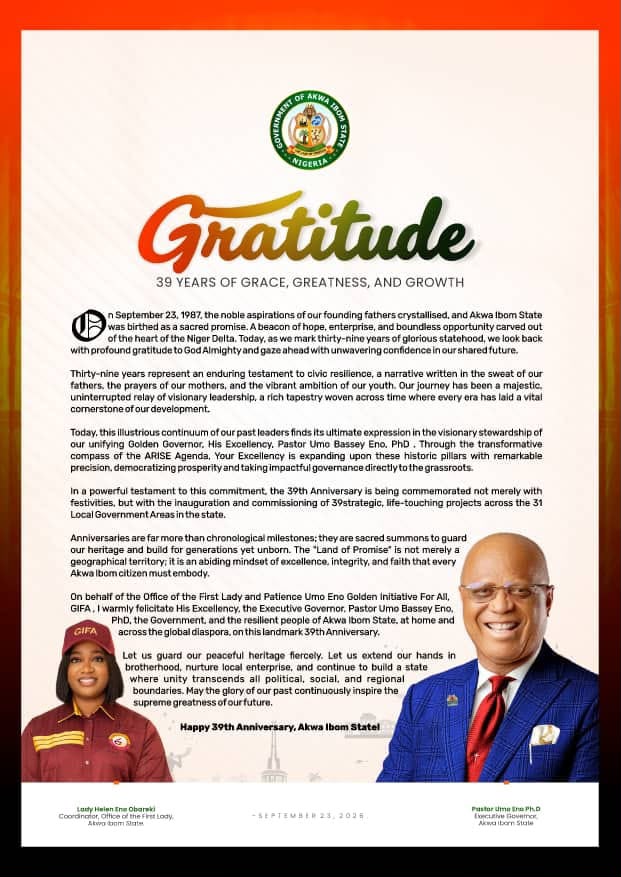
Governor Eno disclosed at the reception that the aircraft was one of 39 key initiatives marking Akwa Ibom’s 39th anniversary. It could hardly have been more appropriate. As Akwa Ibom looks back on 39 years of statehood, the third Airbus offers a physical representation of the distance travelled. From an idea conceived decades ago to an international airport.
From an airport to a state-owned airline.
From a young domestic airline to a carrier approaching five million passengers. From a handful of aircraft to a 10-aircraft fleet. From domestic connectivity to ambitions for Douala, Libreville and Malabo. From an airline to an emerging aviation ecosystem.
But perhaps the most beautiful way to understand this story is through gratitude. Governor Eno has consistently spoken about governance as stewardship. And nowhere is that philosophy more evident than in his approach to inherited projects.
He did not establish the idea of the airport. He did not establish Ibom Air. He inherited them, and has been expanding them. That is why the third Airbus can be described as a canon of gratitude.
The first gratitude to Obong Victor Attah for the original aviation vision. The second gratitude to Senator Godswill Akpabio for advancing the airport project and bringing aviation infrastructure closer to reality. The third gratitude to Mr Udom Emmanuel for establishing Ibom Air. The next gratitude, expressed through action, by Governor Eno for taking that inheritance and investing further in it. Another to the staff and management of the airline for sustained high level and remarkable operations. Another one yet, for the customers of the airline for believing in its capacity and maintaining loyalty to the brand. Lastly, the ultimate gratitude to God Almighty, the maker of heaven and earth for protection, safety, security and prosperity.