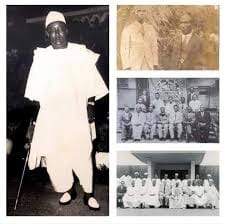
Dr. Esin Anwana Esin was a pioneering physician, statesman, senator, Federal Minister and community leader whose remarkable life reflected the transformative power of education, professional excellence and public service.
He belonged to the pioneering generation of Akwa Ibom sons who recognised very early that education was the pathway to personal advancement, community development and meaningful participation in the affairs of a rapidly changing Nigeria.
Born on September 5, 1908, Dr. Esin Anwana Esin grew up at a time when access to formal education for African children was still limited and opportunities for professional advancement were few. Yet, through determination, intellectual ability and the support of his community, he rose to become one of the earliest professionally trained medical practitioners from Nigeria.
Dr. Esin’s educational journey must be understood against the background of the remarkable emphasis that our people placed on education in the early decades of the twentieth century.
Oro was among the areas of what is now Akwa Ibom that embraced Western education relatively early. The establishment of the Oron Native Training Institute in 1905, later known as Oron Institute, was an important milestone in this development. The school became one of the earliest educational institutions in the area and attracted students from Oro and neighbouring communities.
Infact his father, the late Oro pathfinder, Offong John Anwana Esin was a pioneering figure in the history of the Oro Nation. As one of the founding members of Oron Union in 1925, he played a pivotal role in shaping its early direction. He not only made the first financial contribution toward the Union’s establishment but also graciously hosted its inaugural meeting at his residence in Esin Ufot, Oron Town.A man of considerable influence, vision, and enterprise, Chief Esin served as a British Political Agent during his lifetime and was a prominent palm produce industrialist. In 1924, he made history by acquiring a Ford Model TT One Ton Lorry from Weeks Transport & Engineering Company, becoming the first Oro indigene to own a motor vehicle.He was also the first Paramount Chief in Oro Nation. His children aside Dr Anwana were Mrs. Arit O. O. Ita, the first Oro Headmistress of a Primary School, Chief (Mrs.) Edu Uye, the first female student to be admitted to the Higher School Section of the famous Methodist Boys’ High School, Oron and the first “Old Boy In Skirt’s of the School , first Oro Female Chartered Accountant and first Bursar of the University of Uyo, and Justice Okon Anwana Esin, the first Oro man to earn a Master’s Degree in Law, the first to serve as a State Attorney General, and the first Legal Adviser to the President of the Federal Republic of Nigeria.
It was within this emerging culture of education that the young Esin developed the foundation for the professional career that would eventually take him to Britain.
The Oron Union placed education at the centre of its development agenda. The Union understood that the future depended on producing educated professionals who could return home and contribute to the advancement of their people.
In 1942, the Union established an overseas scholarship scheme funded through the sacrifices of Oro workers, who contributed the equivalent of a month’s salary to finance the education of promising young men abroad.
Dr. Esin Anwana Esin became one of the first beneficiaries of this historic scholarship scheme. According to Oron Union’s historical account, he left for the United Kingdom in 1944 to study medicine, making his journey one of the earliest examples of Oro’s collective investment in professional education overseas.
His scholarship, therefore, represented a social contract between an emerging community and one of its brightest sons: the community invested in his education, and he would eventually use his knowledge and professional accomplishments in the service of society.
In Britain, Dr. Esin undertook medical training and achieved a remarkable set of professional qualifications.
He obtained L.R.C.P. Edinburgh, L.R.C.S. Edinburgh, and L.R.F.P.S. Glasgow in 1949
These qualifications were the recognised professional credentials of the period and established him as a fully trained medical practitioner.
His achievement was extraordinary for a Nigerian of his generation. At a time when professionally trained African doctors were still very few, Dr. Esin had acquired medical qualifications from leading Scottish institutions and was returning with knowledge that was desperately needed in a developing colonial society.
He became widely remembered as the first Oro medical doctor, making his achievement a landmark not only in his personal history but also in the history of medical education and professional advancement among the Oro people.
Before entering the political arena, he had already established himself professionally and had become involved in the affairs of his community.
An important indication of his early community leadership is his connection with the Oron Union’s Ikot Ekpene Branch, which was established in 1935, and which he served as branch’s first president.
He was not simply a beneficiary of community development; he became one of its active leaders.
Having established himself as a medical professional and community leader, Dr. Esin eventually entered politics and rose to national prominence during Nigeria’s formative years.
He became a Minister and subsequently served as a Senator, becoming one of the earliest Akwa Ibom sons to attain high national political office.
His transition from medicine to politics was characteristic of the pioneering Nigerian professionals of his generation. Their education had opened doors not only to professional careers but also to leadership roles in the struggle to shape the institutions of an emerging nation.
One of the most enduring aspects of Dr. Esin’s ministerial career was the campaign for the abolition of the Osu system, a discriminatory social institution that affected thousands of people in parts of Eastern Nigeria.
As Minister of Welfare, as a principal supporter and proponent of legislation to abolish the Osu system, working with Dr. Nnamdi Azikiwe, then Premier of Eastern Nigeria, he worked on a legislation which was passed on May 10, 1956, formally abolishing the system and the social disabilities associated with it.
Dr. Esin’s involvement in this historic reform is an important part of his legacy because it demonstrates that his public service extended beyond holding political office. He used political authority to address a deeply rooted social injustice.
His contribution placed him among the Nigerian leaders of his generation who understood that nation-building required the dismantling of oppressive social practices.
Even after his period in high political office, he is said to have returned to work at the hospital in Oron.
As Akwa Ibom celebrates 39 years of statehood, we remember Dr. Esin Anwana Esin as one of the early pathfinders whose life helped demonstrate what education, professional excellence and responsible leadership could achieve for the larger society.
#AkwaIbomAt39
#IbomLeadingLights
#CelebratingOurHeroesOurPrides
#39Heroes39Prides
#HeroEsinAnwanaEsin
#The39thAnniversaryCollectives
#AkwaIbomStateMinistryOfInformation
#AriseAgenda