(Series 213 — Phase 3)
By Emmanuel Ndon
For a child entering a primary school each morning, the condition of the classroom is not an abstract infrastructure question. It determines where the child sits, whether the roof protects against rain, whether there is adequate space to learn, whether there are functioning toilets and whether the school environment communicates that education is something worth investing in. This is why the release of ₦15 billion in counterpart funding to the Akwa Ibom State Universal Basic Education Board carries significance far beyond the value of the cheque.
Governor Umo Eno announced the release as part of the State’s commitment to accessing and implementing Universal Basic Education interventions. The funding is designed to support SUBEB projects across public schools, with interventions covering infrastructure and learning facilities. Recent disclosures by the Board indicate that matching grants have enabled work including classroom construction, furniture, perimeter fencing, water, sanitation and hygiene facilities as well as the provision of learning materials.
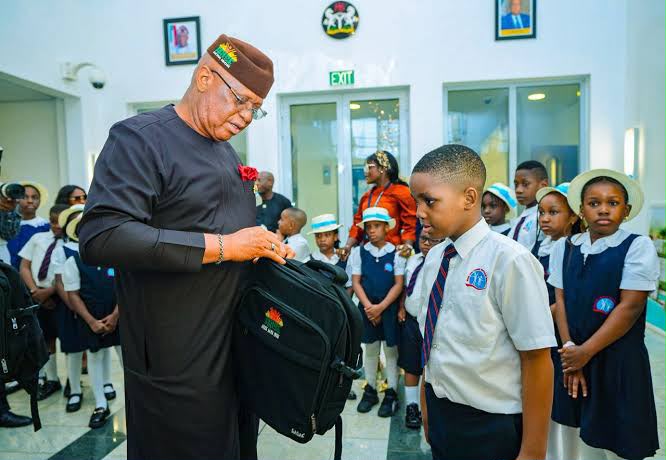
The first beneficiaries are therefore the children themselves. A reconstructed classroom provides more than a new building. It creates a physical environment in which pupils can sit, listen, read, write and interact with teachers without the distractions and risks associated with deteriorating infrastructure. Where schools receive adequate furniture, functional sanitation facilities and other basic amenities, the daily experience of learning becomes more orderly and dignified.
For families, the benefit is equally important. A child does not experience a school project in isolation from the household. Parents and guardians carry the consequences when a school lacks basic facilities, particularly when they have to compensate privately for shortcomings in the public system. Stronger public primary schools reduce some of that pressure by bringing essential educational infrastructure closer to the communities where children live.
The intervention also has an important equity dimension. Not every family can afford to send a child to a well-equipped private school. For many households, the public primary school is the most accessible route to formal education. Improving those schools therefore means improving the educational environment available to children regardless of their parents’ income, occupation or social circumstances. AK-SUBEB itself describes its mandate in terms of providing equitable and quality basic education for children across the State’s 31 local government areas.
The benefits extend into the communities around the schools. Construction and reconstruction projects create demand for local labour, artisans, suppliers, transport services and other businesses during implementation. Once completed, the facilities become long-term community assets. A properly fenced school is safer, a functional water system improves hygiene and adequate sanitation protects children and staff from conditions that can undermine attendance and wellbeing.
There is also a direct relationship between infrastructure and the effectiveness of teachers. A teacher working in a properly equipped classroom has a more suitable environment in which to organise lessons and engage pupils. This is particularly important because the State has simultaneously been expanding its investment in the teaching workforce. AK-SUBEB opened recruitment for 1,000 teachers in June 2026, while Governor Eno announced a further recruitment of 2,000 teachers in October as part of the wider education-sector intervention.
The physical transformation is already visible in projects undertaken under the administration. Governor Eno said in October that 38 model primary schools had been constructed and furnished, with at least one in each of the State’s 31 local government areas. These facilities include solar power, ICT centres, sick bays, libraries, assembly halls and teachers’ residences, showing the extent to which the concept of a primary school is moving beyond a collection of classrooms.
The scale of the latest funding becomes apparent when viewed against what AK-SUBEB has reported since 2023. In September, the Board said about ₦10.9 billion had been provided by the State as counterpart funding for Universal Basic Education matching grants between 2023 and 2026, helping unlock intervention funds for infrastructure and learning facilities. The Board also reported the construction of 34 classroom blocks during the period. The recently announced ₦15 billion therefore represents a substantial continuation and expansion of the funding mechanism through which more schools can be reached.
The wider economic return is long-term because primary education is where much of a child’s educational foundation is formed. Classrooms, books, furniture, sanitation, electricity and digital facilities do not automatically produce good learning outcomes, but they create the conditions in which teachers can teach and children can learn. Combined with teacher recruitment, training and stronger accountability, improved infrastructure can contribute to a school system better equipped to build literacy, numeracy, confidence and the basic skills children will need at later stages of education.
There is also a generational dimension. A primary school reconstructed today may serve thousands of children over many years. Its benefits can therefore outlive the funding cycle that created it. Children who learn in safer and better-equipped schools become teenagers with stronger foundations, graduates with greater educational possibilities and eventually adults whose skills contribute to the economy of their communities. Investment in primary schools is consequently an investment whose returns can continue to appear long after the construction work has ended.
That is the larger meaning of the ₦15 billion commitment. The most important beneficiaries are not the structures themselves but the children who will occupy them, the teachers who will work in them and the families who depend on them. In communities where a dilapidated classroom gives way to a functional school, the change is experienced every school day. Through the SUBEB intervention, Governor Umo Eno’s education investment is therefore reaching one of the most consequential points in the life of a child: the place where the foundation is first laid.