N.T.A Efo
Some men inherit a title. Others create a ilegacy so enduring that the title becomes secondary to the name.
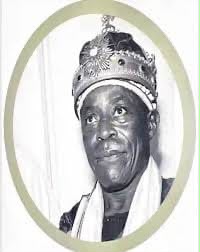
Chief Nyong Essien, the late Nsom of Uruan, belonged to the latter category.
Long before Akwa Ibom State came into existence in 1987, Chief Essien had already established himself as one of the most formidable voices of the people of the area in the political, educational and traditional evolution of Nigeria.
He was a teacher, educationist, community organiser, legislator, nationalist, traditional ruler, and defender of indigenous rights.
His life straddled several defining chapters in Nigeria’s journey from colonial rule towards self-government and independence.
Born on 9 November 1872, into the royal family of Akpan Efiom-Iwat Effembe Efiom in Issiet Ekim, Southern Uruan, he grew into a man whose influence would eventually extend far beyond his immediate community.
His formal education began relatively late by today’s standards. In 1900, at the age of 28, he was admitted to Duke Town School, Calabar, operated by the Church of Scotland Mission.His intellectual ability quickly became evident.
By 1904, he had distinguished himself so remarkably in the school’s general examination that he became senior prefect and was awarded the prestigious DUX distinction. His name was reportedly engraved as No. 1 on the school’s brass honour roll.
But education, for Chief Essien, was never simply about personal advancement.It became the foundation upon which he built a lifetime of public service.
He served as an interpreter in the Supreme Court and became involved in organisations seeking political representation, justice and equality for people living in Calabar and the wider mainland territory.
In the 1920s, he emerged as one of the leading organisers of the Ibibio people.In October 1924, Chief Essien invited mainland Ibibio indigenes, then comprising of all the people from present day Akwa Ibom, to his residence in Calabar, where he helped form what became the Ibibio Association and Community League.
The movement subsequently evolved into the Ibibio Union, which became one of the most influential indigenous organisations in colonial Nigeria.
His contribution to the development of the Ibibio Union was therefore not incidental.He belonged to the generation that recognised that scattered communities could not effectively negotiate with a powerful colonial administration unless they developed structures of collective organisation.
The Ibibio Union became such a structure.It mobilised people around education, social advancement, self-reliance, political representation and the protection of collective interests.
Obong Essien was at the centre of that awakening though his activism was not restricted to Ibibio affairs.He was also deeply involved in the struggle for the political rights of non-Efik residents of Calabar.
He held other leadership positions, including President of the Legal Servants and Aspirants Association of Calabar (where Dr. Nnamdi Azikiwe once served as Secretary), member of both the Calabar and Uruan Native Authority Councils, and Secretary-General of the Uyo Divisional Council (1932–1936). He also founded and led movements such as the Calabar People’s Rights and Liberties Protection Union and the Uruan National Council.
At a time when political representation and participation were heavily influenced by colonial structures and traditional hierarchies, Obong Essien challenged discriminatory arrangements and advocated a broader conception of citizenship and representation.
He argued for justice and representation for taxpayers irrespective of their place of origin and pushed for the transformation of the Obio Efik Council into a more inclusive Calabar Council.His interventions contributed to reforms in the colonial administration and helped widen political participation in Calabar.
In 1938, following sustained representations by Ibibio leaders for political representation, Obong Essien was nominated and approved as the representative of the six Ibibio Colonial Districts in the Legislative Council in Lagos.
He became the voice of an entire people at a time when indigenous representation in the colonial legislature was still severely restricted.
His arrival in the Legislative Council was historically significant.He was there as the spokesman of the people of the Mainland Territory, what was then known as the Ibibio Division and which substantially corresponds to today’s Akwa Ibom State.
For more than two decades, he participated in Nigeria’s evolving constitutional and political process.
He was particularly vocal on questions concerning the rights of traditional rulers and the place of indigenous institutions in the emerging political order.
In 1947, Chief Essien represented Eastern Nigerian Chiefs in the NCNC Pan-Nigeria Delegation to London, where he was hailed as the “Father” of the delegation. Known as a fearless orator, he lectured widely for the NCNC across the three regions of Nigeria and helped establish several of its branches. Under the Richards and Macpherson Constitutions, he served in the Legislative Council of Nigeria, and from 1954 to 1955, he was a member of the Eastern Regional Production Development Board
His advocacy eventually helped shape one of his most enduring national achievements: the establishment of the Eastern Regional House of Chiefs.
When the question of creating a House of Chiefs in the Eastern Region became a major constitutional issue, Nyong Essien was among the strongest advocates for the institution.
He participated in the 1957 Constitutional Conference in London, where he argued for recognition of the traditional institutions of the Eastern Region.His advocacy succeeded.
The Eastern House of Chiefs was eventually constituted, and in January 1960, Chief Essien was appointed its first President.
The parliamentary records of October 1960, for instance, identify Chief the Hon. Nyong Essien as President of the Eastern House of Chiefs as he presided over proceedings attended by Dr. Nnamdi Azikiwe, then Governor-General-designate of Nigeria.
During the economic difficulties of the 1930s, he organised farmers and traders and helped establish the Eastern Provinces Trade Depression Association, through which he advocated for better opportunities for local producers and direct access to international markets.
He also played a role in efforts to protect community interests against colonial policies affecting forests and mangrove lands.
In one notable instance, he protested the proposed declaration of mangrove swamp areas in Calabar, Qua, Efut, Uruan, Oron and Efiat as forest reserves without adequate consultation with the communities that owned the lands.
His intervention contributed to the reversal of the proposed declaration.
Perhaps no chapter of his life better connects the statesman with the traditional ruler than his emergence as Nsom of Uruan.Chief Nyong Essien became the first officially recognised Nsom of Uruan in 1952, and Paramount Ruler of old Uyo Local Government Area in 1979.
The traditional institution itself acquired a new significance under his leadership. The Nsom stool was elevated to first-class status and given an official staff of office.Thus, the man who had spent decades speaking for his people in legislative chambers and political forums returned to the traditional institution to provide another form of leadership.
By the time he became Nsom, he had already served as an educator, administrator, community organiser, political representative, constitutional advocate and legislator.He brought all these experiences to the traditional institution.He demonstrated that traditional leadership could coexist with intellectual sophistication, political consciousness and a commitment to public service.
His love for knowledge was equally legendary.Chief Essien maintained an extensive private library known as the Shekinah Library. The library contained thousands of books. It was later handed over to the University of Uyo, whose library bears his name.
His contributions has consequently been recognised through several honours, including the Commander of the Order of the Niger (CON) and the Order of St Michael and St George (CMG).
A major street in Uyo bears his name, while his statue stands at a prominent roundabout in the state capital.
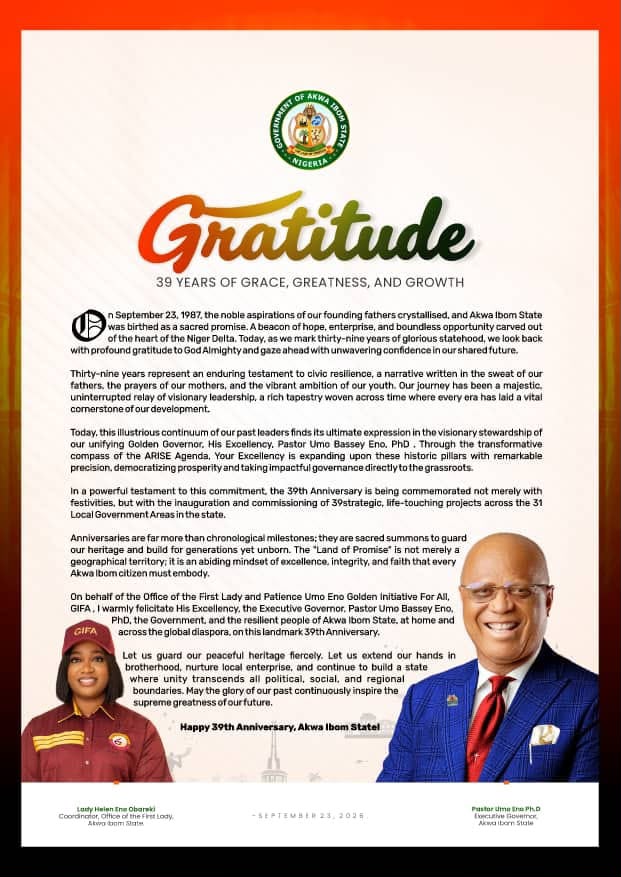
As Akwa Ibom marks its 39th anniversary, Chief Nyong Essien deserves to be remembered not merely as the late Nsom of Uruan, but as a HERO, one of the men who helped lay the foundations upon which the modern state was eventually built.
#AkwaIbomAt39
#IbomLeadingLights
#CelebratingOurHeroes
#39Heroes39Prides
#HeroNyongEssien
#The39thAnniversaryCollectives
#AkwaIbomStateMinistryOfInformation
#AriseAgenda