Idongesit Ashameri, Uyo
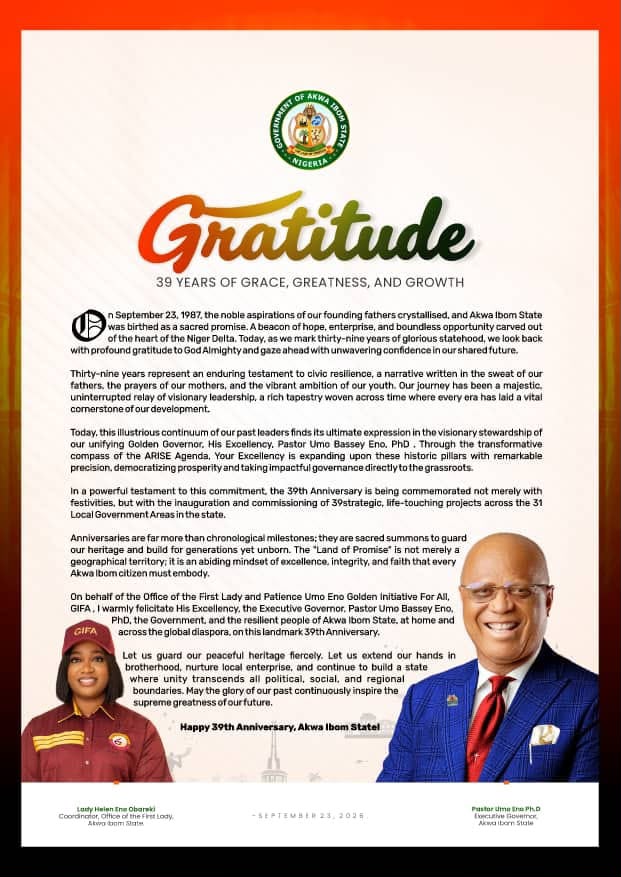
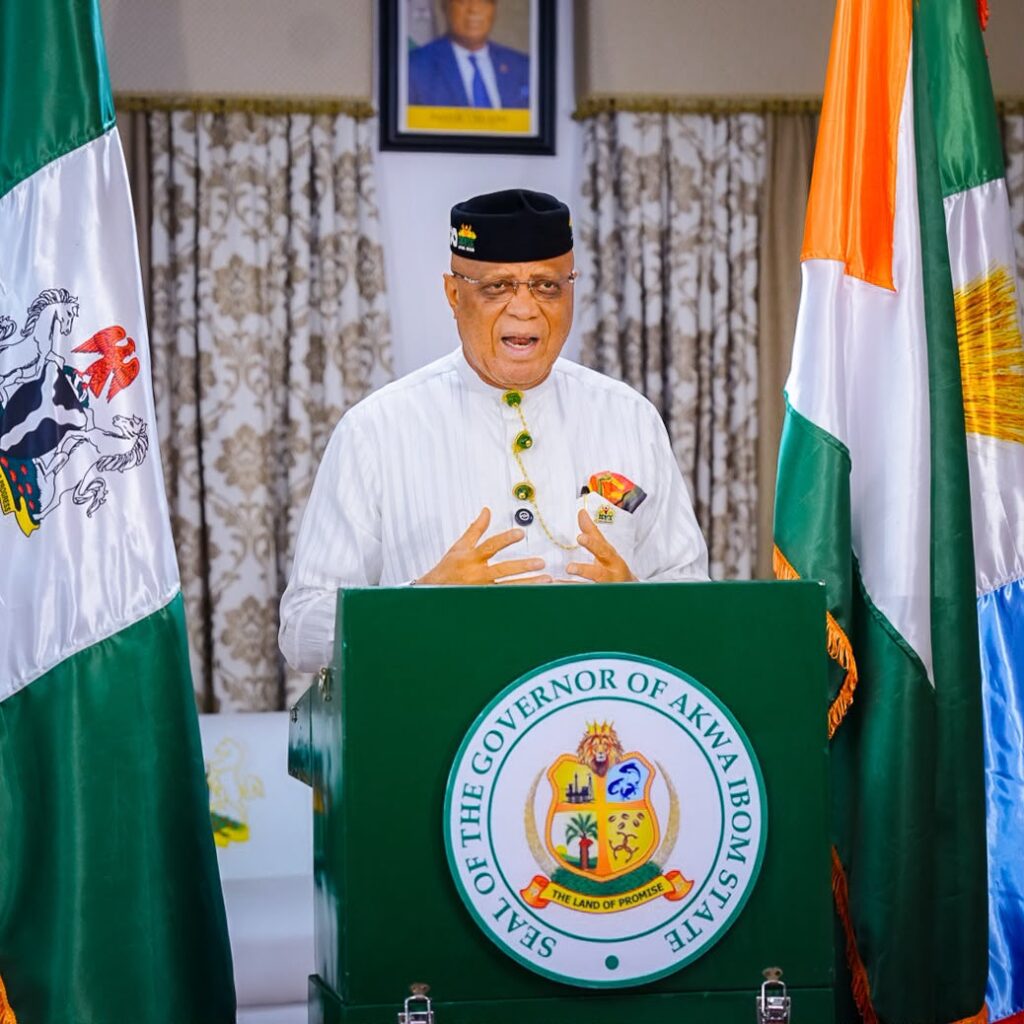
As Akwa Ibom State marks 39 years of creation, Governor Umo Eno has presented a three-year scorecard of his administration while setting out an ambitious next phase centred on industrialisation, agro-industrialisation, jobs, investment-driven prosperity and a knowledge-based economy.
In his anniversary broadcast to the people of the state on Wednesday, Eno said his administration had recorded progress in infrastructure, education, healthcare, agriculture, youth empowerment, social protection, aviation and other sectors, but acknowledged that the work of building the state remained unfinished. The anniversary activities had been preceded by plans to commission 39 projects across the state.
According to him, the next chapter of Akwa Ibom’s development must go beyond physical infrastructure and convert the foundations already laid into sustainable economic opportunities, declaring: “The next chapter must be bigger.” He said the new direction would move the state “from infrastructure to industrialisation, from agriculture to agro-industrialisation, from skills to enterprise, from enterprise to jobs.”
The governor said the transition would also involve moving “from investment attraction to investment-driven prosperity, from tourism potential to a tourism economy, from human capital development to a knowledge economy, and from economic growth to shared prosperity,” describing the programme as the challenge and promise of ARISE 2.0.
Reflecting on the first three years of his administration, Eno said the ARISE Agenda was conceived as “a covenant of service” to build, empower, protect, create opportunities and ensure that government reached ordinary citizens. He said the anniversary was “not a time for triumphalism” but “a time for accountability and gratitude,” adding that whatever had been achieved was a collective accomplishment.
On infrastructure, the governor said his administration had undertaken, commissioned or continued work on more than 1,500 kilometres of roads, including 43 bridges, since May 29, 2023. He said the road programme was intended not merely to expand the state’s physical network but to change the economic geography of rural communities.
“These are not simply kilometres of asphalt,” Eno said. “Every road means a community brought closer. A farmer brought closer to the market. A child brought closer to school. A patient brought closer to healthcare. An investor brought closer to opportunity.” He added that the administration had deliberately taken infrastructure into rural communities because “no community is too remote to matter.”
Education, which the governor described as the state’s most enduring investment, also featured prominently in the scorecard. He said free and compulsory education had been sustained at primary and secondary levels, N1.69 billion disbursed as student bursaries, 3,000 teachers recruited, with further recruitment approved, while the transformation of the Akwa Ibom College of Education, Afaha Nsit, into a University of Education had been advanced.
“The greatest resource of Akwa Ibom is not beneath our soil. It is within our people,” Eno said. “Our children are our greatest investment. Their education is our most enduring infrastructure.” He also announced N30 million in full scholarship support for Uwakmfon Unwana Jacob to study software engineering at Nile University, Abuja, and N160 million for Dr Joseph Akpan’s master’s programme in Surgical and Intervention Science at McGill University, Canada.
In healthcare, Eno said government had expanded interventions in primary healthcare facilities and human resources while advancing the development of the Ibom International Hospital. He said 258,000 residents, including elderly citizens, had been enrolled in the state’s health insurance scheme and that every local government area had an ambulance for emergency medical situations. “Government must be felt where the people live,” he declared.
Agriculture was presented as another area where the administration intends to move from social intervention to wealth creation. Eno said 1,700 farmers had received grants, while government had approved the acquisition of hundreds of thousands of oil-palm seedlings as part of its Palm Tree Crop Revolution. “Our land must feed our people. Our farmers must prosper,” he said, adding that young people must begin to see agriculture “not as a punishment, but as a business.”
The governor said his administration had also invested in the state’s young population, with more than 4,000 youths trained through IBOM-LED and DASAC in skills development and entrepreneurship, while more than N2 billion had been disbursed through grants and related empowerment interventions. Youth-friendly centres, he said, were being developed to direct young people towards technology and the creative industries. “You are not merely the leaders of tomorrow. You are partners in building Akwa Ibom today,” he told youths.
On social protection, Eno said more than 500 units of the ARISE Compassionate Homes had been completed and handed over to vulnerable residents, with financial support provided to beneficiaries. He also said the administration had paid more than N98 billion out of approximately N111 billion in inherited gratuities and other emoluments owed to retirees. “Behind every payment is a family. Behind every home is a human story. Behind every intervention is a citizen whose dignity matters,” he said.
The governor also pointed to aviation as an emerging component of the state’s economic ambitions, announcing the arrival of the fifth aircraft acquired for Ibom Air, an Airbus A220-300. He said the airline represented “confidence” and “enterprise” and demonstrated that Akwa Ibom could compete in sectors previously considered the preserve of others. He said preparations were also underway at the international airport for expanded operations, with the ambition of making the state an aviation and economic hub in the South-South.
On the long-discussed Ibom Deep Seaport, Eno reaffirmed his administration’s commitment to its actualisation but acknowledged the complexity of the project. “Our approach is to do it properly. To follow due process. To build the necessary foundations,” he said, describing the proposed port as “a new economic gateway” for trade, industry, logistics, jobs, investment and a new generation of prosperity.
Tourism is another sector the governor wants to reposition as an economic driver. He said investments were being made in the Arise Palm Resort, International Convention Centre, Arise Shopping City and other hospitality assets, while highlighting the state’s beaches, forests, cuisine, culture, music and hospitality. “We want the world to discover Akwa Ibom,” he said, linking the anniversary programme to preparations for Christmas Unplugged 4.0 and its planned carols, choir auditions, Ibom Kitchen, Mbopo Akwa Ibom, LGA performance days and food showcases.
Power, according to Eno, is central to the next stage of economic development. He said the state had established the Akwa Ibom Electricity Regulatory Commission and Akwa Ibom State Electrification Agency following constitutional and legislative changes in the electricity sector, alongside a roadmap for improving supply and extending access to underserved communities. “Businesses cannot thrive without power. Industries cannot grow without power. Young entrepreneurs cannot compete without power,” he said.
But beyond the economic scorecard and new promises, Eno placed peace and unity at the centre of the state’s future, describing them as among Akwa Ibom’s most valuable achievements. “Our peace is priceless. Our unity is priceless. Our brotherhood is priceless. Let us protect them,” he said, urging citizens to prevent political differences from becoming hatred and ethnic differences from becoming division. The governor’s appeal comes amid his recent anniversary call for socio-cultural and political groups to avoid actions capable of undermining the state’s unity.
Looking beyond the 39th anniversary, Eno said the responsibility for the next phase could not be left entirely to government. “Government can build the platform. But the people must build the future,” he said, explaining that government could provide roads, schools and opportunities, but citizens must create businesses, value education, seize opportunities and protect peace. “The Akwa Ibom of tomorrow is therefore a shared responsibility,” he declared.
As the state enters its 40th year, Eno ended his address with a pledge to sustain the interventions already underway while pursuing the broader ARISE 2.0 transition. “We shall continue to build. We shall continue to empower. We shall continue to unite,” he said, also promising continued investment in children and youths, support for farmers, stronger healthcare, rural development and investment attraction. “Thirty-nine years is not the end of our story. It is another chapter,” he said. “For the best chapters of Akwa Ibom’s story are not behind us. They are ahead of us.”